
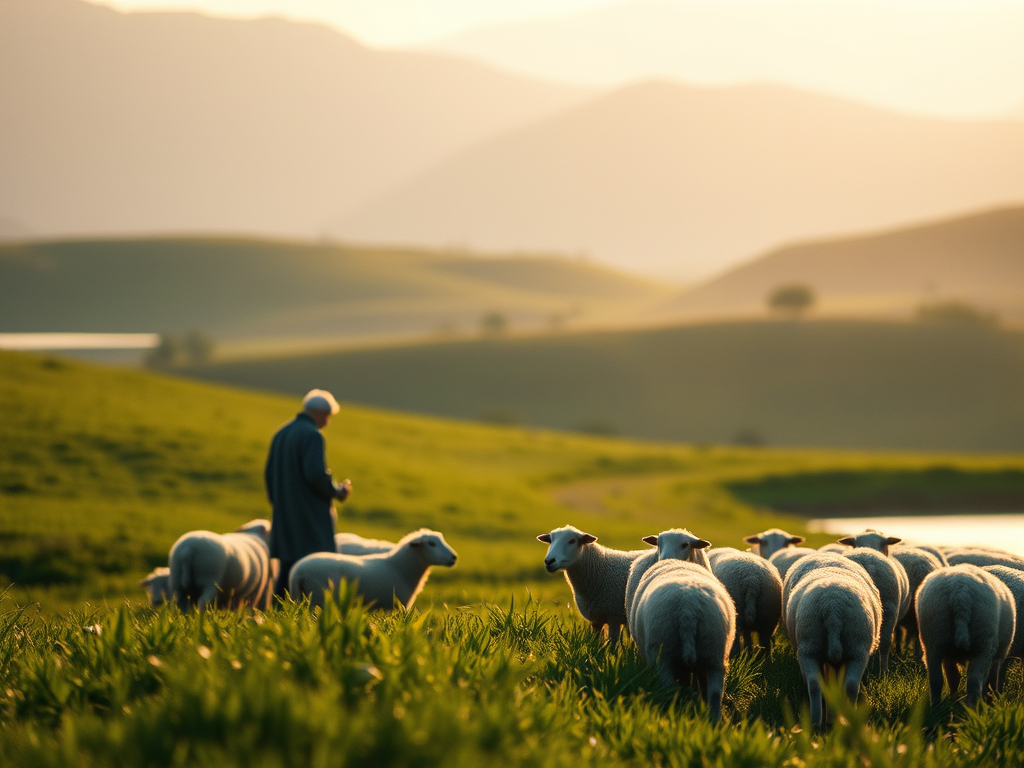
Psalm 23:1 (NKJV)
“The LORD is my shepherd; I shall not want.”
“The LORD is my shepherd — not was, not will be, not might be. He is. Right now, in this moment, He is.” — F.B. Meyer
Six words in Hebrew. Seven in English. And in those seven words, David collapses the entire theology of divine provision into a single image so familiar that we have to be careful not to let its familiarity drain it of its power.
The LORD is my shepherd.
Begin with the name. LORD here is the covenant name of God — YHWH (Yahweh), the great I AM who spoke to Moses from the burning bush, the God who bound Himself to His people in unbreakable covenant, the One whose name means He who is — eternally, unchangeably, presently existing. David does not say “a god is my shepherd” or even “God is my shepherd.” He says the LORD — reaching for the most personal, most covenantally loaded name available to him. The provision he is about to describe flows not from a generic divine being but from the One who has pledged Himself by covenant to His people.
And His relationship to David is that of a shepherd.
In the ancient Near East, the shepherd metaphor was one of the most profound available for describing royal care. Kings were called shepherds of their people. But when David — himself a former shepherd who knew the work from the inside — applies the image to God, he is drawing on something far more intimate than political language. He knows what it costs to be a good shepherd. He killed a lion and a bear to protect his father’s flock (1 Samuel 17:34–36). He searched the hills for strays. He led the sheep to water with careful, patient attention — the Hebrew nahal (Strong’s H5095) in verse 2 carries the image of gentle, unhurried leading, the way a shepherd guides exhausted sheep to still water rather than driving them toward a rushing current they cannot drink from safely.
The first verse contains, in its opening declaration, the seed of everything that follows. The LORD is my shepherd — therefore, I shall not want. The Hebrew lo’ echsar (Strong’s H2637) means literally I lack nothing or I am without deficiency. It is not the claim of a man who has everything he desires. It is the claim of a man who has the One who supplies everything he needs. Want, in the biblical sense, is not the absence of luxury — it is the absence of what is necessary. And David’s declaration is that under this Shepherd’s care, nothing necessary will ever be absent.
What follows in the psalm is the unpacking of that single promise across every terrain a life might traverse. Green pastures — the abundance of spiritual nourishment, the Word and the Spirit feeding the inner life. Still waters — the quiet places of restoration that an anxious soul cannot find on its own but the Shepherd knows how to lead it to. He restores my soul — the Hebrew yeshobeb (Strong’s H7725), turning back, bringing home what had strayed or been scattered. The Shepherd does not simply prevent damage. He repairs it.
And then the valley — the valley of the shadow of death — which is perhaps the most pastorally honest verse in the entire psalm. David does not pretend that life under the Shepherd’s care bypasses the dark places. He says though I walk through — not around, not over, not somehow teleported past, but through — and even there, I will fear no evil, for You are with me. The provision of the Shepherd in the valley is not the removal of the valley. It is His presence in it. Your rod and Your staff, they comfort me — the rod that defends against predators, the staff that guides and retrieves the straying sheep.
And then Psalm 23 does something remarkable. It ends not with a sheep in a field but with a guest at a table — a feast prepared in the presence of enemies, a cup running over, goodness and mercy pursuing the psalmist all the days of his life, and a final resting place in the house of the LORD forever. The Shepherd, it turns out, is also the Host. The One who guided you through the valley prepared a feast at the end of it. And the overflow of His provision — that revayah (Strong’s H7310), the saturation that spills over the edges of the cup — is not for you alone. It runs over. Other people drink from the overflow of what God has poured into your life.
All of it — green pasture, still water, valley, table, cup — flows from six Hebrew words: The LORD is my shepherd.
He is. Right now. For you.
Reflect: In which verse of Psalm 23 do you find yourself living today — the green pastures, the valley, or the table with enemies still in sight? How does identifying your location in the psalm change the way you pray through it?
Pray: Lord, You are my Shepherd. Not a distant deity who oversees from afar, but the One who walks beside me, leads me to what restores me, and stays with me in what frightens me. I receive Your provision today — not because I have earned the green pasture or deserve the still water, but because You are who You are, and I am Yours. Lead me. Restore what has been scattered. And let my cup run over for someone else’s benefit as well as my own. In Jesus’ name, Amen.

Leave a Reply