
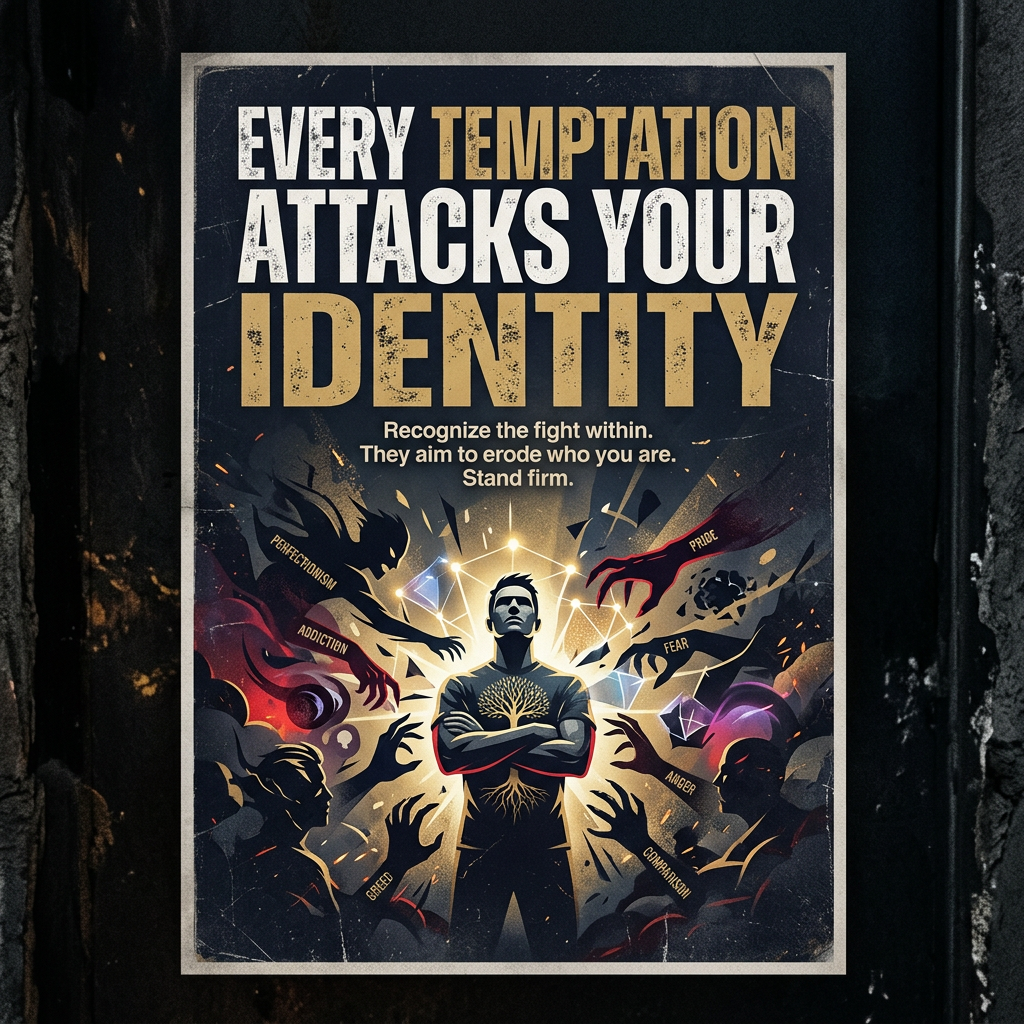
There is a pattern in the Bible that, once you see it, you cannot unsee.
The serpent’s first sentence in Genesis 3 and the devil’s first sentence in Matthew 4 are the same kind of sentence. Different words on the surface. Same move underneath.
In Genesis 3:1 the serpent says, Has God indeed said, You shall not eat of every tree of the garden?
In Matthew 4:3 the devil says, If You are the Son of God, command that these stones become bread.
Different victims. Different stakes. Same opening move.
Both attacks question identity. Eve’s identity as the image-bearing daughter of a good God who has spoken truth. Jesus’ identity as the beloved Son who has just heard the Father’s voice from heaven say, This is My beloved Son in whom I am well pleased (Matt 3:17). Forty days later the devil shows up and says, if you are the Son. The serpent does not say do bad things. He says did God really say. The devil does not say commit a list of sins. He says if you are who you think you are, prove it.
Once you spot the pattern, you can spot it everywhere. The temptation always goes for the identity first.
The Eden Pattern
Read Genesis 3 slowly. Watch the serpent’s strategy.
He starts with a question that exaggerates God’s prohibition. Has God indeed said you shall not eat of every tree? No. God did not say that. God said one tree was off limits. The serpent’s distortion is the first crack in the picture of God Eve has been carrying.
Eve corrects him, but adds something. We may eat the fruit of the trees of the garden, but of the fruit of the tree which is in the midst of the garden, God has said, You shall not eat it, nor shall you touch it, lest you die. Touch was not in the original command. Already the prohibition feels heavier than it really was. The serpent has nudged her into a misremembering of her Father.
Then the serpent moves in for the actual hit. You will not surely die. For God knows that in the day you eat of it your eyes will be opened, and you will be like God, knowing good and evil (Gen 3:4-5).
Look at what he does. He tells her she is not what she thinks she is. She is not in the place of full delight under God’s care. She is not trusted, not given everything, not honored as His image bearer. She is, according to the serpent, a being on the wrong side of a wall, kept down, kept small, kept in the dark. The way out is to grab the fruit and become like God.
But she was already like God. Let Us make man in Our image, according to Our likeness (Gen 1:26). She had the image already. The serpent just convinced her she did not.
Every temptation since has been a variation on that move. You are not what God says you are. You will not get what God promises. You have to take what He has not given.
The Wilderness Pattern
Now read Matthew 4. Watch how Jesus handles it.
The devil tries three doors. Command these stones become bread. Throw Yourself down from the temple. Bow to me and the kingdoms are Yours. Each one starts with a challenge to identity. If You are the Son of God. The if is doing the work. It is asking Jesus to verify a sonship that the Father has just confirmed three verses earlier.
Jesus does not produce bread. Does not jump from the temple. Does not bow to the devil. But notice what He also does not do. He does not argue about whether He is the Son of God. He does not have to. He has heard the Father.
Each time, Jesus answers from Scripture. Each time, the Scripture He chooses is from Deuteronomy, and each one comes from Israel’s wilderness story. He is recapitulating the test Israel failed and answering as the true Son who passes where they did not. Man shall not live by bread alone. You shall not tempt the Lord your God. You shall worship the Lord your God, and Him only you shall serve.
He does not get hooked into the if. He stands inside the am.
This is the model for the believer. Temptation does not have to be argued with on its own terms. It has to be answered from the place of who you already are.
Why This Reframes Spiritual Warfare
Most of what passes for spiritual warfare in the average church is reactive. The temptation comes, the believer panics, the believer wrestles, the believer either holds the line or falls. The whole drama plays out at the level of behavior.
The New Testament pattern is different. Spiritual warfare is mostly the defense of an identity that has already been given.
Therefore submit to God. Resist the devil and he will flee from you. Draw near to God and He will draw near to you. (Jas 4:7-8)
Look at the order. Submit first. Resist second. The submission is the posture of a child under a Father’s care. The resistance flows out of that posture, not the other way around. Resistance without submission is willpower. Submission without resistance is passivity. Submission first, then resistance, is the New Testament way.
In Ephesians 6, Paul lays out the armor of God. Read it slowly and notice what it actually is. Truth. Righteousness. Gospel. Faith. Salvation. The Word. None of these are produced by the believer. All of these are gifts of God in Christ that the believer puts on. The armor is the believer’s identity in Christ, worn deliberately, day by day.
Then Paul tells them what to do with it.
Stand. (Eph 6:11)
Withstand in the evil day, and having done all, to stand. (Eph 6:13)
Stand therefore. (Eph 6:14)
Three times. Stand. The Greek verb is histēmi (G2476) and its compounds. Not advance, charge, conquer, climb. Stand. The territory has been given. Hold the ground.
That changes the whole feel of spiritual battle. The believer is not fighting to earn a position. The believer is standing in a position already won and refusing to be moved off of it.
How the Lie Works on a Tuesday
Most temptations in the average believer’s week are not exotic. They look like this.
You are tired. The voice in your head says you deserve this. That is the serpent’s move. You are owed something God has not given. Whatever the this is, food, a screen, a sharp word at someone you love, the sentence underneath is the same. It is questioning whether your Father has given you enough.
Or you are afraid. The voice says if you do not handle this, no one will. That is the wilderness move. If you really were a son, your Father would have already fixed it. So fix it yourself. Anxiety masquerades as responsibility, but underneath it is a doubt about whether you really are kept.
Or you are ashamed of something you have done. The voice says people like you do not get back up. That is the oldest move of all. The serpent has been telling people who they are not for thousands of years. Your Father says you are forgiven, kept, His. The serpent says you are exposed, damaged, finished. One of those voices is telling the truth.
Every temptation is a sentence that misnames you. Every act of resistance is a sentence that names you correctly.
The Practice of Standing
Here is what this looks like in actual practice.
When the temptation lands, do not start with the temptation. Start with the truth that the temptation is contradicting.
If the lie is you are not loved, the truth is I am accepted in the Beloved (Eph 1:6).
If the lie is you have to fix this, the truth is the Father knows what I need before I ask Him (Matt 6:8).
If the lie is you are alone, the truth is the Spirit of Christ dwells in me (Rom 8:9).
If the lie is you are too far gone, the truth is there is therefore now no condemnation (Rom 8:1).
Speak the truth out loud if you can. Not as an incantation. As a confession. Stand on the ground that has been given. Refuse to be moved.
Then do the next right thing in front of you. Eat the meal you actually need, not the one that was offered as compensation for an unmet ache. Make the phone call you have been avoiding. Confess what you have done. Take the long way home. Do the small obedience that fits a son who knows he is a son.
A Word to the Reader
If you have spent years feeling like spiritual warfare was a wrestling match you keep losing, it might be that you have been fighting on the wrong terrain.
The fight is not over whether you can produce a victorious life. The fight is over whether you will let the lie of who you are rewrite the truth of who you are. In Christ. Beloved. Adopted. Sealed. Indwelt. Already righteous. Still becoming.
Read Genesis 3 and Matthew 4 back to back this week. Watch the pattern. Watch how the serpent and the devil aim for the identity. Watch how Eve falls because she lets the picture of her Father get distorted. Watch how Jesus stands because the picture of His Father is unshakeable.
Then ask yourself, every time temptation comes for you this week, the simple question. What sentence is this attack quietly telling me about who I am, or about who my Father is? Find the lie. Speak the truth. Stand.
You are not climbing a hill toward victory. You are standing on a hill that has already been taken.
Next post we go to one of the most quietly transforming truths in the New Testament. What it actually means to repent and confess from a place of belovedness, instead of from a place of condemnation.

Leave a Reply