
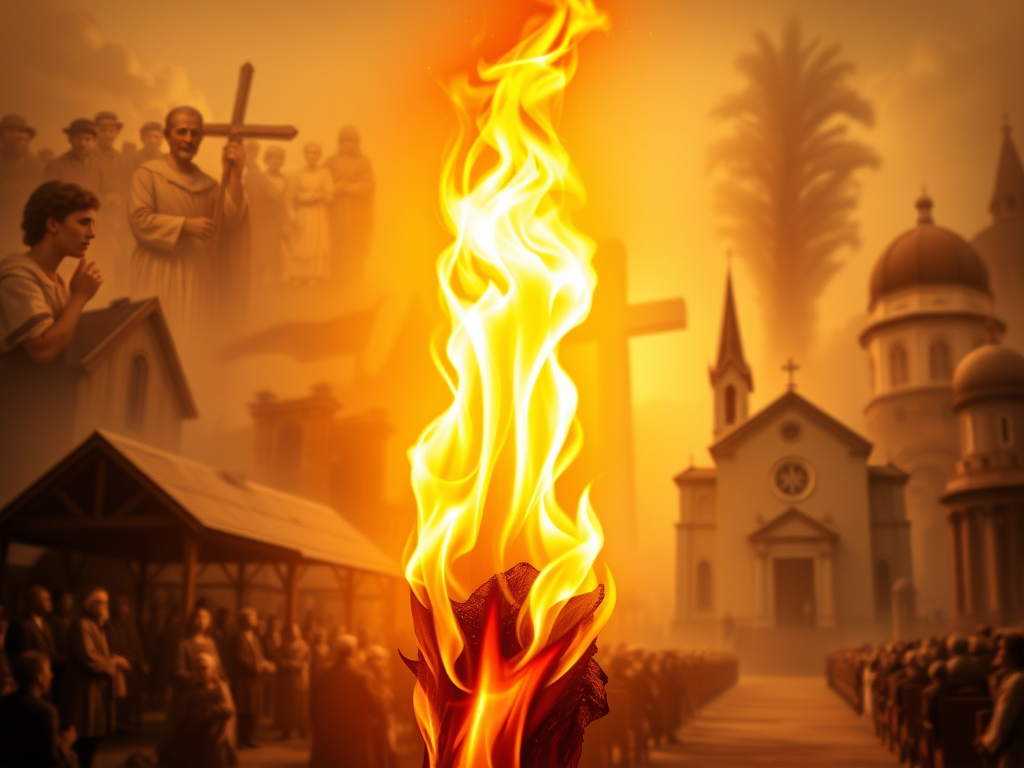
A FLAME THAT NEVER DIES
The Miraculous Working of the Holy Spirit
from the Epistles Through Twenty Centuries to Today
Primary Texts:
1 Corinthians 12:7–11 • Galatians 3:5 • Romans 15:18–19
Hebrews 2:3–4 • James 5:14–16 • 1 Thessalonians 5:19–21
MEMORY VERSE
“And I will pray the Father, and He will give you another Helper, that He may abide with you forever.”
— John 14:16 (NKJV)
INTRODUCTION: THE PROMISE OF “FOREVER”
On the night before His crucifixion, Jesus made an extraordinary promise: “I will pray the Father, and He will give you another Helper, that He may abide with you forever—the Spirit of truth” (John 14:16–17). The word “forever” is eis ton aiōna (εἰς τὸν αἰῶνα)—into the age, without end, perpetually. Jesus did not say the Spirit would be with the church for the apostolic era. He did not say the miraculous would accompany the first generation and then retire. He said forever.
That word is the interpretive key for this entire study. If the Spirit’s presence is permanent, and if the Spirit’s nature is unchanging, then we should expect to see His supernatural work in every era of church history—not identical in form, not always at the same intensity, but never absent. The flame kindled at Pentecost has never been extinguished.
In our previous studies, we traced the miraculous through the Book of Acts—how the Spirit established God’s kingdom and combated Satan’s influence through healings, deliverances, signs, and wonders. But Acts 28:31 ends mid-sentence, mid-story. Paul is in Rome, “preaching the kingdom of God … with all confidence, no one forbidding him.” The book closes not with a period but with a comma—because the story was not finished.
Today we pick up where Acts left off. We will trace the Spirit’s miraculous working from the New Testament Epistles through two thousand years of church history to the present day. Our goal is not merely historical curiosity but faith-building confidence that the same Spirit who raised Christ from the dead, who filled the apostles at Pentecost, who healed the sick and cast out demons in Acts, is the same Spirit who indwells every believer in this room today.
As Paul wrote to the Galatians: “Therefore He who supplies the Spirit to you and works miracles among you, does He do it by the works of the law, or by the hearing of faith?” (Galatians 3:5). Notice the present tense: “supplies … works.” Not supplied. Not worked. The Spirit’s miraculous activity was not past tense even when Paul wrote it, and it is not past tense now.
PART I: THE EPISTLES — THE MIRACULOUS AS NORMATIVE CHURCH LIFE
Before we move beyond the New Testament, we must establish that the Epistles—the letters written to churches and individuals—treat the miraculous not as the memory of a bygone era but as the ongoing, expected reality of Spirit-filled community life.
A. Paul’s Testimony: “Signs and Wonders by the Power of the Spirit”
In Romans 15:18–19, Paul gives a personal summary of his ministry: “For I will not dare to speak of any of those things which Christ has not accomplished through me, in word and deed, to make the Gentiles obedient—in mighty signs and wonders, by the power of the Spirit of God, so that from Jerusalem and round about to Illyricum I have fully preached the gospel of Christ.”
Several features stand out. First, Paul mentions “word and deed” together—preaching and miraculous action as inseparable. Second, he attributes the miracles to “the power of the Spirit of God”—not to apostolic office or special status. Third, he says this is what it means to have “fully preached the gospel.” For Paul, a gospel preached without accompanying power was an incomplete gospel. The Word confirmed by the Spirit’s demonstrations was the full gospel.
In 2 Corinthians 12:12, Paul references “the signs of an apostle”—“signs and wonders and mighty deeds”—as ongoing marks of his ministry. And in 1 Corinthians 2:4–5, he reminds the Corinthians: “My speech and my preaching were not with persuasive words of human wisdom, but in demonstration of the Spirit and of power, that your faith should not be in the wisdom of men but in the power of God.” The word “demonstration” is apodeixei (ἀποδείξει, Strong’s G585)—a showing forth, an exhibition, a proof. Paul’s ministry came with visible, experiential proof of the Spirit’s power.
B. The Galatian Churches: Miracles Among Ordinary Believers
Galatians 3:5 is perhaps the most significant text for our study: “Therefore He who supplies the Spirit to you and works miracles among you, does He do it by the works of the law, or by the hearing of faith?”
This verse reveals that miracles were happening among ordinary Galatian believers—not just through apostles. The verb “works miracles” is energōn dynameis (ἐνεργῶν δυνάμεις)—present active participle, indicating ongoing, continuous miraculous activity. God was presently and actively working miracles among the Galatians as Paul wrote. And these were not apostolic churches in Jerusalem; they were young congregations in rural Asia Minor. The miraculous was not confined to the apostles or to Jerusalem. It was the normal experience of Spirit-filled communities wherever the gospel took root.
C. The Corinthian Church: Spiritual Gifts in Corporate Worship
First Corinthians 12–14 is the most detailed treatment of spiritual gifts in the New Testament. Paul lists nine gifts of the Spirit (12:7–11): word of wisdom, word of knowledge, faith, gifts of healings, working of miracles, prophecy, discerning of spirits, different kinds of tongues, and interpretation of tongues.
These gifts were operating in the weekly worship gatherings of Corinth. Paul gives specific instructions for their orderly exercise: “Whenever you come together, each of you has a psalm, has a teaching, has a tongue, has a revelation, has an interpretation. Let all things be done for edification” (1 Corinthians 14:26). The miraculous was not a special event; it was the fabric of regular corporate worship. Healings happened. Prophecies were spoken and weighed. Tongues were interpreted. Revelatory knowledge was shared. This was church as Paul knew it.
Crucially, Paul’s instructions regulate these gifts; they do not eliminate them. His closing charge is: “Therefore, brethren, desire earnestly to prophesy, and do not forbid to speak with tongues” (1 Corinthians 14:39). He commands pursuit of the gifts and prohibits their suppression.
D. James: Healing Prayer in the Local Church
James 5:14–16 gives the most direct instruction for healing ministry in the local church: “Is anyone among you sick? Let him call for the elders of the church, and let them pray over him, anointing him with oil in the name of the Lord. And the prayer of faith will save the sick, and the Lord will raise him up.”
This is not apostolic healing. It is elder-led, local-church healing prayer. James assumes that ordinary church leaders—not apostles with special authority—can pray for the sick with the expectation that the Lord will heal. There is no indication that this instruction was limited to the first century. James writes to the church as the church—for all time.
E. Hebrews and Thessalonians: Testing and Expecting
The author of Hebrews confirms the Spirit’s miraculous attestation of the gospel: “God also bearing witness both with signs and wonders, with various miracles, and gifts of the Holy Spirit, according to His own will” (Hebrews 2:4). The phrase “according to His own will” (kata tēn autou thelēsin) reminds us that the miraculous is always sovereign—never formulaic, never on demand, but genuinely expected.
And Paul’s instruction to the Thessalonians is equally clear: “Do not quench the Spirit. Do not despise prophecies. Test all things; hold fast what is good” (1 Thessalonians 5:19–21). The church is commanded to not suppress the Spirit’s activity, to not look down on prophetic gifts, but to test everything and retain what is genuine. The posture of the New Testament church toward the miraculous is expectant openness combined with careful discernment. This is the balance we must carry forward into every era.
PART II: THE PATRISTIC ERA (AD 100–600) — THE FATHERS BEAR WITNESS
After the apostolic generation passed, did the miraculous disappear? The testimony of the early church fathers says emphatically: No.
A. Justin Martyr (AD 100–165)
Writing in the mid-second century, Justin Martyr testified: “For the prophetical gifts remain with us, even to the present time. You may see among us women and men who possess gifts of the Spirit of God.” In his Second Apology, he wrote: “For numberless demoniacs throughout the whole world, and in your city, many of our Christian men, exorcising them in the name of Jesus Christ … have healed and do heal, rendering helpless and driving the possessing devils out of the men.”
Justin’s testimony is significant because he was writing an apology—a defense of Christianity addressed to the Roman emperor and Senate. He would not have cited ongoing miracles and exorcisms as evidence for Christianity if they were not occurring and verifiable. His reputation was on the line.
B. Irenaeus of Lyon (AD 130–202)
Irenaeus, who was personally connected to the apostolic tradition through his teacher Polycarp (a disciple of the Apostle John), wrote in Against Heresies: “Those who are in truth His disciples, receiving grace from Him, do in His name perform miracles … Others have foreknowledge of things to come: they see visions, and utter prophetic expressions. Others still heal the sick by laying their hands upon them, and they are made whole. Yea, moreover, as I have said, the dead even have been raised up, and remained among us for many years.”
Irenaeus was not speaking speculatively. He claimed personal knowledge of people raised from the dead who then lived for years afterward. He distinguished these genuine works of the Spirit from the counterfeit magic of the Gnostics, emphasizing that true miracles are performed “in His name”—through relationship with Christ, not occult technique.
C. Origen (AD 185–254)
Origen, one of the most brilliant minds of the early church, wrote in Contra Celsum: “Traces of that Holy Spirit who appeared in the form of a dove are still preserved among Christians. They charm demons away and perform many cures and perceive certain things about the future.” He further noted that these signs were evidence of the gospel’s truth: “The name of Jesus can still remove distractions from the minds of men, expel demons, and also take away diseases.”
D. Augustine of Hippo (AD 354–430): A Surprising Reversal
Augustine’s testimony is particularly instructive because he changed his mind. Early in his ministry, he wrote that miraculous gifts had served their purpose in establishing the church and were no longer to be expected. But later, in The City of God (Book XXII, Chapter 8), he reversed himself dramatically, recording miracle after miracle that he had personally witnessed or investigated:
He described a blind man whose sight was restored when relics of the martyrs were brought to Milan. He recounted the healing of a woman with breast cancer through a dream in which she was told to have a newly baptized woman make the sign of the cross over her tumor. He documented a man healed of fistula, a paralytic restored, and multiple other healings—all in his own diocese of Hippo. Augustine concluded that miracles were so numerous he could not record them all.
Augustine’s reversal teaches us a crucial lesson: our theology must be shaped by what God is actually doing, not merely by what we have previously concluded He should be doing. When Augustine encountered the Spirit’s ongoing miraculous work firsthand, he had the integrity to revise his earlier cessationist assumptions.
PART III: THE MEDIEVAL ERA (AD 600–1500) — MIRACLES IN THE MONASTERIES AND MISSIONS
The medieval period is often overlooked in Protestant studies of the Spirit, yet these centuries produced remarkable evidence of the Spirit’s ongoing miraculous work—particularly through the mystics, monastic movements, and missionary expansion.
A. The Celtic Missionaries
The Celtic Christian movement produced extraordinary missionaries like Patrick of Ireland (AD 387–461), Columba of Iona (AD 521–597), and Aidan of Lindisfarne (d. 651). Contemporary accounts record healings, prophetic knowledge, supernatural protection, and dramatic conversions accompanying their preaching. These missionaries carried the gospel into pagan territories where they confronted demonic strongholds directly—echoing the pattern of Acts. The Spirit’s power was essential because they were doing Acts-like work: bringing the kingdom into territory held by darkness.
B. Francis of Assisi (AD 1181–1226)
Francis’s life was marked by remarkable supernatural phenomena. Beyond the famous stigmata—the wounds of Christ appearing in his body—his ministry included healings, prophetic knowledge, and extraordinary authority over creation itself. What made Francis distinctive was that these manifestations arose from a life of radical poverty, humility, and love. The miraculous accompanied a character so saturated with Christ that the Spirit’s power flowed without obstruction. This echoes the New Testament pattern: power and character, signs and fruit, operating together.
C. The Eastern Tradition: Symeon and Gregory Palamas
In the Eastern Orthodox tradition, Symeon the New Theologian (AD 949–1022) insisted that conscious, experiential encounter with the Holy Spirit was essential to authentic Christianity. He described visions of divine light, prophetic gifts, and transformative spiritual experiences that he contended should be normative for believers.
Gregory Palamas (AD 1296–1359) defended the reality of direct, experiential encounter with God’s uncreated energies through the Spirit. The Hesychast tradition of contemplative prayer reported phenomena remarkably similar to what later Pentecostal and Charismatic believers would describe—encounters with divine fire, visions, and supernatural knowledge. The Spirit was working in the East as well as the West, through diverse expressions but with the same authenticating power.
D. Pre-Reformation Witnesses
The Waldensians (12th century onward), John Wycliffe (1320s–1384), and Jan Hus (1369–1415) all demonstrated Spirit-empowered boldness in proclaiming truth against institutional corruption. Hus was burned at the stake but his followers, the Hussites, continued with reports of supernatural preservation, prophetic boldness, and divine guidance. These movements demonstrated that the Spirit’s work included not just physical miracles but the supernatural courage to speak truth in the face of death—the same Spirit who emboldened Stephen, Peter, and Paul.
PART IV: THE REFORMATION ERA (AD 1500–1700) — THE SPIRIT AND THE WORD REUNITED
The Reformation recovered the authority of Scripture and the doctrine of justification by grace through faith. Its relationship to the miraculous is complex but more nuanced than often presented.
A. Martin Luther (1483–1546)
Luther is sometimes cited as a cessationist, but the evidence is more complex. While he was cautious about claims of new revelation (having dealt with the radical enthusiasts who claimed Spirit-guidance apart from Scripture), Luther himself reported supernatural experiences. He engaged in what he described as direct confrontations with the devil. He prayed for the healing of his friend Philip Melanchthon, who recovered from what appeared to be a fatal illness. Luther’s famous prayer was recorded: “I besought the Almighty with great vigor … quoting from Scripture all the promises I could remember, that prayers should be granted, and said that He must grant my prayer, if I was henceforth to put faith in His promises.”
Luther’s emphasis was that the Spirit works through the Word—that miraculous gifts must be tethered to Scripture, not independent of it. This principle is vital for every generation: the Spirit who inspired the Word never contradicts the Word.
B. The Anabaptists and Radical Reformation
The Anabaptist movement—the “radical wing” of the Reformation—placed greater emphasis on direct Spirit-leading, community discernment, and experiential faith. While some leaders like Thomas Müntzer pushed this to dangerous extremes, others like Menno Simons (1496–1561) maintained a balance of Word and Spirit that produced communities of remarkable spiritual vitality, sacrificial love, and courageous witness under severe persecution.
The Anabaptist martyrs—thousands were killed for their faith—demonstrated supernatural peace and joy in the face of execution that contemporary observers found inexplicable. The Martyrs Mirror (1660) documents countless accounts of believers singing hymns while being burned alive, forgiving their executioners, and displaying a boldness that convinced onlookers of the reality of the Spirit’s power. This is the spirit of Stephen operating in a new century.
C. The Puritans: John Owen and Experiential Faith
John Owen (1616–1683), the greatest Puritan theologian, wrote extensively on the Spirit in his masterwork Pneumatologia. Owen emphasized what the Puritans called “experimental religion”—Christianity that is not merely doctrinal but experientially real. He analyzed the Spirit’s work in conviction, regeneration, assurance, and sanctification with remarkable psychological and spiritual insight.
The Quakers, founded by George Fox (1624–1691), emphasized the “Inner Light”—the Spirit’s direct, immediate presence. Their worship consisted of waiting in corporate silence for the Spirit to move someone to speak. While their pneumatology sometimes undervalued Scripture, their radical expectation of the Spirit’s immediate activity was a significant corrective to formalism.
PART V: THE AGE OF REVIVALS (AD 1700–1900) — WHEN FIRE FELL
If the medieval and Reformation eras demonstrate the Spirit’s steady, sustaining work, the Age of Revivals demonstrates His explosive, transformative power. Beginning in the early eighteenth century, a series of revivals swept through Europe and the Americas that bore all the marks of genuine Spirit-outpouring.
A. The First Great Awakening (1730s–1740s)
Jonathan Edwards (1703–1758), America’s greatest theologian, was also a witness to and interpreter of genuine revival. In Northampton, Massachusetts, entire communities were transformed. Edwards reported that in a period of months, “The town seemed to be full of the presence of God. It never was so full of love, nor of joy, and yet so full of distress, as it was then.” People experienced profound conviction of sin, dramatic conversions, extraordinary joy, and visible transformation of character.
Edwards provided what remains the most valuable theological framework for evaluating miraculous claims in his work The Distinguishing Marks of a Work of the Spirit of God. Drawing from 1 John 4, Edwards identified five marks of genuine Spirit-work:
1. It exalts Christ—genuine Spirit-work always glorifies Jesus.
2. It opposes Satan’s kingdom—it works against sin, worldliness, and demonic influence.
3. It honors Scripture—it leads to greater regard for the Word of God.
4. It promotes truth—it leads to conviction of gospel truth.
5. It produces love—it results in love for God and neighbor.
These five marks remain the gold standard for discerning genuine Spirit activity in any era.
George Whitefield (1714–1770) preached to crowds of thousands on both sides of the Atlantic with extraordinary anointing. Benjamin Franklin, a skeptic, estimated Whitefield’s voice could carry to 30,000 people without amplification. People fell under conviction, wept openly, and experienced radical conversion—often against their own intentions. The power at work was not rhetorical technique; it was the Spirit of God.
B. John Wesley and Methodism
John Wesley (1703–1791) recorded in his journals numerous supernatural phenomena accompanying his preaching: people falling under the power of the Spirit, trembling, crying out, experiencing visions, and receiving instantaneous healing. Wesley was initially suspicious of these manifestations but, like Augustine before him, was compelled by the evidence to acknowledge them as genuine works of the Spirit.
Wesley emphasized the Spirit’s “witness”—the inner testimony of the Spirit confirming the believer’s adoption (Romans 8:16). He also taught “entire sanctification”—a definite, subsequent work of the Spirit that perfects love in the believer’s heart. Whether or not one accepts Wesley’s precise formulation, his insistence that the Spirit does more than save us—He continues to transform us through experiential encounters—laid crucial groundwork for later revival and renewal movements.
C. The Second Great Awakening and Beyond
Charles Finney (1792–1875) described what he called a “baptism of the Holy Spirit” that accompanied his conversion: “The Holy Spirit descended upon me in a manner that seemed to go through me, body and soul. I could feel the impression, like a wave of electricity, going through and through me … it seemed like the very breath of God.” Finney’s revivals were accompanied by dramatic conversions, communities transformed, and social reform—including the abolition movement.
D.L. Moody (1837–1899) had a similar experience: “I was crying all the time that God would fill me with His Spirit. Well, one day, in the city of New York—oh, what a day!—I cannot describe it, I seldom refer to it; it is almost too sacred an experience to name … I went to preaching again. The sermons were not different; I did not present any new truths; and yet hundreds were converted.”
George Müller (1805–1898) operated orphanages for over 10,000 children in Bristol, England, without ever asking for money. He documented over 50,000 specific answers to prayer—supernatural provision of food, money, and resources arriving at the exact moment of need. Müller’s life was a sustained miracle of the Spirit’s provision, demonstrating that the gift of faith (1 Corinthians 12:9) was alive and active in the nineteenth century.
D. The Holiness Movement and Missionary Expansion
The Holiness Movement, drawing on Wesley’s teaching, emphasized a “second blessing”—a definite experience of Spirit-empowerment subsequent to conversion. Phoebe Palmer (1807–1874) taught that believers could receive this empowerment by faith. The Keswick Convention (from 1875) promoted “higher life” teaching. These movements created an atmosphere of expectation—believers actively seeking deeper experiences of the Spirit’s power.
Meanwhile, the “Great Century” of missions sent the gospel into territories where missionaries regularly encountered demonic opposition—and experienced miraculous deliverance. Hudson Taylor (1832–1905), founder of the China Inland Mission, documented supernatural provision, divine guidance, and remarkable answers to prayer throughout decades of frontier missions. The mission field became a laboratory confirming that where the gospel advances into enemy territory, the Spirit provides the same supernatural power He gave the early church.
PART VI: THE MODERN ERA (AD 1900–PRESENT) — THE GLOBAL EXPLOSION
The twentieth and twenty-first centuries have witnessed the most dramatic expansion of Spirit-empowered Christianity in history. What began as scattered sparks became a global wildfire.
A. The Birth of Pentecostalism (1901–1909)
In January 1901, at Charles Parham’s Bible school in Topeka, Kansas, student Agnes Ozman reportedly spoke in tongues after prayer and the laying on of hands. Parham concluded that tongues-speaking was the “Bible evidence” of Spirit baptism.
But the movement’s true launching point was the Azusa Street Revival in Los Angeles (1906–1909), led by William J. Seymour (1870–1922), a one-eyed African-American preacher and son of former slaves. For three years, services ran almost continuously at a humble converted warehouse at 312 Azusa Street. Tongues, prophecy, healings, and—remarkably for the deeply segregated Jim Crow era—interracial worship were regular features. Visitors came from around the world, experienced what they called the baptism of the Holy Spirit, and carried the fire home.
The Azusa Street Revival produced all five of Edwards’ marks of genuine Spirit-work: it exalted Christ (Jesus was the focus of every service), opposed Satan’s kingdom (racial barriers were demolished, lives were transformed), honored Scripture (the Bible was the standard), promoted truth (the gospel was preached with conviction), and produced love (the interracial fellowship was itself a miracle in 1906 America).
B. The Charismatic Movement (1960s–1970s)
In 1960, Dennis Bennett, an Episcopal priest in Van Nuys, California, publicly announced his experience of Spirit baptism with tongues. Instead of forming a new denomination, he stayed in the Episcopal Church. This launched the Charismatic Movement—the renewal of mainline Protestant and Catholic churches through the experience of the Spirit’s gifts.
Catholic Charismatic Renewal began in 1967 at Duquesne University and spread rapidly. By the 1970s, millions of Catholics worldwide participated in charismatic prayer groups. The Catholic Church officially accepted the movement while providing guidelines for its expression.
The Charismatic Movement demonstrated something crucial: the Spirit is not limited by denominational boundaries. Presbyterians, Lutherans, Anglicans, Methodists, Baptists, and Catholics—all experienced the same Spirit’s gifts. This cross-denominational work echoed Pentecost itself, when the Spirit fell on people from every nation under heaven.
C. The Third Wave and Vineyard Movement (1980s)
John Wimber (1934–1997) founded the Vineyard movement, emphasizing “power evangelism”—signs and wonders accompanying gospel proclamation. Wimber taught that the supernatural gifts were available to all believers and should be normative in church life. He coined the phrase “doin’ the stuff”—meaning actually doing what the New Testament church did: healing the sick, casting out demons, prophesying, and expecting the Spirit to show up in power.
The Third Wave was significant because many of its participants came from non-charismatic evangelical backgrounds. They accepted the gifts without necessarily adopting classical Pentecostal theology about Spirit baptism or tongues as initial evidence. This broadened the base of Spirit-expectant Christianity significantly.
D. The Global South Explosion
The most dramatic development of the past century is the explosive growth of Spirit-empowered Christianity in Africa, Asia, and Latin America. Today, the majority of the world’s Christians live in the Global South, and the fastest-growing segment of world Christianity is Pentecostal and Charismatic—now numbering over 600 million believers worldwide—roughly one-quarter of all Christians on earth.
In these contexts, the miraculous is not a theological debate; it is daily experience. Healings, deliverances, prophetic words, supernatural provision, and dramatic conversions are regular features of church life. Researcher Craig Keener, in his massive two-volume work Miracles, documented thousands of medically verified healings from around the world. Missionaries in animistic cultures regularly report encounters with demonic powers that are resolved through the authority of Christ—precisely as in Acts.
The Global South reminds the Western church of something we have often forgotten: when the gospel enters territory where Satan’s authority is openly exercised, the Spirit’s power is openly manifested. The book of Acts is not a historical artifact in Nigeria, China, Brazil, or Indonesia. It is a present-tense reality.
PART VII: DISCERNING THE GENUINE — TESTING THE SPIRITS ACROSS THE AGES
If the Spirit’s miraculous work has continued throughout history, so has counterfeiting, excess, and abuse. The Bible never commands uncritical acceptance of every supernatural claim. It commands discernment.
John writes: “Beloved, do not believe every spirit, but test the spirits, whether they are of God; because many false prophets have gone out into the world” (1 John 4:1). Paul writes: “Test all things; hold fast what is good” (1 Thessalonians 5:21). The pattern across every era of church history confirms that genuine and counterfeit spiritual phenomena coexist—and the church must learn to distinguish between them.
Drawing from Edwards’ five marks, Scripture, and two millennia of church experience, we can identify the following tests for genuine Spirit-work:
Does it glorify Christ? The Spirit’s ministry is always to exalt Jesus (John 16:14). Any manifestation that draws attention to itself, to a human leader, or to the experience rather than to Christ is suspect.
Does it align with Scripture? The Spirit who inspired the Word never contradicts the Word. Luther’s principle holds: Word and Spirit together. Any claimed revelation that contradicts Scripture is not from the Holy Spirit.
Does it produce fruit? Jesus said, “By their fruits you will know them” (Matthew 7:20). Genuine Spirit-work produces the fruit of the Spirit: love, joy, peace, patience, kindness, goodness, faithfulness, gentleness, and self-control (Galatians 5:22–23).
Does it build up the body? Paul’s governing principle for spiritual gifts is edification: “Let all things be done for edification” (1 Corinthians 14:26). Gifts exercised for self-promotion, competition, or division are being misused.
Does it bear the marks of humility? The Spirit-filled person does not boast about their experiences. Paul, who had been caught up to the third heaven, preferred to boast about his weaknesses (2 Corinthians 12:1–10). The sons of Sceva used Jesus’ name as a power tool; Paul used it as a servant’s instrument.
PART VIII: THE FLAME IN YOUR HANDS — WHAT THIS MEANS FOR US TODAY
We have traced the Spirit’s miraculous work from the Epistles through twenty centuries to the present day. The evidence is overwhelming: the Spirit has never stopped working supernaturally. From Justin Martyr to Irenaeus, from Augustine to Francis, from Luther to Wesley, from Finney to Seymour, from the revivals of the West to the explosions of the Global South—the flame has never died.
What does this mean for us?
First, it means we are not spectators of history. We are participants. Peter declared at Pentecost: “The promise is to you and to your children, and to all who are afar off, as many as the Lord our God will call” (Acts 2:39). We are the “afar off.” The promise extends to us.
Second, it means we should cultivate an atmosphere of expectation. Every era that experienced renewal was characterized by believers who expected the Spirit to move—who prayed for it, sought it, and positioned themselves to receive it. The Holiness Movement, the revivals, the Pentecostal outpouring—all were preceded by seasons of urgent, expectant prayer.
Third, it means we must hold Word and Spirit together. The pattern of church history is clear: when the church emphasizes the Word without the Spirit, it dries into dead orthodoxy. When it emphasizes the Spirit without the Word, it drifts into subjective excess. The most powerful, most fruitful, most transformative periods of church history are those where Word and Spirit were held in dynamic balance.
Fourth, it means our character must match our claims. Every abuse of the miraculous in church history—from the Montanists to modern charlatans—traces back to the divorce of power from character. The Spirit’s fruit (love, joy, peace, patience) must accompany the Spirit’s gifts (healing, prophecy, tongues). If they don’t, we have Samson’s strength with Samson’s collapse.
Fifth, it means we have a responsibility to add our chapter to this story. Justin Martyr wrote his chapter. Irenaeus wrote his. Francis, Luther, Wesley, Finney, Seymour, and the believers of the Global South have written theirs. The Spirit who worked through them indwells us. The question is: What will our chapter say?
CONCLUSION: THE STORY IS NOT FINISHED
Jesus promised: “I will pray the Father, and He will give you another Helper, that He may abide with you forever.”
That promise has been kept through every generation. The Spirit was present at Pentecost. He was present when Irenaeus saw the dead raised. He was present when Patrick confronted the druids in Ireland. He was present when Luther nailed his theses to the door. He was present when Wesley preached to coal miners and they wept. He was present at Azusa Street when racial barriers fell and tongues of fire descended. He is present in the underground churches of China, the village churches of Nigeria, and the house churches of Iran.
And He is present here. In this room. In your heart. The same Spirit. The same power. The same gifts. The same fruit. The same fire.
The book of Acts has no final amen—because the acts of the Holy Spirit are still being written. Through you. Through us. Through every Spirit-filled believer who dares to believe that the God who worked wonders in the first century is the same God today, and He does not change.
“Jesus Christ is the same yesterday, today, and forever” (Hebrews 13:8). And His Spirit abides with us—forever.
Let’s pray.
Closing Prayer
Father, we are humbled and emboldened by this story—the story of Your Spirit working through flawed, ordinary people across twenty centuries to advance Your kingdom and push back the darkness.
We thank You that the flame has never died. From Jerusalem to Antioch, from Rome to Ireland, from Wittenberg to Northampton, from Azusa Street to the ends of the earth, Your Spirit has been faithful to Jesus’ promise.
Now, Lord, we ask: pour out Your Spirit on us. Not for spectacle but for service. Not for our glory but for Yours. Not to impress the world but to liberate it. Give us the gifts we need for the work You have called us to. Produce in us the fruit that proves we belong to Christ. And grant us the courage to believe that what You did through Peter, Paul, Wesley, and Seymour, You can do through us.
May we be found faithful stewards of this sacred flame. May the chapter we write bring honor to the Author of the story. And may the world see in us the same love, the same power, and the same holy boldness that has marked Your people in every age.
In the name of the Father, the Son, and the Holy Spirit—who abides with us forever. Amen.
DISCUSSION QUESTIONS
- Galatians 3:5 describes God “working miracles among you” in the present tense among ordinary Galatian believers. How does this challenge the idea that the miraculous was limited to the apostles? What implications does this have for our expectations today?
- Paul said his preaching came “in demonstration of the Spirit and of power” (1 Corinthians 2:4–5). What does it look like for the gospel to be preached with “demonstration” rather than merely with words? Have you ever experienced or witnessed this kind of preaching?
- Augustine initially believed miracles had ceased, then reversed his position when he personally witnessed them. Have you ever had to revise a theological position because of something God actually did? What did that process look like?
- Jonathan Edwards identified five marks of genuine Spirit-work: it exalts Christ, opposes Satan, honors Scripture, promotes truth, and produces love. Apply these five tests to a spiritual movement or experience you are familiar with. What do you find?
- The Anabaptist martyrs displayed supernatural peace and joy while being executed for their faith. Is this kind of supernatural courage as much a “miracle” as a physical healing? Why or why not? How does this expand our understanding of the Spirit’s miraculous work?
- The Azusa Street Revival (1906–1909) was marked by interracial worship during the Jim Crow era—itself a kind of miracle. Where do you see the Spirit doing similar boundary-breaking work today? Where do you wish you could see more of it?
- The study traces a pattern: when the church emphasizes Word without Spirit, it produces dead orthodoxy; when it emphasizes Spirit without Word, it drifts into excess. Where does our church (or your personal spiritual life) currently sit on this spectrum? What adjustments might be needed?
- George Müller documented 50,000 specific answers to prayer. D.L. Moody described an experience of the Spirit that transformed his preaching. These were not “pentecostal” or “charismatic” in the denominational sense—they were simply Spirit-filled believers. How does this broaden our understanding of who experiences the Spirit’s power?
- The study concludes by saying the Book of Acts has no final amen—because the acts of the Holy Spirit are still being written. What “chapter” do you believe the Spirit is inviting you personally to write? What about our church corporately?
- Paul commanded: “Do not quench the Spirit. Do not despise prophecies. Test all things; hold fast what is good” (1 Thessalonians 5:19–21). What does it look like practically for our Bible Study group to obey all three of these commands simultaneously—being open without being gullible, being discerning without being dismissive?
KEY GREEK TERMS REFERENCE
| Term | Strong’s | Meaning |
| eis ton aiōna (εἰς τὸν αἰῶνα) | — | Forever, into the age, without end |
| apodeixei (ἀποδείξει) | G585 | Demonstration, exhibition, proof |
| energōn dynameis | G1754/G1411 | Working miracles (present active) |
| charisma (χάρισμα) | G5486 | Grace-gift, spiritual endowment |
| dunamis (δύναμις) | G1411 | Power, inherent ability, miracle |
| sunepimarturountos | G4901 | Bearing witness together with |
| prophēteia (προφητεία) | G4394 | Prophecy, Spirit-inspired speech |
| charismata iamatōn | G5486/G2386 | Gifts of healings (both plural) |
| diakrisis pneumatōn | G1253/G4151 | Discerning of spirits |
| glōssa (γλῶσσα) | G1100 | Tongue, language |
| phobos (φόβος) | G5401 | Fear, holy reverence, awe |
| oikodomē (οἰκοδομή) | G3619 | Edification, building up |
| parresia (παρρησία) | G3954 | Boldness, freedom of speech |
| parakletos (παράκλητος) | G3875 | Helper, Comforter, Advocate |
APPENDIX: HISTORICAL TIMELINE — THE SPIRIT’S MIRACULOUS WORK ACROSS THE AGES
| Date / Era | Person / Movement | Miraculous Evidence |
| NEW TESTAMENT EPISTLES (AD 50–95) | ||
| AD 50–55 | Paul to the Galatians | Present-tense miracles among ordinary believers (Gal 3:5) |
| AD 55 | Paul to the Corinthians | Nine gifts operating in weekly worship (1 Cor 12–14) |
| AD 57 | Paul to the Romans | Signs and wonders by Spirit’s power (Rom 15:18–19) |
| AD 45–62 | James to the churches | Elder-led healing prayer commanded (James 5:14–16) |
| AD 60–70 | Hebrews | God bearing witness with signs, wonders, gifts (Heb 2:3–4) |
| AD 51 | Paul to Thessalonians | “Do not quench the Spirit” (1 Thess 5:19–21) |
| PATRISTIC ERA (AD 100–600) | ||
| AD 100–165 | Justin Martyr | Testified to continuing gifts, exorcisms, healings |
| AD 130–202 | Irenaeus of Lyon | Healings, prophecy, raisings from the dead reported |
| AD 185–254 | Origen | Exorcisms, cures, and foreknowledge among believers |
| AD 172+ | Montanism | Prophetic gifts claimed (controversial but documented) |
| AD 354–430 | Augustine | Reversed cessationist view; documented miracles in Hippo |
| MEDIEVAL ERA (AD 600–1500) | ||
| AD 387–597 | Celtic missionaries (Patrick, Columba) | Healings, prophetic knowledge, confrontations with paganism |
| AD 949–1022 | Symeon the New Theologian | Visions, direct Spirit-encounters, experiential gifts |
| AD 1181–1226 | Francis of Assisi | Stigmata, healings, prophetic knowledge, supernatural authority |
| AD 1296–1359 | Gregory Palamas | Defense of experiential Spirit-encounters |
| 12th–15th c. | Waldensians, Wycliffe, Hus | Supernatural boldness, preservation, prophetic preaching |
| REFORMATION ERA (AD 1500–1700) | ||
| AD 1483–1546 | Martin Luther | Healing prayer for Melanchthon; spiritual warfare |
| 16th c. | Anabaptist martyrs | Supernatural peace and courage under execution |
| AD 1496–1561 | Menno Simons | Spirit-empowered community; persecution endurance |
| AD 1616–1683 | John Owen | Rich pneumatological writing; “experimental” faith |
| AD 1624–1691 | George Fox / Quakers | Inner Light; waiting worship; immediate Spirit-presence |
| AGE OF REVIVALS (AD 1700–1900) | ||
| 1730s–1740s | Edwards / Whitefield / 1st Great Awakening | Mass conversions, supernatural phenomena, community transformation |
| AD 1703–1791 | John Wesley / Methodism | Healings, Spirit-witness, sanctification, revival phenomena |
| AD 1792–1875 | Charles Finney / 2nd Great Awakening | “Baptism of the Spirit”; mass conversions; social reform |
| AD 1805–1898 | George Müller | 50,000+ documented answers to prayer; supernatural provision |
| AD 1837–1899 | D.L. Moody | Spirit-empowerment experience; dramatic preaching anointing |
| AD 1807–1874 | Phoebe Palmer / Holiness Movement | Second blessing emphasis; expectation for Spirit power |
| 1875+ | Keswick Convention | Higher life teaching; Spirit-filled living emphasis |
| 19th century | Missionary expansion (Taylor, Carey) | Supernatural provision, guidance, protection on mission fields |
| MODERN ERA (AD 1900–PRESENT) | ||
| 1901 | Agnes Ozman / Topeka, Kansas | Tongues-speaking; Pentecostal doctrine articulated |
| 1906–1909 | Azusa Street Revival / Seymour | Tongues, prophecy, healings, interracial worship |
| 1914+ | Assemblies of God and Pentecostal denominations | Institutional growth; global missions with signs |
| 1960 | Dennis Bennett / Charismatic Renewal | Spirit gifts in mainline Protestant churches |
| 1967 | Catholic Charismatic Renewal | Spirit gifts in Catholic tradition; papal acceptance |
| 1980s | John Wimber / Vineyard / Third Wave | Power evangelism; signs and wonders in evangelical settings |
| Late 20th c. | Global South explosion | 600+ million Pentecostal/Charismatic believers worldwide |
| 21st century | Underground church (China, Iran, etc.) | Healings, visions, dreams, dramatic conversions under persecution |
PRIMARY SCRIPTURE REFERENCES
Gospels
Matthew 7:20 • John 14:16–17 • John 15:5 • John 16:14 • Luke 10:17–19
Acts
Acts 1:8 • 2:1–11, 38–39 • 10:38 • 28:31
Epistles
Romans 8:16 • 15:18–19 • 1 Corinthians 2:4–5 • 12:7–11 • 13:1–3 • 14:26, 39 • 2 Corinthians 12:1–12 • Galatians 3:5 • 5:22–23 • Ephesians 5:18 • 1 Thessalonians 5:19–21 • Hebrews 2:3–4 • 13:8 • James 5:14–16 • 1 John 4:1 • 2 Peter 1:4

Leave a Reply