
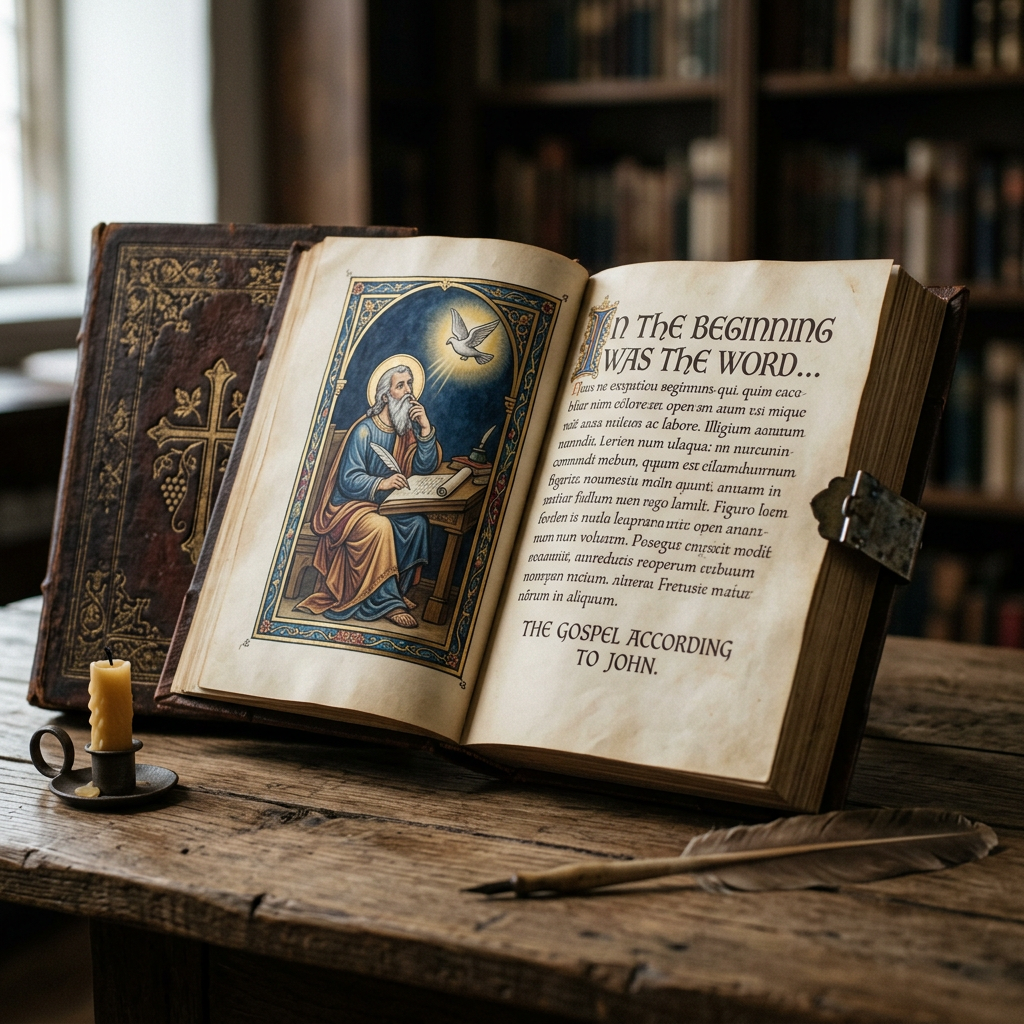
Before Bethlehem
Most people who know anything about Jesus think His story starts in a stable. Matthew starts with a family tree. Luke starts with an angel and a priest struck dumb. Mark skips the birth altogether and opens with a wild man in the desert. John does something none of them do. He goes back before the stable, before Abraham, before the first day. He goes back before there was a before.
And that changes how you read every page that follows. If Jesus is a good man who was born in Bethlehem and grew into His calling, then the miracles are impressive and the teaching is wise and the cross is a tragedy. But if the One who turned water into wine is the same One who spoke water into existence, then nothing in this book is a stunt. It is the Maker walking through what He made.
There is a second reason to slow down here. These eighteen verses are the most fought-over ground in the New Testament. The Jehovah’s Witnesses built their whole denial of the deity of Christ on one missing article in verse 1. Liberal scholarship for a century tried to turn the Word into a Greek philosophical idea that John borrowed and softened. And plenty of good church folks have read verse 14 for forty years without ever hearing the tabernacle in it.
So we are going to do something with this session that we will not do every week. We are going to read John with two other apostles looking over his shoulder. Paul wrote Colossians a generation before John wrote his Gospel. The writer of Hebrews wrote somewhere in between. Neither of them had John’s prologue in front of them. Yet when you set Colossians 1 and Hebrews 1 beside John 1, they say the same things in the same order with different words. That is not coincidence. That is three witnesses agreeing under separate examination, which is exactly what the Law of Moses required before a matter could be settled.
We’re going to read the whole thing aloud. John wrote it to be heard. Notice the shape. It opens in eternity, comes down into the world, gets rejected, gets received, and lands in a body. Then it closes where it opened, in the bosom of the Father. That is the arc of the whole Gospel.
In the beginning was the Word, and the Word was with God, and the Word was God. He was in the beginning with God. All things were made through Him, and without Him nothing was made that was made. In Him was life, and the life was the light of men. And the light shines in the darkness, and the darkness did not comprehend it. There was a man sent from God, whose name was John. This man came for a witness, to bear witness of the Light, that all through him might believe. He was not that Light, but was sent to bear witness of that Light. That was the true Light which gives light to every man coming into the world. He was in the world, and the world was made through Him, and the world did not know Him. He came to His own, and His own did not receive Him. But as many as received Him, to them He gave the right to become children of God, to those who believe in His name: who were born, not of blood, nor of the will of the flesh, nor of the will of man, but of God. And the Word became flesh and dwelt among us, and we beheld His glory, the glory as of the only begotten of the Father, full of grace and truth. John bore witness of Him and cried out, saying, “This was He of whom I said, ‘He who comes after me is preferred before me, for He was before me.’” And of His fullness we have all received, and grace for grace. For the law was given through Moses, but grace and truth came through Jesus Christ. No one has seen God at any time. The only begotten Son, who is in the bosom of the Father, He has declared Him.
John 1:1–18 (NKJV)
Verses 1–2. The Word Was God
In the beginning was the Word, and the Word was with God, and the Word was God. He was in the beginning with God.
John 1:1–2 (NKJV)
Every Jewish reader who picked up this scroll heard the first three words and thought of Genesis. In the Greek Old Testament, Genesis 1:1 begins en archē. John begins en archē. He is not being clever. He is telling you that what follows is a new Genesis, and the same God is at work in it.
But John does not say, “In the beginning God created.” He says, “In the beginning was the Word.” Not came to be. Was. The verb is ēn, the imperfect of “to be,” and it describes something already going on. When the beginning began, the Word was already there. Hold that verb in your hand. In verse 14 John will switch to a different one, and the switch is the hinge of the whole passage.
Why “Word”? The Greek is logos, and yes, the Stoics and the Platonists had used it for the rational principle that holds the universe together. John knew that. But John was a Jew, and behind logos stands the Hebrew dabar, the word of Jehovah. By the word of Jehovah the heavens were made (Psalm 33:6). The word of Jehovah came to the prophets. The word went out from His mouth and did not return void (Isaiah 55:11). In the Old Testament the word of God is never a mere sound. It is God going out from Himself to act. John takes the term the Greeks knew and fills it with the God the Hebrews knew. Then he does something neither group was ready for. He says the Word is a Person.
The writer of Hebrews opens his letter on exactly this ground.
God, who at various times and in various ways spoke in time past to the fathers by the prophets, has in these last days spoken to us by His Son.
Hebrews 1:1–2a (NKJV)
God has always been a speaking God. He spoke through Moses and through Isaiah and through a donkey once. But those were pieces. Various times, various ways. Now He has spoken by a Son. Not another prophet carrying another message. The message Himself. Hebrews says in a sentence what John says in a word. The Son is God’s speech. When you want to know what God has to say, you look at Jesus, because Jesus is what God said.
Three clauses in John, three claims. The Word was in the beginning, so He is eternal. The Word was with God, so He is distinct from the Father. The Word was God, so He is divine. All three stand at once. Take away any one and you have a heresy the early church already named.
The second clause deserves a closer look. “With God” translates pros ton theon. Pros is not the ordinary word for “with.” It carries the sense of facing toward, in the presence of, in living relationship with. Two persons face to face. The Word was not beside God like a tool on a shelf. He was toward God, in fellowship, before there was anything else to have fellowship with. Love did not begin at creation. It was already there.
Now the third clause, and the fight. In Greek the sentence reads theos ēn ho logos. God was the Word, with “God” placed first for emphasis and without the definite article. The New World Translation of the Jehovah’s Witnesses renders it “the Word was a god,” and they point to the missing article as proof. Here is what actually happens in Greek grammar. When a predicate noun comes before the verb, it normally drops the article, and it does so to tell you it is describing quality, not identity. If John had written ho theos ēn ho logos, with the article, he would have said the Word and God are the same person, which is exactly what he denied in the clause before. Without the article, he says the Word has everything that makes God God. The same construction appears in John 4:24, “God is Spirit,” and nobody translates that “God is a spirit.” John chose his grammar with care. The Word was fully God and was not the Father. That is the Trinity in one sentence, written by a fisherman.
Paul makes the same two-sided claim with a different pair of words.
He is the image of the invisible God, the firstborn over all creation.
Colossians 1:15 (NKJV)
Image and firstborn. Both get misused, so nail them down. Image is eikōn, and it does not mean a copy or a picture. In Greek thought the eikōn shared in the reality of the thing it imaged. A king’s image on a coin carried the king’s authority. Paul says the invisible God has an image you can see, and the image is a Person who shares His nature. That is John’s third clause. Then firstborn. The Witnesses read this as “first created.” But prōtotokos in the Old Testament is a rank, not a birth order. Jehovah calls Israel His firstborn in Exodus 4:22 and David His firstborn in Psalm 89:27, and David was the youngest of eight boys. Firstborn means heir, the one with the rights and the rule. Paul says He is firstborn over all creation, not among it. And the very next verse tells you why. He is the one who made it.
Verse 2 of John repeats verse 1 on purpose. “He was in the beginning with God.” John wants you to notice the He. Not it. A Person, eternal, in relationship, divine.
| Term | Original | Strong’s | Meaning and Use |
|---|---|---|---|
| archē | ἀρχή | G746 | Beginning, origin, first principle. Echoes Genesis 1:1 in the Septuagint. The Word is prior to it. |
| bereshit | בְּרֵאשִׁית | H7225 | In the beginning. The first word of the Hebrew Bible. John’s opening is a deliberate echo. |
| logos | λόγος | G3056 | Word, reason, message. In John, the eternal self-expression of God who is Himself a Person. |
| dabar | דָּבָר | H1697 | Word, matter, thing. The word of Jehovah in the Old Testament is God going out from Himself to act. |
| ēn | ἦν | G1510 | Was. Imperfect of eimi. Continuous existence with no starting point in view. |
| pros | πρός | G4314 | Toward, face to face with, in the presence of. Relationship, not proximity. |
| theos | θεός | G2316 | God. Without the article in the third clause to stress nature rather than identity. Fully God, not the Father. |
| eikōn | εἰκών | G1504 | Image, likeness. Colossians 1:15. Not a copy but a manifestation sharing the nature of the original. |
| prōtotokos | πρωτότοκος | G4416 | Firstborn. Colossians 1:15. A title of rank and inheritance, not of origin. Used of David in Psalm 89:27. |
The Son is God’s speech. When you want to know what God has to say, you look at Jesus.
Verses 3–5. Life and Light
All things were made through Him, and without Him nothing was made that was made. In Him was life, and the life was the light of men. And the light shines in the darkness, and the darkness did not comprehend it.
John 1:3–5 (NKJV)
Verse 3 says it twice, once positive and once negative, so no one can wriggle out. Everything that came into being came through Him. Nothing that exists got here another way. The verb is ginomai, “to become, to come into being,” and John sets it against the ēn of verse 1. Created things became. The Word was. He stands on the Creator side of the line between the Creator and everything else.
Now watch Paul say the same thing and go further.
For by Him all things were created that are in heaven and that are on earth, visible and invisible, whether thrones or dominions or principalities or powers. All things were created through Him and for Him. And He is before all things, and in Him all things consist.
Colossians 1:16–17 (NKJV)
John says all things. Paul unpacks the all. Heaven and earth. Visible and invisible. Thrones, dominions, principalities, powers. Paul is writing to a church in Colossae that had gotten interested in angels and spiritual hierarchies, and he tells them every rank of spirit being they have ever heard of was made by Christ. There is nothing above Him because He made everything above you. Then Paul adds two prepositions John does not use. Through Him and for Him. He is not only the channel of creation. He is its goal. Everything exists to arrive at Him.
And then verse 17. “In Him all things consist.” The verb is synistēmi, to hold together, to cohere. Paul is not talking about the past anymore. He is talking about this minute. The reason your chair holds your weight and the atoms in your body do not fly apart is that the Word is holding them. Creation is not a clock He wound up and walked away from. It is a room He is standing in.
Hebrews puts it in one phrase. The Son is the One through whom God made the worlds, “upholding all things by the word of His power” (Hebrews 1:2–3). The verb there is pherō, to carry. Not propping up a wall. Carrying a load forward, the way a river carries a boat. The universe is being carried somewhere, and He is the one carrying it.
That is what John means when he moves from making to sustaining. “In Him was life.” Not He had life. Life was in Him as its source. Everything that breathes borrows its breath from Him. And that life was the light of men. Genesis 1 comes back again. Light was the first thing God spoke into the dark. John says the light that has been shining on the human race since Eden, the light of conscience and reason and the longing for God, has its source in the Word.
Verse 5 is where the tone shifts. “The light shines in the darkness.” Present tense. Still shining. “And the darkness did not comprehend it.” The Greek verb katalambanō can mean to grasp with the mind or to grasp with the hand. To understand or to overpower. Scholars argue about which John meant. I think he meant both, and I think he chose the word because it could carry both. The darkness could not understand the light, and the darkness could not put it out. Every chapter of this Gospel will show you the darkness trying. It never wins.
Notice that John introduces darkness without explaining it. Genesis 1:2 does the same thing. Darkness was over the face of the deep before God said a word. John assumes you know the world is fallen. He does not argue for it. He tells you the light is stronger.
| Term | Original | Strong’s | Meaning and Use |
|---|---|---|---|
| ginomai | γίνομαι | G1096 | To become, come into being. Used of creation in verse 3 and set against ēn. Things became. The Word was. |
| ktizō | κτίζω | G2936 | To create, found. Paul’s verb in Colossians 1:16. Used in the Septuagint for God’s act in Genesis. |
| synistēmi | συνίστημι | G4921 | To hold together, cohere, consist. Colossians 1:17. Present tense. He is holding it together now. |
| pherō | φέρω | G5342 | To bear, carry, bring. Hebrews 1:3. Not static support but active carrying toward a destination. |
| zōē | ζωή | G2222 | Life. John’s word for the life of God Himself, not mere biological existence. Thirty-six times in this Gospel. |
| phōs | φῶς | G5457 | Light. The first created thing in Genesis 1:3. Here the uncreated source of it. |
| skotia | σκοτία | G4653 | Darkness. In John, the moral and spiritual condition of a world that does not know God. |
| katalambanō | καταλαμβάνω | G2638 | To seize, grasp, overtake, comprehend. Double meaning. The darkness neither understood nor overpowered the light. |
Creation is not a clock He wound up and walked away from. It is a room He is standing in.
Verses 6–8. A Man Sent from God
There was a man sent from God, whose name was John. This man came for a witness, to bear witness of the Light, that all through him might believe. He was not that Light, but was sent to bear witness of that Light.
John 1:6–8 (NKJV)
John the apostle breaks his own poem to talk about John the Baptist. It feels abrupt. That is the point. The eternal Word is about to enter history, and history has a date and a place and a man in camel hair who pointed. God does not drop truth on us from the sky. He sends people.
Look at the verb. “There was a man.” The Greek is egeneto, the same ginomai from verse 3. The Word was. John the Baptist came to be. The apostle keeps drawing that line. And then he says three things about the Baptist. He was sent from God. He came to bear witness. He was not the Light. That last one had to be said because some of John’s disciples were still following him decades later, as Acts 19 shows. The apostle wants no confusion. The greatest man born of women, in the words of Jesus, was a lamp, not the sun.
The word witness matters. Martyria and its verb form martyreō appear nearly fifty times in this Gospel. A witness does not argue you into something. A witness tells you what he saw. John the Baptist saw, and he said so. Every believer in the room does the same job. You are not the Light. You have seen it. Say so.
| Term | Original | Strong’s | Meaning and Use |
|---|---|---|---|
| apostellō | ἀποστέλλω | G649 | To send with a commission. The Baptist was sent. Jesus will use the same verb of Himself and of the disciples in 20:21. |
| martyria | μαρτυρία | G3141 | Witness, testimony. Legal language. What a man says about what he has seen. |
| pisteuō | πιστεύω | G4100 | To believe, trust, rely on. John’s key verb. Ninety-eight times in this Gospel, and never once the noun “faith.” |
Verses 9–13. His Own Did Not Receive Him
That was the true Light which gives light to every man coming into the world. He was in the world, and the world was made through Him, and the world did not know Him. He came to His own, and His own did not receive Him. But as many as received Him, to them He gave the right to become children of God, to those who believe in His name: who were born, not of blood, nor of the will of the flesh, nor of the will of man, but of God.
John 1:9–13 (NKJV)
Verse 9 calls Him the true Light. The Greek is alēthinos, which does not mean true as opposed to false so much as real as opposed to shadow. The genuine article. John the Baptist was a lamp. Moses was a lamp. The Law was a lamp. This is the Light itself, the one every lamp was borrowing from. And it gives light to every man. Not every man is saved. Every man is exposed. No one in the world has been left without some light to answer for.
Then three verses of tragedy in the plainest words John has. He was in the world. He made the world. The world did not know Him. He came to His own, and His own did not receive Him. The phrase “His own” appears twice in verse 11, and in Greek the first is neuter and the second is masculine. He came to His own things, His own land and temple and covenant, and His own people would not take Him in. The Creator came home and found the locks changed.
Set that beside Colossians 1:16 for a moment. All things were created for Him. The world exists to arrive at Christ, and when He arrived in it, the world did not know Him. That is the measure of the fall. Not that we broke a rule. That we looked at the One everything was made for and did not recognize Him.
But verse 12 begins with the word that turns the whole passage. “But as many as received Him.” Not everyone slammed the door. And to those who opened it, He gave exousia, the right and the authority, to become children of God. Notice the word become. They were not children already. Being born in Israel did not do it. Being born to believing parents did not do it. Verse 13 shuts every human door. Not of blood, not of the will of the flesh, not of the will of man. A person does not decide to be born. Birth happens to you. The new birth is the same. It is of God.
And notice the pairing. Received Him, and believe in His name. Those are the same act said two ways. Believing is receiving. It is not agreeing that a fact is true. It is taking a Person in. You will see this over and over. When Nicodemus comes at night in chapter 3, this is the verse he needed to have read first.
| Term | Original | Strong’s | Meaning and Use |
|---|---|---|---|
| alēthinos | ἀληθινός | G228 | True, genuine, real. The real thing as opposed to the copy or shadow. Also used of the true vine in 15:1. |
| kosmos | κόσμος | G2889 | World. In John, usually the human world organized without reference to God. Seventy-eight times in this Gospel. |
| idios | ἴδιος | G2398 | One’s own. Neuter in the first use of verse 11 (His own things), masculine in the second (His own people). |
| paralambanō | παραλαμβάνω | G3880 | To receive, take to oneself, welcome. What His own people failed to do. |
| exousia | ἐξουσία | G1849 | Right, authority, privilege. Not the power to make yourself a child but the standing granted to be one. |
| teknon | τέκνον | G5043 | Child, one born. John reserves “Son” for Jesus and “children” for believers. The distinction is deliberate. |
| gennaō | γεννάω | G1080 | To beget, to be born. Passive here. Birth is something done to you, not by you. |
Verse 14. The Word Became Flesh
And the Word became flesh and dwelt among us, and we beheld His glory, the glory as of the only begotten of the Father, full of grace and truth.
John 1:14 (NKJV)
Here is the hinge. For thirteen verses the Word was. Now the Word became. The verb is egeneto, the same ginomai John has used for everything created, and now he uses it of the Word Himself. The eternal One entered time. The One through whom all things became, became. This is the most staggering sentence in the Bible, and it is only five words in Greek.
And He became flesh. Not a man, though He was that. Not a body, though He had one. Flesh. Sarx. The word for meat and skin and weakness and mortality. John could have chosen a gentler word. He chose the one that would offend the Greeks, who thought flesh was a prison the soul needed to escape, and the one that would answer the false teachers of his own day who said Christ only seemed to have a body. The Word did not put on a costume. He took on our nature, all the way down.
Then the word that most English readers walk right past. “Dwelt among us.” The Greek verb is skēnoō, and it means to pitch a tent. To tabernacle. John’s readers heard it instantly. In Exodus 25:8 Jehovah told Moses to build Him a sanctuary that He might dwell among them. The Hebrew verb is shakan, and the tent was the mishkan, the dwelling place. When it was finished in Exodus 40, the glory of Jehovah filled it so thick Moses could not go in. The tabernacle was where God lived in the middle of His people, in a tent, on the move, in the wilderness. John says the Word did that. He pitched His tent in the middle of us. The body of Jesus of Nazareth was the tabernacle of God. Later the rabbis would use the word Shekinah for the glory that dwelt in the tent, from the same root. John is telling you the Shekinah had a face.
Paul reaches for the same picture.
For it pleased the Father that in Him all the fullness should dwell. For in Him dwells all the fullness of the Godhead bodily.
Colossians 1:19 and 2:9 (NKJV)
Dwell. Paul’s verb is katoikeō, to settle down and make a home, and it is the ordinary Greek word for taking up residence. All the fullness of God took up residence in Him. Not a portion. Not a visitation. The whole of what God is, at home in a human body. Paul adds the word bodily in chapter 2 so no one can spiritualize it. John says flesh. Paul says bodily. Two men who never compared notes both refuse to let you make Jesus a ghost.
And we beheld His glory. The apostle is not being poetic. He means it. He was there. He saw the water become wine and the dead man walk out. He put his head on that chest at supper. “We beheld” is the language of an eyewitness, and John will say so again at the end of the book.
Hebrews tells you what glory he saw.
Who being the brightness of His glory and the express image of His person.
Hebrews 1:3a (NKJV)
Two pictures, and both of them answer the question of how you can see the invisible God. Brightness is apaugasma, the radiance that shines out from a source of light. You cannot look at the sun. You can look at sunlight, and the sunlight is not something other than the sun. It is the sun reaching you. The Son is the Father’s glory reaching you. Then express image. The Greek is charaktēr, the impression a seal leaves in wax or a die leaves on a coin. Every line of the original, pressed into something you can hold. And the word for person here is hypostasis, the underlying substance, what God actually is beneath everything He does. Hebrews says Jesus is the exact impression of the very being of God. When John says “we beheld His glory,” that is what he beheld.
The glory as of the only begotten of the Father. Monogenēs. Some translations render it “one and only” and some “only begotten.” The word speaks of a unique relationship. There is one Son who is Son by nature. Everyone else in verse 12 is a child by grace. And the glory John saw was the glory of that Son, which is the glory of the Father, because the Son shows you the Father. Chapter 14 will say it outright.
Full of grace and truth. In Exodus 33 Moses asked to see the glory of Jehovah. God said no man could see His face and live, but He hid Moses in the cleft of a rock and passed by, and in Exodus 34:6 He proclaimed His name. Jehovah, merciful and gracious, longsuffering, and abounding in goodness and truth. The Hebrew behind “goodness and truth” is chesed ve’emet. Lovingkindness and faithfulness. Covenant love and covenant reliability. That phrase becomes the Old Testament’s shorthand for the character of God. It shows up in the Psalms a dozen times. John, writing in Greek, renders it charis kai alētheia. Grace and truth. He is saying the thing Moses could only hear proclaimed, we saw walking around. The glory that would have killed Moses ate fish on a beach with us.
| Term | Original | Strong’s | Meaning and Use |
|---|---|---|---|
| egeneto | ἐγένετο | G1096 | Became. Aorist of ginomai. The eternal Word entered history at a point in time. |
| sarx | σάρξ | G4561 | Flesh. Human nature in its weakness and mortality. The strongest possible word against a Christ who only seemed human. |
| skēnoō | σκηνόω | G4637 | To pitch a tent, tabernacle, dwell. The verb of Exodus 25 and 40 in the Septuagint. God living in the camp. |
| katoikeō | κατοικέω | G2730 | To settle, take up residence, make a home. Colossians 1:19 and 2:9. The fullness of God at home in a body. |
| shakan | שָׁכַן | H7931 | To dwell, settle, abide. The Hebrew verb of Exodus 25:8. Root of mishkan (tabernacle) and Shekinah. |
| mishkan | מִשְׁכָּן | H4908 | Dwelling place, tabernacle. The tent where the glory of Jehovah lived among Israel. |
| doxa | δόξα | G1391 | Glory. Weight, splendor, the visible presence of God. The glory of Exodus 40:34 seen in a man. |
| kavod | כָּבוֹד | H3519 | Glory, weight, heaviness. The glory that filled the tabernacle and the temple. |
| apaugasma | ἀπαύγασμα | G541 | Radiance, brightness shining out from a source. Hebrews 1:3. The Son is the Father’s glory reaching us. |
| charaktēr | χαρακτήρ | G5481 | Exact impression, as of a seal in wax. Hebrews 1:3. Every line of the original reproduced. |
| hypostasis | ὑπόστασις | G5287 | Substance, essential being, what stands under. Hebrews 1:3. The Son is the impress of God’s very nature. |
| monogenēs | μονογενής | G3439 | Only begotten, one of a kind, unique. Speaks of relationship and nature, not origin in time. |
| charis | χάρις | G5485 | Grace, favor, gift freely given. John’s rendering of the Hebrew chesed. |
| chesed | חֶסֶד | H2617 | Lovingkindness, covenant love, steadfast mercy. Jehovah’s self-description in Exodus 34:6. |
| alētheia | ἀλήθεια | G225 | Truth, reality, faithfulness. John’s rendering of the Hebrew emet. |
| emet | אֱמֶת | H571 | Truth, faithfulness, firmness. Paired with chesed throughout the Psalms as the character of God. |
The glory that would have killed Moses ate fish on a beach with us.
Verses 15–18. Grace upon Grace
John bore witness of Him and cried out, saying, “This was He of whom I said, ‘He who comes after me is preferred before me, for He was before me.’” And of His fullness we have all received, and grace for grace. For the law was given through Moses, but grace and truth came through Jesus Christ. No one has seen God at any time. The only begotten Son, who is in the bosom of the Father, He has declared Him.
John 1:15–18 (NKJV)
The Baptist steps in one more time with a riddle. The One who comes after me ranks ahead of me, because He was before me. Jesus was born six months after John and began His ministry after John. But He was first. The Baptist understood the prologue before the prologue was written.
Then verse 16. “Of His fullness we have all received.” That is Paul’s word. Plērōma. The same fullness that dwelt in Him bodily in Colossians is the fullness we draw on. Paul says the fullness lives in Christ. John says it flows out of Christ to us. Put the two together and you have the whole gospel. God in Him, and Him in us.
“And grace for grace.” The phrase is charin anti charitos. Grace in place of grace. Grace replacing grace. The picture is of waves on a beach. One wave comes in and before it is gone the next one is behind it. You never get to the bottom of it. Whatever grace you received yesterday has been replaced this morning by fresh grace. Nobody in the room is living on last year’s supply.
Verse 17 gets misread more than any verse in the passage. “The law was given through Moses, but grace and truth came through Jesus Christ.” Some people hear that as law bad, grace good. But John just told you in verse 14 that grace and truth is the name Jehovah proclaimed to Moses on the mountain. The law was itself a gift of grace. Moses was the middleman of a good thing. The difference is in the verbs. The law was given through Moses. It passed through his hands. Grace and truth came through Jesus Christ. It came in Him. It was Him. Moses delivered a message. Jesus is the message. That is Hebrews 1:1–2 again. God spoke by the prophets. Now He has spoken by a Son.
And verse 18 closes the loop. No one has seen God at any time. Moses did not. Isaiah saw a vision. Ezekiel saw the appearance of the likeness of the glory. But the only begotten Son, who is in the bosom of the Father, has declared Him. The word for bosom is kolpos, the fold of a garment at the chest where you hold what is dear. The place of closest intimacy. It is where the beloved disciple leaned at the Last Supper in 13:23, and John uses the same word. The Son has lived in that place from eternity. And He has declared the Father. The verb is exēgeomai. He has exegeted Him. Explained Him. Drawn Him out and set Him in front of us. Every sermon you have ever heard is a man trying to explain God. Jesus is God explaining Himself.
Notice that all three writers end up at the same door. John says no one has seen God, but the Son has declared Him. Paul says God is invisible, but the Son is His image. Hebrews says God’s being is beyond us, but the Son is its exact impression. Three men, three vocabularies, one answer to the oldest question there is. What is God like? Look at Jesus.
Some of the oldest manuscripts read “the only begotten God” in verse 18 rather than “the only begotten Son.” Either way John says the same thing he said in verse 1. The One in the Father’s bosom is Himself God. The prologue ends where it started.
| Term | Original | Strong’s | Meaning and Use |
|---|---|---|---|
| plērōma | πλήρωμα | G4138 | Fullness, that which fills. Colossians 1:19 and 2:9 for the Godhead dwelling in Christ. John 1:16 for what flows from Him to us. |
| anti | ἀντί | G473 | In place of, instead of. “Grace for grace” means grace succeeding grace without end. |
| nomos | νόμος | G3551 | Law, Torah. Given through Moses as a gift, not a curse. The contrast in verse 17 is between mediator and source. |
| kolpos | κόλπος | G2859 | Bosom, the fold of a garment at the chest. The place of intimacy. Used of the beloved disciple in 13:23. |
| exēgeomai | ἐξηγέομαι | G1834 | To lead out, explain, declare, make known. Our word exegesis. The Son has explained the Father. |
Three Witnesses, One Christ
John, Paul, and the writer of Hebrews did not coordinate. They arrived at the same Christ from three directions because they had met the same Christ.
| The Claim | John 1 | Colossians 1 | Hebrews 1 |
|---|---|---|---|
| He is eternal | In the beginning was the Word (v. 1) | He is before all things (v. 17) | Through whom He made the worlds (v. 2) |
| He is distinct from the Father | The Word was with God (v. 1) | Image of the invisible God (v. 15) | Spoken to us by His Son (v. 2) |
| He is God | The Word was God (v. 1) | In Him all the fullness dwells (v. 19) | Express image of His person (v. 3) |
| He made everything | All things were made through Him (v. 3) | By Him all things were created (v. 16) | Through whom He made the worlds (v. 2) |
| He holds everything together | In Him was life (v. 4) | In Him all things consist (v. 17) | Upholding all things by the word of His power (v. 3) |
| He shows us the Father | He has declared Him (v. 18) | Image of the invisible God (v. 15) | Brightness of His glory (v. 3) |
| He came in a body | The Word became flesh (v. 14) | The fullness of the Godhead bodily (2:9) | Purged our sins (v. 3) |
Deuteronomy 19:15 says one witness is not enough to establish a matter. By the mouth of two or three witnesses it shall be established. On the deity of Christ, the New Testament gives you three, and they were examined separately.
Where This Lands
Some of us have been carrying the idea that God is far off. Maybe you were taught it. Maybe life taught it. A God who is holy and high and hidden behind a cloud like He was on Sinai, with Moses barred from His face. That God is real. John does not shrink Him. No one has seen God at any time.
But John says the far-off God pitched His tent in the camp. Paul says the fullness of God moved into a body and made itself at home. Hebrews says the glory you could never look at came down as light you can stand in. He did not send a message. He came. And when He came He did not come as a warrior or a king in purple. He came as flesh, the same stuff you are made of, the stuff that gets tired and hungry and dies. He came full of grace and truth, and grace was named first.
The invitation in this passage is verse 12. As many as received Him. That is not a doctrine to master. It is a door to open. Some of you have never opened it. Some opened it years ago and have been living like the light went out. The light is still shining. The darkness has never once put it out. And the grace they received back then has been replaced this morning with more.
Every sermon you have ever heard is a man trying to explain God. Jesus is God explaining Himself.
Discussion Questions
- John opens with the same three words as Genesis. What does it change about how you read the rest of this Gospel if the Jesus in it is the God of Genesis 1?
- Verse 1 says the Word was with God and the Word was God. Explain in your own words how both can be true, and why losing either one leads to a wrong picture of Jesus.
- Paul calls Jesus the firstborn over all creation. Someone at your door says that means He was the first thing God made. Answer them from Colossians 1:16 and Psalm 89:27.
- Colossians 1:17 says in Him all things consist, and Hebrews 1:3 says He upholds all things by the word of His power. What difference does it make to your Tuesday that Christ is holding the world together right now, not just that He made it once?
- The darkness did not comprehend the light. Where have you seen the darkness try to understand the light and fail? Where have you seen it try to overpower the light and fail?
- He came to His own, and His own did not receive Him. What does it look like today for people who are closest to the things of God to miss God Himself?
- Moses asked to see the glory and was told no man could see God’s face and live. John, Paul, and Hebrews all say we have now seen it. In what? How should that change the way you pray?
- Grace for grace. Where in your life right now are you living on last year’s grace instead of this morning’s?
Going Deeper
READ ALONGSIDE THIS PASSAGE
- Genesis 1:1–5. The beginning, the word, the light, and the darkness. Read it aloud right before John 1:1.
- Exodus 25:8–9 and 40:34–38. The command to build the tabernacle and the glory filling it. This is the picture behind “dwelt among us.”
- Exodus 33:18–23 and 34:5–8. Moses asks to see the glory. Jehovah proclaims His name. “Abounding in goodness and truth” is the Hebrew behind “full of grace and truth.”
- Colossians 1:15–20 in full. We used verses 15 through 19 in the body. Read to verse 20 and notice where Paul takes it. The One who made all things reconciles all things by the blood of His cross.
- Hebrews 1:1–14 in full. After verse 3 the writer stacks up seven Old Testament quotations to prove the Son is greater than the angels. Verse 8 has the Father calling the Son “God” outright, quoting Psalm 45.
- Psalm 33:6–9. By the word of Jehovah the heavens were made.
- Proverbs 8:22–31. Wisdom with God before the beginning, rejoicing before Him. The early church read this of the Son.
- Isaiah 55:8–11. The word that goes out from God’s mouth and does not return void.
- 1 John 1:1–4. The same author, the same Word, and the same insistence that he saw and touched Him.
LOOKING AHEAD
Next week we open verses 19–51 and meet the man in camel hair. Read the whole chapter before Friday and count how many people point at Jesus in it. Keep the running list of “I am” statements ready. It stays empty this week and next. That is on purpose.

Leave a Reply