
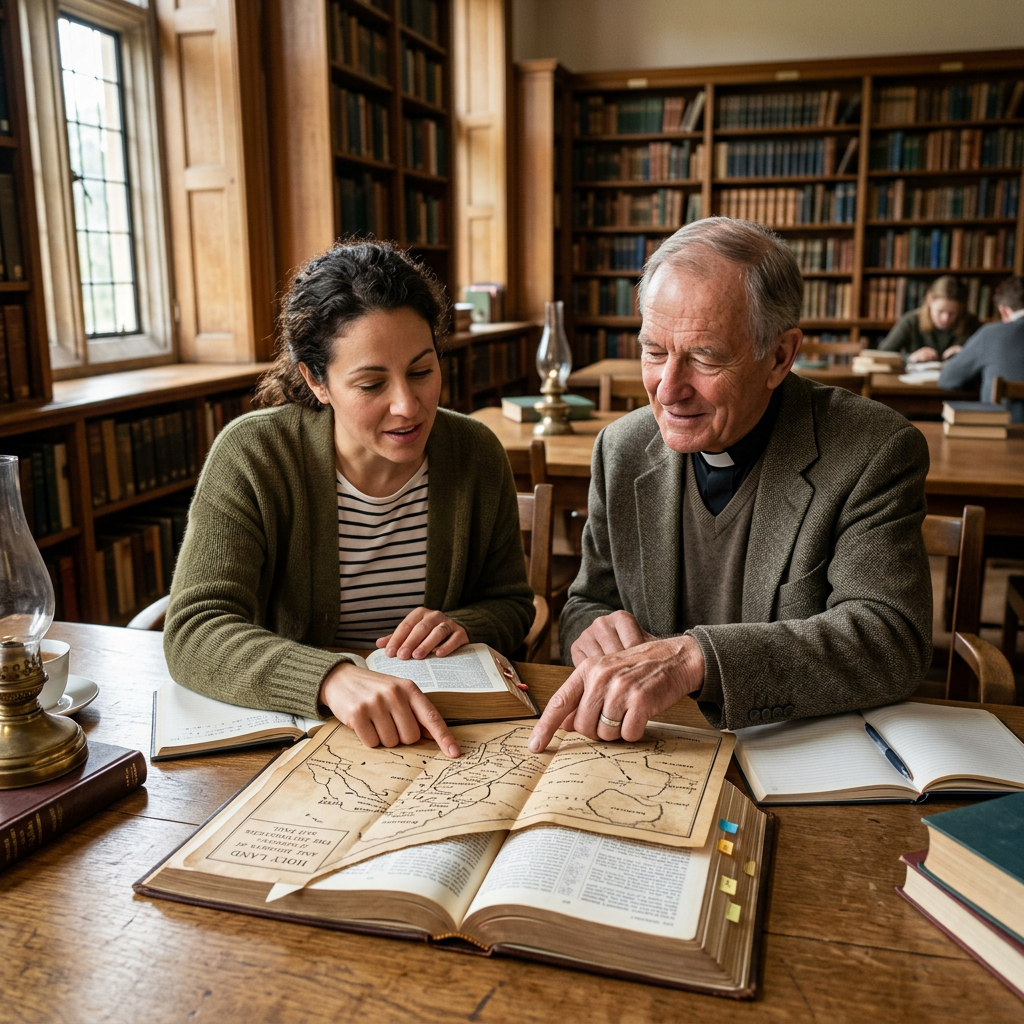
This is part six of Feed Yourself, a series on learning to study the Bible with your own two hands. Today we open the study tool that has been printed in the middle of your Bible all along.
There is a study tool printed in the center column or the margins of most Bibles that people pay monthly subscriptions to get worse versions of. You have probably never once followed it.
I mean that column of tiny letters and numbers running alongside the text. Cross references. Most readers’ eyes slide right past them, the way you stop seeing the wallpaper in your own house. But that little column is a map of the Bible’s own internal conversation, sixty-six books quoting each other, echoing each other, answering each other across fifteen centuries, and generations of editors have done the tracing for you and printed the results an inch from the verse you are reading.
The principle underneath the tool is old and sturdy. Scripture interprets Scripture. The best commentary on any passage of the Bible is another passage of the Bible, because the Book has one divine Author, and He is remarkably consistent. When something in Romans puzzles you, the odds are good that Genesis or Habakkuk or Isaiah is already on record about it, and the margin knows where.
How the Column Works
The mechanics take two minutes to learn. A tiny letter sits in the text, raised beside a word or phrase. Find the matching letter in the margin under that verse number, and it hands you one or more addresses elsewhere in Scripture. That is the whole system. Some references mark a direct quotation, the New Testament citing the Old. Some mark a parallel account, the same event told in Kings and Chronicles, or in two Gospels. Some mark a shared theme or a shared word. The editors rarely tell you which kind you are holding, so the habit that makes the tool sing is one question, asked every time. Why did they connect these two texts?
Ask that question and you are no longer reading a reference. You are studying. Follow the second verse’s own references and you are following a chain, and chains are where the treasure is. Let me show you what a chain does with a single phrase.
Following the Lamb
“The next day John saw Jesus coming toward him, and said, ‘Behold! The Lamb of God who takes away the sin of the world!’”
John 1:29 NKJV
The Lamb of God. John the Baptist says it like everyone standing on the riverbank should know what it means, and everyone did, because the phrase has a history. The margin beside that verse will send you backward, and the trail runs deep.
It starts on a mountain in Genesis 22. Isaac, carrying the wood for his own sacrifice, asks his father where the lamb is, and Abraham answers with one of the most loaded sentences in Scripture. “My son, God will provide for Himself the lamb for a burnt offering” (Genesis 22:8 NKJV). A ram is caught in the thicket that day, but the lamb God would provide for Himself was still coming.
The trail runs to Egypt in Exodus 12. A lamb without blemish, one per household, its blood on the doorposts, and death passes over every house under the blood. Israel is born as a nation on the night a lamb died in place of the firstborn.
Then to Isaiah 53, where the suffering Servant is “led as a lamb to the slaughter” (Isaiah 53:7 NKJV), and the chapter says plainly what the lamb accomplishes, He bore the sin of many. Seven centuries before the riverbank, the lamb and the sin-bearing are already joined.
So when John points at a carpenter from Nazareth and says Lamb of God, he is pulling every one of those threads at once. God providing for Himself. Death passing over. Sin carried by a substitute. And the chain keeps running forward, because in Revelation 5 the scroll of history can be opened by no one until a Lamb appears in the center of the throne, standing as though it had been slain, and all heaven sings that it was slain and has redeemed us by its blood. One phrase, followed through the margins, and you have just traced the spine of the entire gospel from Moriah to the throne room. No video required. The map was in your Bible the whole time.
One phrase, followed through the margins, traces the spine of the entire gospel from Moriah to the throne room. The map was in your Bible the whole time.
The Words Under the Chain
| Word | Original | Strong’s | Meaning |
|---|---|---|---|
| seh | שֶׂה | H7716 | Lamb, one of the flock. Abraham’s word in Genesis 22:8, Isaiah’s in 53:7 |
| amnos | ἀμνός | G286 | Lamb. John the Baptist’s word at the river, John 1:29, and Peter’s in 1 Peter 1:19 |
| arnion | ἀρνίον | G721 | Lamb. The word Revelation uses twenty-nine times for the slain and reigning Christ |
Using the Map Well
A few habits will make this tool part of your regular study. When a verse puzzles you, check the margin before you check anything else, and give Scripture the first chance to explain itself. When the New Testament quotes the Old, always go read the quoted passage in its own home, whole, using everything from parts two and three of this series, because the apostles quote context, not just sentences, and the surrounding verses are usually part of their point. And keep a notebook page for chains you trace, the lamb, the shepherd, the vine, the rock, the bread. Ten minutes with a chain is worth an hour with a highlight reel.
One honest caveat. The cross reference column is an editor’s work, useful and uninspired. It is not exhaustive, and once in a while a reference will feel like a stretch. That is fine. The column is a map, not the territory, and maps can be checked. You know how to check them now.
For the Reader Who Thinks the Bible Is Scattered
Somebody reading this has privately felt that the Bible is a jumble, sixty-six books, forty-odd authors, poetry next to law next to letters, and no way to hold it together. The margins are the answer to that feeling. Trace even one chain and you discover the Book is not a jumble but a weave, and the threads run everywhere. A shepherd boy’s psalm turns up in the mouth of the dying Messiah. A serpent lifted in the wilderness turns up in a midnight conversation with a Pharisee. Abraham’s answer on the mountain gets kept, word for word, two thousand years later at a river. No committee could have engineered that across fifteen centuries. The margins of your Bible are quiet, physical evidence that one Author has been telling one story the whole time, and He finishes what He starts. That is not just a fact about the Book. It is a fact about the promises He has made to you in it.
Discussion Questions
- Follow the cross references on one verse from this Sunday’s sermon. Where did the chain take you, and what did it add?
- Read Genesis 22:1-14, Exodus 12:1-13, and Isaiah 53:4-7, then John 1:29. What does each stop on the trail add to what “Lamb of God” means?
- Why does it matter that we let Scripture get the first chance to interpret Scripture, before commentaries or teachers?
- Find one place where the New Testament quotes the Old, and read the Old Testament passage whole. What did the quoting author assume you knew?
- What theme would you most like to trace through the whole Bible? What is your starting verse?
Going Deeper
Trace the Lamb chain yourself this week with your own Bible’s margins, Genesis 22, Exodus 12, Isaiah 53, John 1, 1 Peter 1:18-19, Revelation 5, and read each passage whole, not just the verse. If your Bible has a thin cross reference column, the Treasury of Scripture Knowledge is the deep well, over half a million references keyed to every verse, free at several sites online including Blue Letter Bible. Then pick a second chain and go. The shepherd thread from Genesis 48:15 through Psalm 23, Ezekiel 34, John 10, and 1 Peter 5:4 will preach to you by the time you reach the end of it.


Leave a Reply