
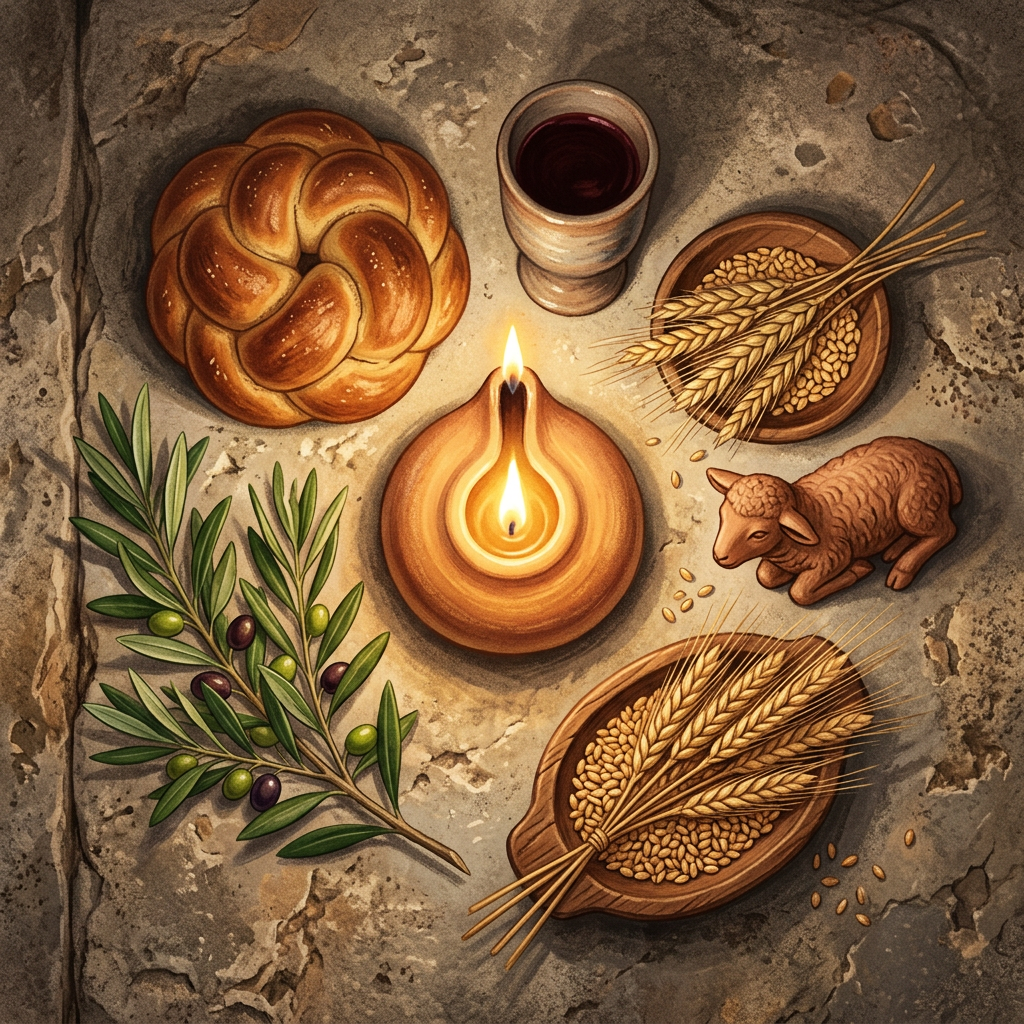
This is part five of Written on the Heart, a series on how a Christian lives with the law of the Old Testament under the New Covenant. Last week we said the threefold division sometimes sticks. This week we use the New Testament’s own word for the laws Christ has fulfilled.
Late in the afternoon, when the sun is low behind you, your shadow walks out ahead of you across the yard. It arrives first. It has your shape, more or less, stretched long and dark. Anybody watching would know someone was coming and could guess something about him. But nobody would mistake the shadow for the person. And when you finally reach the spot where your shadow fell, it has moved on ahead. You are standing where it was.
Paul uses exactly that picture for a large part of the law of Moses.
So let no one judge you in food or in drink, or regarding a festival or a new moon or sabbaths, which are a shadow of things to come, but the substance is of Christ.
Colossians 2:16-17 (NKJV)
Shadow is skia (σκιά), Strong’s G4639, shade or a shadow, and figuratively a faint outline cast ahead of the real thing. Substance is soma (σῶμα), Strong’s G4983, the ordinary word for body. The NKJV footnote gives body as the literal reading. Paul is saying the food laws, the festivals, and the sabbaths were a shadow, and the body that cast it belongs to Christ.
Hebrews uses the same word for the sacrificial system and adds a second.
For the law, having a shadow of the good things to come, and not the very image of the things, can never with these same sacrifices, which they offer continually year by year, make those who approach perfect.
Hebrews 10:1 (NKJV)
Image is eikon (εἰκών), Strong’s G1504, a likeness, a statue, a full representation. A shadow gives you an outline. An image gives you the form itself. The law had the outline of the good things to come, but not their full form. Christ is called the image of the invisible God (Colossians 1:15) with this same word.
One more word before we walk through the shadows. Calling something a shadow is not an insult. God cast these shadows on purpose, and for centuries they were the only outline of Christ His people had. A faithful Israelite who brought his lamb to the altar was not doing something foolish. He was standing in the shadow of the cross before the cross was raised. We honor the shadows best by looking at what cast them.
The Sacrifice
Leviticus opens with five kinds of offerings, and the altar in Israel was never cold for long. Morning and evening, feast days and new moons, the blood ran. Hebrews draws attention to the repetition. Every priest stands ministering daily and offering repeatedly the same sacrifices, which can never take away sins (10:11). Then comes the contrast.
But this Man, after He had offered one sacrifice for sins forever, sat down at the right hand of God, from that time waiting till His enemies are made His footstool. For by one offering He has perfected forever those who are being sanctified.
Hebrews 10:12-14 (NKJV)
The priests stood because their work was never done. Read the furniture list for the tabernacle in Exodus 25-27 and you will find a table, a lampstand, and an altar, but no seat for the priest. Christ sat down. The shadow was a line of priests on their feet for well over a thousand years. The body is one Man seated, because there is nothing left to offer.
The Priest and the Temple
Israel’s priests came from the tribe of Levi and the family of Aaron. Jesus came from Judah. Hebrews faces that squarely and draws a conclusion with large consequences. For the priesthood being changed, of necessity there is also a change of the law (7:12). The whole Levitical system was bound up with the priesthood, and when God appointed a new High Priest after the order of Melchizedek, the arrangement built around the old one changed with Him.
The temple follows the same pattern. When Jesus said, Destroy this temple, and in three days I will raise it up, John tells us He was speaking of the temple of His body (John 2:19-21). The tabernacle and temple were where Jehovah’s presence dwelt among His people. In Christ the Word became flesh and dwelt among us, and the word John uses for dwelt in John 1:14 is skenoo (σκηνόω), Strong’s G4637, to tent or encamp. He pitched His tent among us. The building was the shadow. His body is the place where God and man meet.
The Feasts
Paul names festivals in Colossians 2:16. Israel’s calendar was built around them, and the New Testament keeps finding Christ inside them. For indeed Christ, our Passover, was sacrificed for us (1 Corinthians 5:7). Jesus died at Passover, and the Lord’s Supper grew out of a Passover meal. He rose on the first day of the week during the Feast of Unleavened Bread, which many connect with the day the sheaf of firstfruits was waved before the LORD (Leviticus 23:10-11), and Paul calls Him the firstfruits of those who have fallen asleep (1 Corinthians 15:20). The Spirit was poured out at Pentecost, the Feast of Weeks, when the first harvest was brought in, and three thousand were gathered that day. The feasts were a calendar of the gospel written in advance.
The Food Laws
Leviticus 11 divides animals into clean and unclean. For Israel those rules were daily and visible. They shaped every meal and set Jews apart from their Gentile neighbors at the table. That separation was the point. Jehovah tied the food laws directly to His call for Israel to be holy, set apart, because He is holy (Leviticus 11:44-45).
Jesus addressed the question in Mark 7. Whatever enters a man from outside cannot defile him, because it does not enter his heart but his stomach, and is eliminated, thus purifying all foods (7:18-19). The last phrase is Mark’s comment on what Jesus’ words meant. Purifying is katharizo (καθαρίζω), Strong’s G2511, to cleanse or declare clean. Jesus declared the food itself was never the real problem. The heart was.
It took the disciples a while to absorb it. Years later Peter was praying on a rooftop in Joppa around noon, and he was hungry. God showed him a great sheet let down from heaven, full of animals the law called unclean.
And a voice came to him, “Rise, Peter; kill and eat.” But Peter said, “Not so, Lord! For I have never eaten anything common or unclean.” And a voice spoke to him again the second time, “What God has cleansed you must not call common.”
Acts 10:13-15 (NKJV)
Common is koinos (κοινός), Strong’s G2839, shared by all, and in a ceremonial sense profane, not set apart. Cleansed is katharizo again, the same word Mark used. It happened three times. Then the sheet went back up, and while Peter was still puzzling over it, three men sent by a Roman centurion knocked at the gate.
That is when Peter understood what the vision was really about. Standing in Cornelius’ house, he said, You know how unlawful it is for a Jewish man to keep company with or go to one of another nation. But God has shown me that I should not call any man common or unclean (10:28). The food laws had been a fence between Jew and Gentile. The shadow pictured a holy people set apart from the nations. The substance is a holy people gathered from the nations into one body in Christ. When the fence came down at the table, it came down between the people sitting at it.
The Sabbath
Paul includes sabbaths in his list in Colossians 2:16, and this is the place where sincere Christians most often disagree, so we should go carefully. Some read sabbaths there as the special feast-day sabbaths of Israel’s calendar, not the weekly day. Others think the weekly Sabbath is included. Both readings are held by serious scholars.
What the New Testament clearly does is point the Sabbath forward to a rest found in Christ. Jesus said, Come to Me, all you who labor and are heavy laden, and I will give you rest (Matthew 11:28), and in the very next scene in Matthew He is in the grainfields on the Sabbath declaring Himself Lord of it. Hebrews says, There remains therefore a rest for the people of God. For he who has entered His rest has himself also ceased from his works as God did from His (4:9-10). The word for rest in verse 9 is sabbatismos (σαββατισμός), Strong’s G4520, a Sabbath-keeping, used only here in the New Testament. The Sabbath rest that remains is entered by faith, by ceasing from our own works and resting in His.
How that bears on a weekly day of rest and worship is a question we will take up in the final post. Jesus’ own Sabbath controversies, where He healed on purpose in front of His critics, are covered in an earlier study, Breaking the Sabbath on Purpose.
| Word | Original | Strong’s | Meaning |
|---|---|---|---|
| skia | σκιά | G4639 | Shadow, shade, an outline cast ahead of the real thing |
| soma | σῶμα | G4983 | Body. Rendered substance in Colossians 2:17 |
| eikon | εἰκών | G1504 | Image, likeness, full representation. Used of Christ in Colossians 1:15 |
| katharizo | καθαρίζω | G2511 | To cleanse, to declare clean. Mark 7:19 and Acts 10:15 |
| koinos | κοινός | G2839 | Common, shared, and in a ceremonial sense profane or unclean |
| sabbatismos | σαββατισμός | G4520 | A Sabbath rest, a Sabbath-keeping. Only in Hebrews 4:9 |
Standing Where the Shadow Fell
There is a pull in every generation to go back to the shadows. Some do it out of love for the Jewish roots of the faith, which is a good thing to love. Some do it because the shadows can be seen and handled and scheduled, and the substance has to be trusted. Paul’s word to the Colossians was firm. Let no one judge you. Nobody gets to tell you that you are less right with God because you ate pork or skipped a new moon festival.
But Paul’s point cuts the other way too. If the shadows were about Christ, then the believer who stands in Christ has more of what the shadows promised, not less. More cleansing than any washing. More access than any high priest on the Day of Atonement. More rest than any Sabbath.
So the next time you come to the Lord’s Table, take a moment before the bread is passed and read Exodus 12:1-13 to yourself. The lamb without blemish. The blood on the doorposts. I will pass over you. Then take the bread and the cup and remember that you are not standing in the shadow anymore. You are standing where it fell.
Discussion Questions
- What does the picture of a shadow and a body teach about the relationship between the Old Testament ceremonies and Christ?
- Why does Hebrews make so much of the fact that Christ sat down?
- In Acts 10, how did Peter’s vision about food turn out to be about people? What fences between people does the church still need to take down?
- Which of Israel’s feasts most helps you see Christ, and why?
- Why do you think people are drawn back to the shadows? Have you felt that pull?
Going Deeper
Read Leviticus 16, the Day of Atonement, and then Hebrews 9:1-14 and 10:1-18, and list every point where Hebrews draws a line from the shadow to the substance. Then read Leviticus 23, the calendar of feasts, and see how many of them you can connect to events in the life of Christ and the early church. Next time we come to the heart of the matter in Romans 7 and 8, where Paul says believers have died to the law in order to be married to Another.

Leave a Reply