
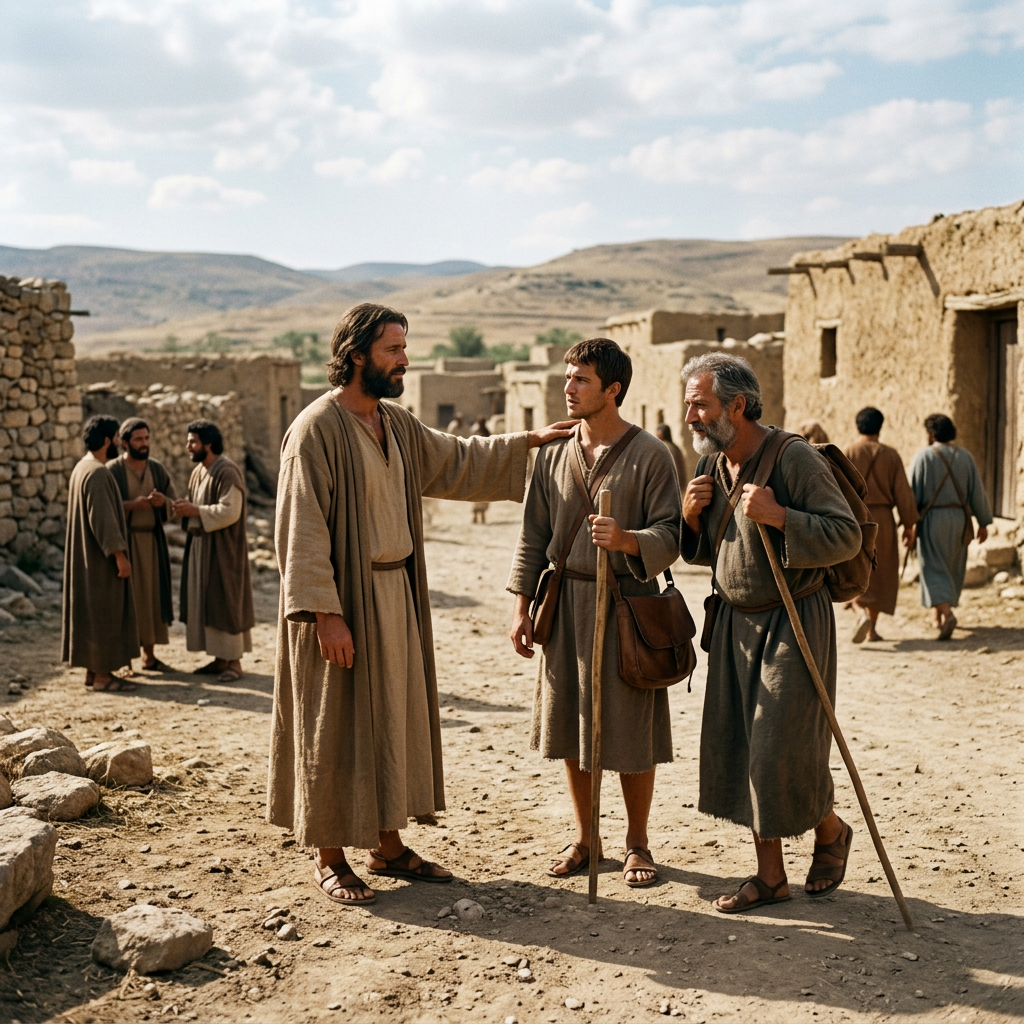
When Jesus sent the disciples out, He sent them in pairs.
Mark records it plain. “And He called the twelve to Himself, and began to send them out two by two, and gave them power over unclean spirits” (Mark 6:7 NKJV). Luke records the same pattern with a different group, the seventy others Jesus appointed. “After these things the Lord appointed seventy others also, and sent them two by two before His face into every city and place where He Himself was about to go” (Luke 10:1 NKJV).
Two by two. Twice. Once with the inner twelve. Once with the seventy. The pattern is not an accident, and it is not a logistical convenience. It is the way Jesus shapes the church.
Watch the names that follow.
Acts 13. The Holy Spirit speaks to the church at Antioch and says, “Now separate to Me Barnabas and Saul for the work to which I have called them” (Acts 13:2 NKJV). Two men. Sent out together. The first formal missionary journey of the church does not produce a solo missionary. It produces a pair.
Then Acts 15. Paul and Barnabas split. Not because the pattern was wrong, but because there were now two pairs to send instead of one. “Then Barnabas took Mark and sailed to Cyprus; but Paul chose Silas and departed” (Acts 15:39-40 NKJV). The pairs multiplied. The mission did not become solo. It doubled.
Then Acts 18. Paul comes to Corinth and finds Aquila and his wife Priscilla, and the three of them work together. Then Paul leaves with the pair, and Priscilla and Aquila stay together in Ephesus, where they pull Apollos aside and teach him the way of God more accurately. They are everywhere in Paul’s letters. They are never apart from each other in the text.
You start looking for it and you cannot stop seeing it. Paul and Timothy. Paul and Titus. Paul and Luke. Barnabas and Mark. Andronicus and Junia. Tryphena and Tryphosa. Euodia and Syntyche, who Paul names because they were not getting along, and Paul cannot stand for two co-laborers in the gospel to be at odds.
There are no solo apostles in the New Testament.
Feel the weight of that sentence. There are no solo apostles in the New Testament. Not one. Paul does not travel alone. Peter does not travel alone. John does not travel alone. The whole structure of the apostolic mission is built on the pattern Jesus established when He sent out the twelve.
Now the question. Why?
Jesus did not have a logistical problem to solve. He could have sent the twelve out one by one and covered twice the ground in the same amount of time. He could have stationed one disciple in every village in Galilee. There were efficiency reasons to send them solo. He did not.
The pairs are not about efficiency. They are about formation.
He is teaching the disciples how the church will operate. He is showing them, before they ever stand in front of a hostile crowd, that the work of the kingdom is not solo work. It functions as two people walking together, watching each other, correcting each other, encouraging each other, and bearing witness to the same Lord with two voices instead of one.
The Greek for “two by two” in Mark 6:7 is δύο δύο (duo duo, G1417), literally “two two.” A Hebraic intensifier, a way of doubling the noun for emphasis. Mark preserves the Hebrew way of saying it because the Hebrew way of saying it carries the weight. Two two. By twos. In pairs.
Now look at what Paul calls his ministry partners. The word he uses most often is συνεργός (synergos, G4904), “fellow worker.” From the Greek syn (together) and ergon (work). Co-laboring. He uses it of Timothy. Of Titus. Of Aquila and Priscilla. Of Epaphroditus, Apollos, Aristarchus, Demas before Demas went back to the world. More than a dozen times across his letters. One of his favorite words for the people God has given him to walk with.
And the structural word for that life together. κοινωνία (koinonia, G2842). Fellowship. Partnership. Sharing in common. Not a feeling. A shared reality. Money in the same pot, suffering on the same shoulders, mission carried in the same hands.
Paul lived this. He did not lecture about it from a distance. He had real partners with real names whom he loved and who loved him, and when he was lonely, he asked for them by name. Read 2 Timothy 4. He is writing the last letter he will ever write, the cell is cold, the winter is coming, and he tells Timothy, “Be diligent to come to me quickly” (2 Timothy 4:9 NKJV). And then he names who he wants. “Get Mark and bring him with you, for he is useful to me for ministry” (2 Timothy 4:11 NKJV). He wants his cloak. He wants his books. And he wants his brothers.
The greatest missionary in church history, on the eve of his execution, is asking for his partners by name.
If Paul needed that, what makes us think we do not?
Most of us are trying to do the work of discipleship alone. We are trying to grow as Christians alone. We are trying to fight temptation alone. We are trying to read Scripture alone, pray alone, walk with the Lord alone. We are trying to be the Christian Jesus did not send.
Jesus did not send a solo Christian to anyone. The twelve, two by two. The seventy, two by two. The whole apostolic generation, in pairs and small bands. Even Jesus Himself, in the deepest hour of His own suffering, took Peter and James and John with Him into the garden and asked them to watch with Him.
You do not get to do this alone. The Lord did not.
So now the work.
Who is the other half of your two?
I do not mean your spouse. Not necessarily. Marriage is a real partnership, and a strong one is a gift, but it is not what Jesus is talking about in Mark 6 and Luke 10. He is talking about a partner in ministry. A co-laborer. A brother or sister who walks with you in the spiritual work the Lord has put in front of you. The one you would call before you said yes to a hard thing. The one whose discernment you would trust on a decision you cannot see clearly.
If you can name that person, go thank them this week. Tell them you see what they are. Tell them what their walking-with you has done for your soul.
If you cannot name that person, that is the work.
It is not a failure of faith to need someone. It is not weakness to ask for a partner. It is not less spiritual to want company in the fight. It is the pattern Jesus Himself established when He sent the twelve in pairs, the pattern He never broke, the pattern that runs all the way through Acts and the Epistles and into the building of the church across two thousand years.
The Lord did not send you to fight alone. He has a partner for you, and your job is to ask Him for that partner, keep your eyes open for that partner, and show up where brothers and sisters gather so that you can see who the Lord has put on the road with you.
When you find them, walk slowly. Talk often. Tell each other what you are carrying. Watch each other’s blind sides. Be the kind of partner who can be trusted with the costly things.
That is what Jesus had in mind when He called the twelve and started sending them two by two. And it is what He still has in mind for you.
The armor stands. But the soldier stands with someone.

Leave a Reply