
We have lost something the first hearers had for free.
They heard Jesus on located ground. They felt the wind off the lake, the temple wall at their back, the road dust on their feet, the foot of the mountain rising behind the man speaking. The ground he stood on was not background. The ground was the sermon.
Modern Bible reading has a habit of draining the geography out of the Gospels. We picture Jesus on a generic hillside, in a generic synagogue, on a generic dusty road. The mind softens the locations into stained-glass abstraction. But the Gospels do not work that way. They are stories about specific people in specific places saying specific things at specific times, and the specific places carry specific freight.
Move the sermon to a different room and the same words mean something else. Recover the room and the same words land like a thunderclap.
The cliff at Caesarea Philippi
Start with the one that started it for me.
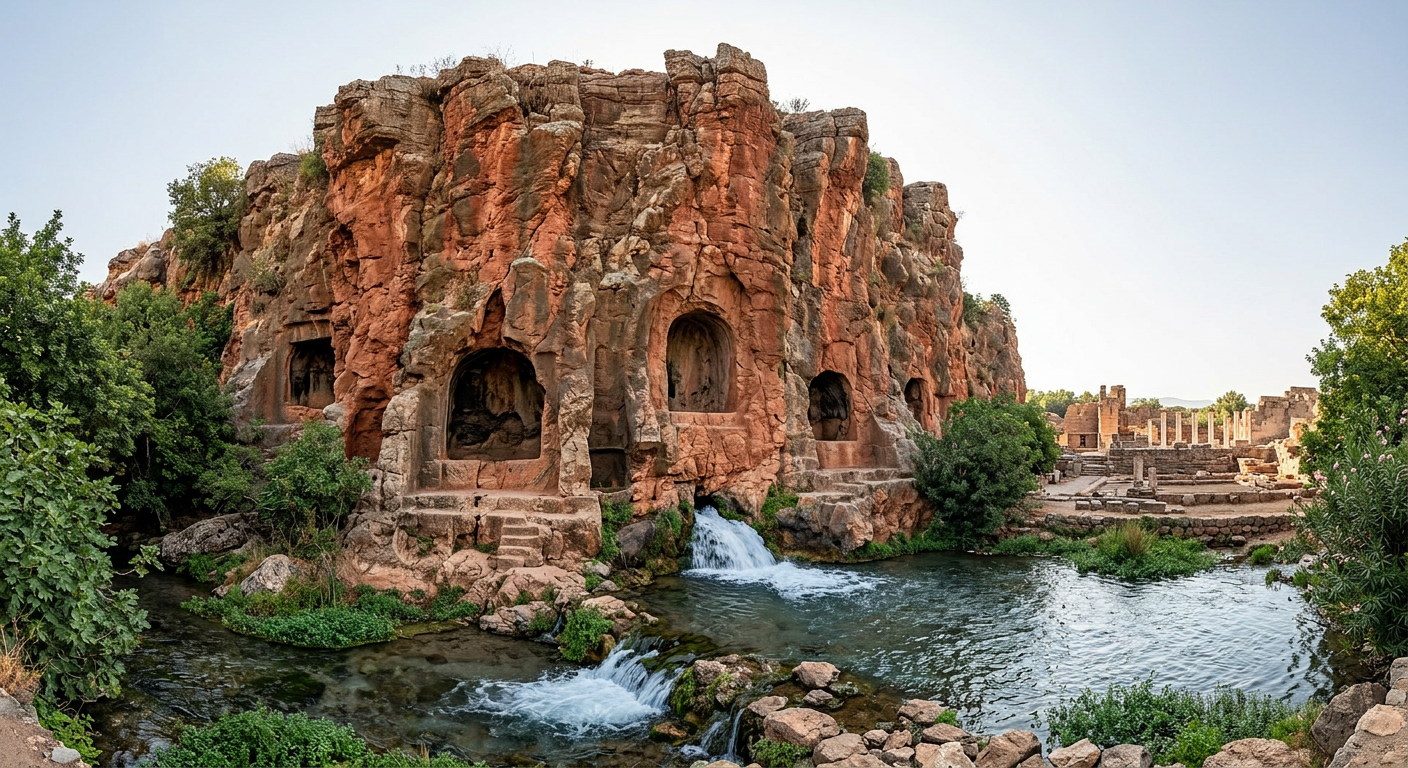
Jesus took the disciples to the far northern edge of the land, to the foot of Mount Hermon. Twenty-five miles north of the Sea of Galilee, in territory that had been pagan for centuries. The place was almost entirely Gentile. There was a massive cliff face there, riddled with niches carved into the stone that had once held idols of Pan and other Greek gods. At its base was a cave the locals believed reached down to the underworld. Spring water poured out of the cave. The ancient writer Eusebius reports that goats were thrown into the cave as offerings and never reappeared, which the locals took as proof that the cave reached all the way down.
And on top of all that, Herod’s son Philip had recently built a gleaming white marble temple to Caesar Augustus on the platform above the cliff. The imperial cult, the worship of Rome’s emperor as a divine son, planted on the very rock the locals called the mouth of hell. Pagan idolatry and Roman imperialism layered on top of one another at the worst religious address in the region.
That is where Jesus walked them. To the worst place on the map. And he asked them who they thought he was.
Peter answered. “You are the Christ, the Son of the living God” (Matthew 16:16, NKJV). Spoken in front of a row of dead gods carved into a cliff. Peter is not just confessing the deity of Jesus. He is contrasting Jesus with everything that cliff face stood for. The God in front of us is alive. The gods in the niches behind you are not.
Then Jesus answered. “On this rock I will build My church, and the gates of Hades shall not prevail against it” (Matthew 16:18, NKJV). He may well have gestured at the cliff while he said it. On this rock. He was standing in front of the rock everyone in the region thought belonged to death and to Caesar, and he claimed it for his church. He picked the worst possible address on the map to plant the church. The location was the sermon.
The garden named for being crushed
Walk south now to Gethsemane. The name itself is the lesson. Gethsemane comes from the Hebrew gat shemanim, oil press. The garden where Jesus prayed before the cross was an olive press.
A working olive press of the first century had three stages. The first pressing, under the lightest weight, produced the highest grade of oil. The second pressing produced everyday cooking oil. The third pressing, with the heaviest weight the press could deliver, ground the last drops out of the pulp. The third press was the crushing press.
That is where Jesus knelt. In a place named for being crushed.
Luke tells us his sweat became like great drops of blood falling down. The Greek word for drops there is thromboi, thick drops, clots. In a place named for the crushing that produces oil, the Lord sweats what the press produces. Oil in Scripture is the picture of the Holy Spirit. The Comforter you have felt in your worst pressed seasons was bought at the press. He went there before any of us did.
The wadi and the wise builder
Jesus closes the Sermon on the Mount with the two builders. We hear it as an abstract lesson about good and bad foundations. The crowd in front of him heard a specific landscape.
The Judean country is cut by riverbeds called wadis. In summer they are flat sandy bottoms baking in the sun, smooth and inviting. The kind of ground that looks like a perfect building site if you do not know. Then the winter rains come, and the wadi turns into a flash flood in a matter of minutes. Walls of water moving fast enough to roll boulders downstream.
Everyone in that crowd knew somebody who had built where the water plainly ran. The wise man and the foolish man both hear the same sermon. The difference is what they do with it. The wise man digs through the sand to the bedrock. The foolish man builds where the building is easy. The storm comes for both. The difference is which house is standing after.
The Lord still preaches with the ground
Place after place, the same thing. He walks his disciples to a cliff face dripping with demonic memory and claims that rock for his church. He kneels in a press to be pressed. He picks a flash-flood wadi as the picture of his closing warning. He drowns a Roman legion in symbolic flesh on the wrong side of the lake. He clears the one room in the temple the nations had been given. He builds his most cutting parable out of a road every hearer knew by name.
He is not picking sermon spots because they are convenient. He is preaching with the ground.
This matters for us in two directions.
It matters backward, into the text. You will not get the full weight of these sayings if you read them as if Jesus could have spoken them anywhere. The place is part of the saying. Get out a map. Open a study Bible. Find out what stood behind him while he talked. The setting is not extra credit. It is the lesson.
It matters forward, into your life. The Lord is still preaching with the ground. He still meets his people in particular places. The kitchen at three in the morning. The hospital hallway. The funeral home parking lot. The row of folding chairs in a circle. The seat where the bad news came. He has not abandoned located ground. He still chooses where he speaks and what he means by speaking there.
The places where you have heard him most clearly probably tell you what he was saying. Look at the location and ask what about the location was the point. He was not just there because that was where you were. He was there because the room had a sermon in it too.
This post is part of a series called Hidden in Plain Sight, on the sayings of Jesus that open up when you know the world they were spoken into.

Leave a Reply