
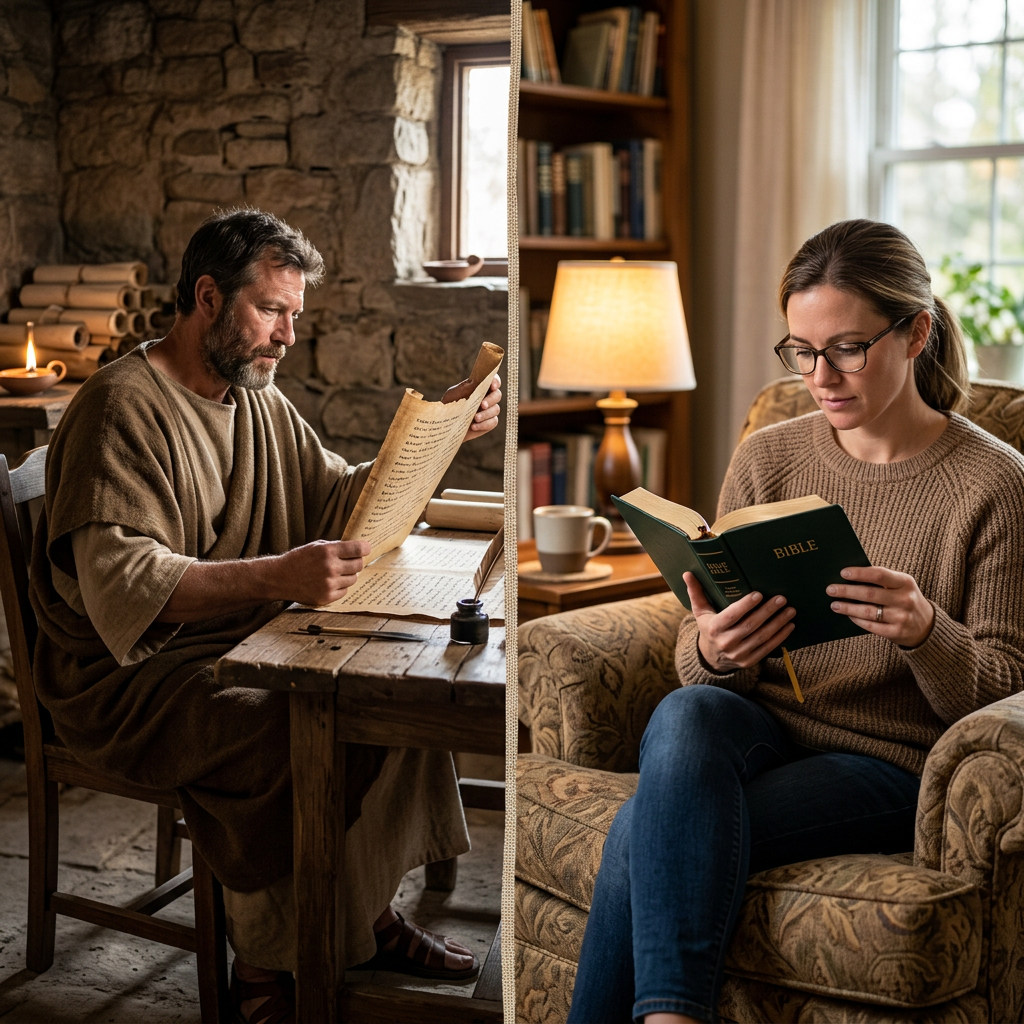
This is part five of Feed Yourself, a series on learning to study the Bible with your own two hands. We have spent three posts learning what the text meant to its first readers. Today we cross the bridge to what it means for us.
Here is the tension this whole series has been building. If Philippians was written to a Roman colony, and Jeremiah 29 to exiles in Babylon, and Revelation 3 to a city with bad plumbing, what is left for us? Is Bible study just archaeology now?
Readers tend to break two ways under that pressure. Some ignore context altogether and claim every promise on the page as a personal delivery, which is how Jeremiah 29:11 ended up on the graduation cards. Others quietly conclude the Bible is a museum, inspiring but sealed behind glass, and their reading dries up into duty. Both are wrong, and Paul refutes both in single sentences.
“For whatever things were written before were written for our learning, that we through the patience and comfort of the Scriptures might have hope.”
Romans 15:4 NKJV
“Now all these things happened to them as examples, and they were written for our admonition, upon whom the ends of the ages have come.”
1 Corinthians 10:11 NKJV
Notice what Paul is doing in both places. He is reading Israel’s Scriptures, texts written centuries before him to audiences long dead, and claiming them for the church at Rome and Corinth. Written to them. Written for us. Both true at once, and held together on purpose. The whole Old Testament was someone else’s mail, Paul says, and it was preserved by Jehovah with you in mind.
The Three-Step Bridge
So how do you get from their mail to your marching orders without cheating? You walk a bridge with three planks, in order.
First, what did it mean to them? This is everything from the last three posts. Whole book, first audience, cultural background. You are not allowed to skip this plank. Ever.
Second, what timeless truth is underneath it? Every specific instruction to a specific people rests on something permanent, about who Jehovah is, or what people are, or how the two relate. Dig under the instruction until you hit that bedrock.
Third, what does that truth demand in my circumstances? Now, and only now, you cross to today. The bedrock truth gets applied to your marriage, your workplace, your church, and because you crossed in order, what you land on carries the Bible’s authority and not just your own.
The order is the whole method. Application that skips the first two planks is not application. It is ventriloquism, making the Bible mouth thoughts we already had. And the sobering part is that ventriloquism can sound wonderfully spiritual while it does it.
Application that skips what the text meant to them is not application. It is ventriloquism, making the Bible mouth thoughts we already had.
Walking the Bridge Through a Meat Market
Let us walk it with a passage no one is tempted to put on a coffee mug. In 1 Corinthians 8, the church asks Paul whether Christians may eat meat that was sacrificed to idols. In Corinth, most meat in the market had passed through a pagan temple on its way to the butcher. Some believers, knowing an idol is nothing, ate freely. Others, saved out of those very temples, could not touch the stuff without their conscience screaming.
Plank one, what it meant to them. Paul sides with the knowledge, an idol is nothing in the world, and then refuses to let the knowledge settle it. “Knowledge puffs up, but love edifies” (1 Corinthians 8:1 NKJV). He tells the strong that their liberty is real and that love may set it down anyway, because a brother for whom Christ died matters more than a dinner. “Therefore, if food makes my brother stumble, I will never again eat meat, lest I make my brother stumble” (1 Corinthians 8:13 NKJV).
Plank two, the bedrock. Being right is not the highest good in the body of Christ. Love outranks liberty, and the strong bear the weight of that, not the weak. Knowledge that does not build anybody up is just swelling.
Plank three, our side of the river. Not one reader of this blog has agonized in a pagan meat market. Every reader of this blog has watched believers go to war over disputable things, drink or don’t, homeschool or don’t, this style of music, that view of the end times. The passage was never about the meat. It is Jehovah’s word on how the free hold their freedom around the tender, and it lands on about a hundred modern disputes without modification.
The Words Under the Passage
| Word | Original | Strong’s | Meaning |
|---|---|---|---|
| eidolothyton | εἰδωλόθυτον | G1494 | Things offered to idols. The specific, dated question the Corinthians asked |
| oikodomeo | οἰκοδομέω | G3618 | To build up, edify, as in constructing a house. What love does that knowledge alone cannot |
| typos | τύπος | G5179 | Example, pattern, imprint. 1 Corinthians 10:6. Israel’s history struck a die that still stamps true |
Guardrails for the Bridge
Two cautions will keep this tool honest. First, not everything crosses the bridge the same way. Commands tied to the old covenant reach us through Christ, who fulfilled that covenant, which is why we do not sacrifice lambs and why Hebrews spends thirteen chapters on the difference. When you bridge from the Old Testament, always ask how the cross stands between you and the text. Second, beware of bridges built to a predetermined destination. If your application always confirms what you already wanted, you are probably walking the planks backward. The text should regularly cost you something. When it never does, the ventriloquist is back.
For the Reader Behind the Glass
I said earlier that some believers quietly turn the Bible into a museum, and I want to end with you, because that quiet usually has a history. Somewhere along the line the promises got claimed and did not land, and it felt safer to stop expecting the Book to speak to you at all. Respectful distance. Glass between you and the page.
Romans 15:4 was written for you too. Whatever things were written before were written for our learning, that we through the patience and comfort of the Scriptures might have hope. Patience and comfort and hope, Paul says, from texts addressed to other people. That is Jehovah’s own stated purpose for preserving every page of it, and He did not preserve it to sit behind glass. Walk the bridge honestly and the Book will speak, not the way the greeting cards promised, but the way the exiles and the Corinthians found, which is truer and holds longer. There is no passage of Scripture, rightly crossed, with nothing on your side of the river.
Discussion Questions
- Which way do you naturally break under the tension, claiming everything or museum glass? What has that cost you?
- Walk the three planks through 1 Corinthians 8 in your own words. Where do modern believers most need its bedrock truth?
- Take one Old Testament command that clearly does not apply to you as written. Walk it across the bridge. What survives the crossing?
- When has the Bible genuinely cost you something in application? If you cannot remember a time, what might that mean?
- Read Romans 15:4 and 1 Corinthians 10:11 side by side. What do patience, comfort, hope, and admonition each look like when an ancient text delivers them today?
Going Deeper
Read 1 Corinthians 8-10 in one sitting, because Paul walks his own bridge across three chapters and lands it at 10:31, whatever you do, do all to the glory of God. Then try the bridge on Deuteronomy 22:8, the command to build a parapet around your roof. To them, for us, and you will find it preaches. Fee and Stuart’s How to Read the Bible for All Its Worth has strong chapters on exactly this problem, and J. Scott Duvall and J. Daniel Hays wrote a whole book on the method called Grasping God’s Word that walks the same bridge under a different name.

Leave a Reply