
Most study Bibles are built to answer one question. What does this verse mean? That is a good question, and I have spent more than thirty years asking it. But there is a second question most study Bibles never quite get around to, and it may be the more important one. Where does this verse sit in the whole story?


You can know a great many verses and still not know the story. I have taught faithful church people who could quote John 3:16 and Psalm 23 from memory and could not tell you what the tabernacle in Exodus has to do with John 1:14, where “the Word became flesh and dwelt among us.” The word John uses for “dwelt” is skēnoō (σκηνόω, G4637). It means to pitch a tent. To tabernacle. John wants you to hear Exodus in that sentence. Most readers never do, because nobody ever showed them how the pieces fit. They had a box full of puzzle pieces and no picture on the lid.
The NIV Biblical Theology Study Bible was built to give you the picture on the lid. It has earned a permanent place on my desk.
Jesus Taught This Way First
“Biblical theology” sounds like a seminary phrase, and it is. But the idea behind it is as old as the road to Emmaus.
On the afternoon of the resurrection, two disciples were walking the seven miles from Jerusalem to Emmaus with their hopes in the ground. “We were hoping that it was He who was going to redeem Israel,” they said (Luke 24:21). Jesus fell in beside them, and Luke tells us what He did with the rest of that walk.
“And beginning at Moses and all the Prophets, He expounded to them in all the Scriptures the things concerning Himself.”
Luke 24:27, NKJV
The Greek word behind “expounded” is diermēneuō (διερμηνεύω, G1329). It means to interpret thoroughly, to explain something all the way through. Jesus walked those two men through the whole thing, Moses to the Prophets, and showed them that every road ran to Him. That same night He did it again for the eleven, pointing them to everything “written in the Law of Moses and the Prophets and the Psalms concerning Me” (Luke 24:44).
That is biblical theology. Systematic theology asks what the whole Bible teaches about a subject and arranges the answers by topic. Biblical theology asks how a theme grows across time, book by book and covenant by covenant, until it comes to rest in Christ. D. A. Carson, the general editor of this Bible, says in his introduction that the aim is “to highlight the way various themes develop within the Bible across time.”
Both disciplines matter. But most of us were only ever handed the first one.
Where This Bible Came From
If this Bible looks familiar, there is a reason. It first came out in 2015 as the NIV Zondervan Study Bible. In 2018 Zondervan reset the whole thing in its Comfort Print typeface and gave it the name it carries now. In the process the book dropped 312 pages, half an inch of thickness, and half a pound of weight. According to Zondervan, not one of its 1.1 million words of notes and articles was cut.
So here is the first practical word. If you already own the NIV Zondervan Study Bible, you already own this content. The redesign is easier to read and easier to lift, but the notes are the same notes. Save your money or give the old one away.
The team behind it is serious. D. A. Carson, who taught New Testament for decades at Trinity Evangelical Divinity School, served as general editor. T. Desmond Alexander and Richard Hess served as associate editors on the Old Testament side, and Douglas Moo on the New. Andrew David Naselli managed the project as assistant editor, four years full-time and a fifth year part-time. More than sixty scholars wrote the notes and articles. These are people who have spent their lives in the text, and it shows on the page.
A Word About the Translation
Most of you know I teach from the NKJV. It is the text I have marked up and taught from for years, and it is the Bible open on the table every Friday night. So let me be plain. This is an NIV study Bible, and the text is the 2011 NIV.
The NIV sits near the middle of the translation spectrum. It is less literal than the NKJV or the NASB and more literal than the NLT. It reads cleanly. It is accurate enough to study from and smooth enough to read aloud to a room. It also made some choices you should know about going in. The 2011 revision often renders the Greek adelphoi (ἀδελφοί, G80) as “brothers and sisters” where the NKJV has “brethren.” Some readers welcome that and some do not. Either way, it helps to know which choices belong to the translators and which belong to the apostle.
Here is how I use it. My NKJV stays open, and this one sits open beside it. When the two read differently, I stop and ask why. That gap is often where the real study begins.
And if you would rather not keep two Bibles open, the same notes are available digitally through Bible Gateway Plus and in Logos, so you can read them next to whatever translation you prefer. One thing to watch if you go that route. The notes were written against the NIV wording, so now and then a note will comment on a phrase that reads differently in your Bible.
The Notes and the Book Introductions
There are about 20,000 notes in this Bible, and they fill a good share of nearly every page. You will find historical background, geography, the meaning of key words, and the kind of plain explanation that gets you unstuck on a hard verse.
What sets these notes apart is where they keep pointing. Again and again they pull back far enough to show you where the passage sits in the larger story, backward to where a theme began and forward to where it lands in Christ. You start reading the Bible the way Jesus read it on that road.
The book introductions deserve their own mention. Many of them run several pages. They cover the expected ground of author, date, setting, structure, and purpose. Then they go further and trace the book’s major theological themes and show how it connects to the rest of Scripture, especially to the New Testament. If you are about to start teaching through a book, read its introduction first. It will save you a week of groundwork.
One caution I would give about any study Bible. The notes are not Scripture. They are the best thinking of good scholars, and good scholars still disagree. On some debated passages these notes lay out more than one reading and leave the decision with you. Romans 7 is a good example, where the notes set out both major views of Paul’s struggle with sin. On other passages the notes take a side. When a note gives you pause, go back to the text and test it. Good notes start your thinking. They are not supposed to finish it.
The Articles in the Back
The back of this Bible holds what may be its best feature. Twenty-eight articles on biblical theology, each one taking a single theme and following it from Genesis to Revelation. Three introductory pieces set the table, including Tim Keller’s “The Story of the Bible” and two by Carson. Then twenty-five articles trace the major themes of Scripture one at a time. None of them is long. Most run a few pages. All of them are worth your time.
Here is the full list, so you can see the ground they cover.
| Article | Author |
|---|---|
| The Story of the Bible | Timothy Keller |
| The Bible and Theology | D. A. Carson |
| A Biblical-Theological Overview of the Bible | D. A. Carson |
| The Glory of God | James M. Hamilton Jr. |
| Creation | Henri Blocher |
| Sin | Kevin DeYoung |
| Covenant | Paul R. Williamson |
| Law | T. Desmond Alexander |
| Temple | T. Desmond Alexander |
| Priest | Dana M. Harris |
| Sacrifice | Jay A. Sklar |
| Exile and Exodus | Thomas R. Wood |
| The Kingdom of God | T. Desmond Alexander |
| Sonship | D. A. Carson |
| The City of God | T. Desmond Alexander |
| Prophets and Prophecy | Sam Storms |
| Death and Resurrection | Philip S. Johnston |
| People of God | Moisés Silva |
| Wisdom | Daniel J. Estes |
| Holiness | Andrew David Naselli |
| Justice | Brian S. Rosner |
| Wrath | Christopher W. Morgan |
| Love and Grace | Graham A. Cole |
| The Gospel | Greg D. Gilbert |
| Worship | David G. Peterson |
| Mission | Andreas J. Köstenberger |
| Shalom | Timothy Keller |
| The Consummation | Douglas J. Moo |
Try this. Read the article on the temple, and then sit down and read Genesis 2 and 3, Exodus 40, 1 Kings 8, John 2, 1 Corinthians 6, and Revelation 21 in one sitting. God walking in the garden in the cool of the day. The glory filling the tabernacle, and then filling Solomon’s temple. Jesus saying, “Destroy this temple, and in three days I will raise it up” (John 2:19). Paul telling believers their bodies are the temple of the Holy Spirit. And John looking at the New Jerusalem and seeing no temple in it at all, “for the Lord God Almighty and the Lamb are its temple” (Revelation 21:22).
You will not read those chapters the same way again. That is what these articles do. They train your eye to see the thread, so the next time it runs through a passage you can spot it on your own.
Maps, Charts, and Pictures
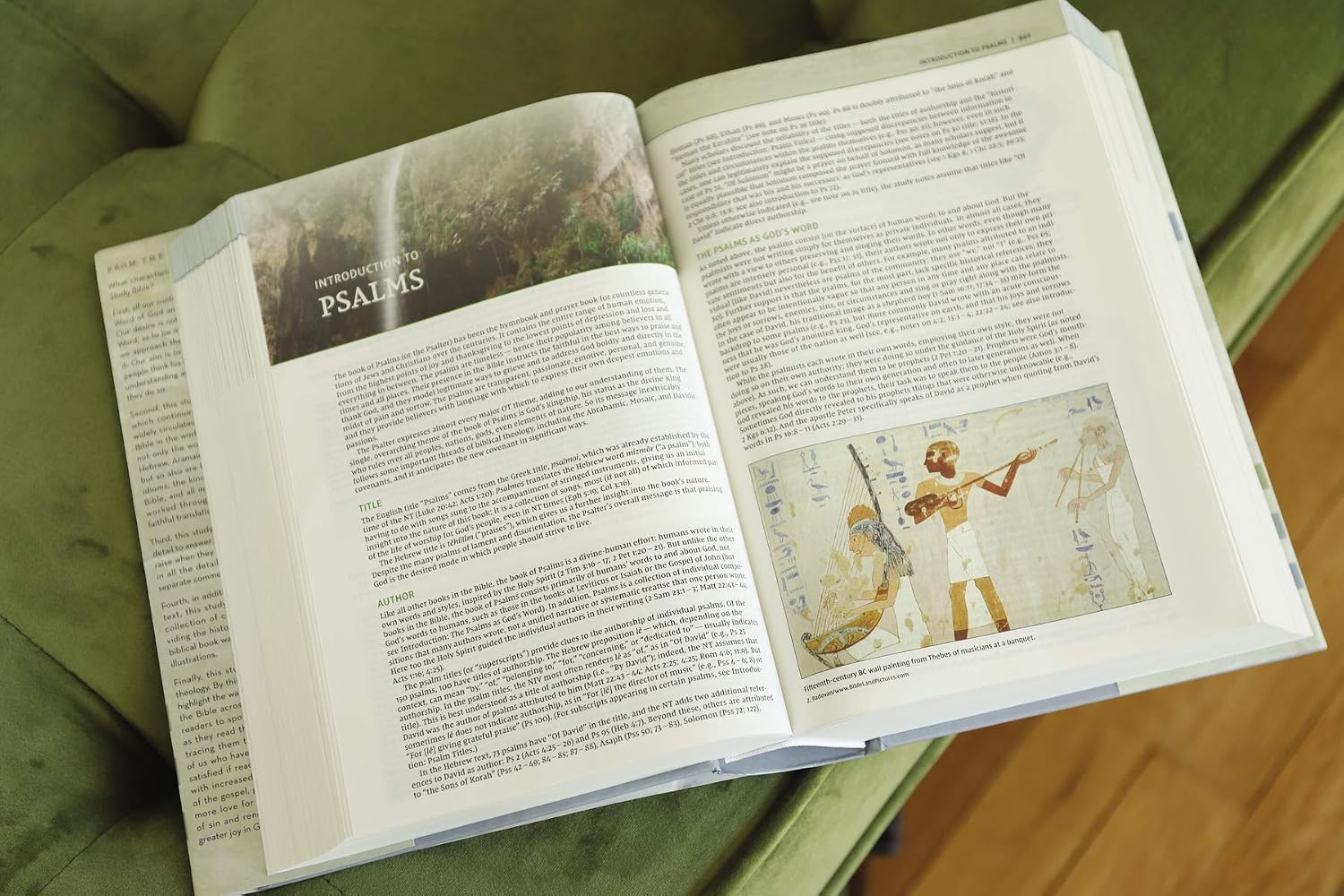
There are more than 90 maps, more than 60 charts, and hundreds of full-color photographs, and they sit inside the text where you need them instead of being banished to the back. When a passage puts you in a city you have never seen, or a building that has been rubble for two thousand years, there is usually a map or a picture close by. For a teacher, a good chart can carry half a lesson.
Cross-references run alongside the text, and there is a full concordance in the back.
The Physical Bible
This is the hardcover edition, and it is built for a desk. It runs more than 2,500 pages and measures roughly nine and a quarter by six and a quarter inches and close to two inches thick. You feel it when you pick it up. It will never ride along in your bag on a Tuesday. It will sit open on the kitchen table while you prepare, and that is where it belongs.
The Bible text is set in a single column of 9.1-point Comfort Print, and it reads well. The notes sit below the text in smaller type, and that small type is the most common complaint you will hear about this Bible. It is a fair complaint. If your eyes are tired, you will want good light.
It is a black-letter edition, so the words of Jesus are not printed in red. Two ribbon markers come with it, which is about the right number for anyone who reads in two places at once. And the paper is thin, as it has to be. There is no other way to fit 1.1 million words into a book a man can lift. Use a dry highlighter or a soft pencil, not a wet marker.
Where It Falls Short
No study Bible does everything, and this one has limits worth naming.
The weight and the small note type are the obvious ones. Nobody will mistake this for a carry Bible, and readers with tired eyes will feel the notes by the end of a long session.
It is NIV only. If you want a word-for-word text under your notes, you will need to pair it with one.
The contributors are solidly evangelical and lean Reformed, though the circle is a little wider than you will find in the ESV Study Bible. They are careful scholars, and on many debated questions they present the options fairly. But you will notice the leanings. On 1 Timothy 2, for instance, the notes lay out three readings and then come down on the traditional one. On Matthew 24, they tie much of verses 4 through 28 to the fall of Jerusalem in AD 70. You may land in the same place or you may not. Read with your Bible open and your discernment awake.
And it cannot replace a good commentary. No single volume can carry the whole canon. When a passage needs real digging, these notes will point you down the right road, and then you will need to keep walking.
Who This Bible Is For
If you teach, this is the study Bible I would put on your desk. Sunday school, small group, Friday night, or pulpit, it does not matter. The introductions alone will save you hours, and the articles will hand you the backbone of a teaching series you have not thought of yet.
If you have read the Bible for years in pieces, a chapter here and a verse there, and you have never quite seen how it hangs together, this Bible was built for you. It will show you the thread.
If you are a brand-new believer, I would start you somewhere lighter. The depth here is a gift, but it can bury someone who is still learning where to find Habakkuk. Grow into this one.
And if you want a strict word-for-word text with technical notes on the Hebrew and Greek, this is not that tool. Keep it beside your NKJV or your NASB and let each one do its own work.
A Pastoral Word
Those two disciples got the whole Old Testament on a country road, taught by the One it was written about. And when it was over and Jesus had vanished from their table, they turned to each other and said, “Did not our heart burn within us while He talked with us on the road, and while He opened the Scriptures to us?” (Luke 24:32).
The word for “opened” is dianoigō (διανοίγω, G1272). It means to open something completely, the way you would open a door that has been shut a long time. Luke uses it three times in that one chapter. Their eyes were opened (Luke 24:31). The Scriptures were opened (Luke 24:32). And their understanding was opened, “that they might comprehend the Scriptures” (Luke 24:45).
No study Bible can do what Jesus did on that road. Only He opens eyes. But a good study Bible can put you on the road and hand you a map, and this one does it as well as any I own. It keeps telling you that the Bible is one story, that the story has a center, and that the center has a name.
If you have been reading your Bible in scraps and wondering why it never quite comes together, pick up a thread. Start in Genesis with one of these articles open beside you. Follow one theme all the way through. Watch where it ends up.
It always ends up at the same Person.
Recommended.

Leave a Reply