
There is a sentence near the front of this Bible that every Bible reader ought to tape to the refrigerator. John Walton, who edited the Old Testament notes, puts it this way. The Bible was written for us, but it was not written to us.


Every book in your Bible was somebody else’s mail first. It went to exiles in Babylon, to shepherds and kings, to a handful of house churches in a Roman city. Those first readers knew things the authors never bothered to explain, because nobody explains what everybody in the room already knows. They knew what a threshing floor smelled like. They knew what it meant when a man took off his sandal at the city gate. They knew what a Roman legion could do to a village.
We do not know those things. So we read their mail with our own assumptions filling in the blanks, and sometimes we fill them in wrong.
I spent a whole post in the Feed Yourself series on this problem, using the lukewarm water of Laodicea as the example (What Everybody in the Room Already Knew). The hardest part of that tool is knowing where to find the background. The NIV Cultural Backgrounds Study Bible puts a large share of it on the same page as the verse. It lets you read over the first readers’ shoulder.
What This Bible Is Built to Do
Most study Bibles try to do everything. Theology, application, word meanings, history, devotional thoughts, all crowded into the bottom half of the page. This one does one job. Its notes stay with the culture, history, geography, and literature of the ancient world, and they leave the rest to you.
That narrow focus is the reason to own it. When you read a note in this Bible, you get the world the verse was written in. What a custom meant. What a place looked like. What the neighbors believed. What a word carried in its own time.
The two men behind it have spent their careers in that world. John H. Walton, longtime Old Testament professor at Wheaton College, edited the Old Testament. Craig S. Keener of Asbury Theological Seminary edited the New. Walton drew the Old Testament notes from the Zondervan Illustrated Bible Backgrounds Commentary, which he edited with a team of scholars. Keener has been doing this work on the New Testament for decades. His IVP Bible Background Commentary has sold more than half a million copies, and he has said he had collected 100,000 index cards of research before he ever moved his notes to a computer. That is the kind of homework sitting under these notes.
The Bible came out in 2016 and won the 2017 Christian Book Award for Bible of the Year from the Evangelical Christian Publishers Association.
A Word About the Translation
Most of you know I teach from the NKJV, and this is the NIV edition. The text is the 2011 NIV. It sits near the middle of the translation spectrum, less literal than the NKJV and more literal than the NLT. It reads cleanly and it is accurate enough to study from. My NKJV stays open beside it, and when the two read differently, I stop and ask why.
But here is good news for my NKJV readers. Zondervan released an NKJV Cultural Backgrounds Study Bible in 2017 with the same editors, the same 300-plus articles, and the same photographs and charts, paired with the New King James text. If the NKJV is your Bible, that edition may be the one for you. The notes and articles I describe below come with it.
And if you would rather keep your study in one place, the NIV edition’s notes are also available digitally through Bible Gateway Plus, where you can read them next to whatever translation you prefer.
The Notes
This is where the Bible earns its keep. Thousands of verse-by-verse notes, and nearly all of them answer the question an honest reader asks when the text gets strange.
Take Judges 1. Israel catches a Canaanite king named Adoni-Bezek “and cut off his thumbs and big toes” (Judges 1:6, NKJV). Most readers flinch and move on. But the old king explains himself in the next verse. He had done the same thing to seventy kings, and “as I have done, so God has repaid me” (Judges 1:7). In the ancient world, cutting off thumbs and big toes had a purpose. A man without thumbs cannot grip a sword or draw a bow. A man without big toes cannot keep his balance in a fight. It was a way of making sure a defeated warrior would never take the field again. The notes walk you through that, and suddenly the passage reads like history instead of a horror story.
Or take Mark 5. Jesus steps out of a boat onto Gentile ground and meets a man possessed by a whole crowd of demons. “What is your name?” Jesus asks. “My name is Legion; for we are many” (Mark 5:9). The word is legeōn (λεγεών, G3003), a Latin word borrowed into Greek, the name of a Roman army unit of several thousand soldiers. For a Jewish audience living under Roman occupation, that name carried the weight of an empire. The notes catch details like that, and you start to hear the story the way its first hearers heard it.
The book introductions are built the same way. They change shape depending on what kind of book you are reading, so a history book and a prophet get different treatment. Each one covers the date, the author, the historical setting, the literary form, the structure, and the key concepts a first reader would have carried into the book. If you are about to teach through a book, read its introduction before you read anything else.
The Articles and the Extras
There are more than 300 articles in this Bible, and they sit in the text right where the subject comes up. Before Isaiah, you get an introduction to the oracles of the prophets and a long piece on the historical background of the book. Leviticus comes with an article on the law codes of the ancient world. In the Psalms, a piece on the psalm titles. In the Gospels, a piece on crucifixion that you will not read quickly.
The front and back matter is useful too. There is a section on key Hebrew terms from the Old Testament, many of them words that have no exact equivalent in English, and a matching section on key New Testament terms. There is an Old Testament chronology and a section on the period between the Testaments, the four hundred years most church people skip straight over. The articles are indexed both by Bible book and alphabetically, so you can find one when you need it.
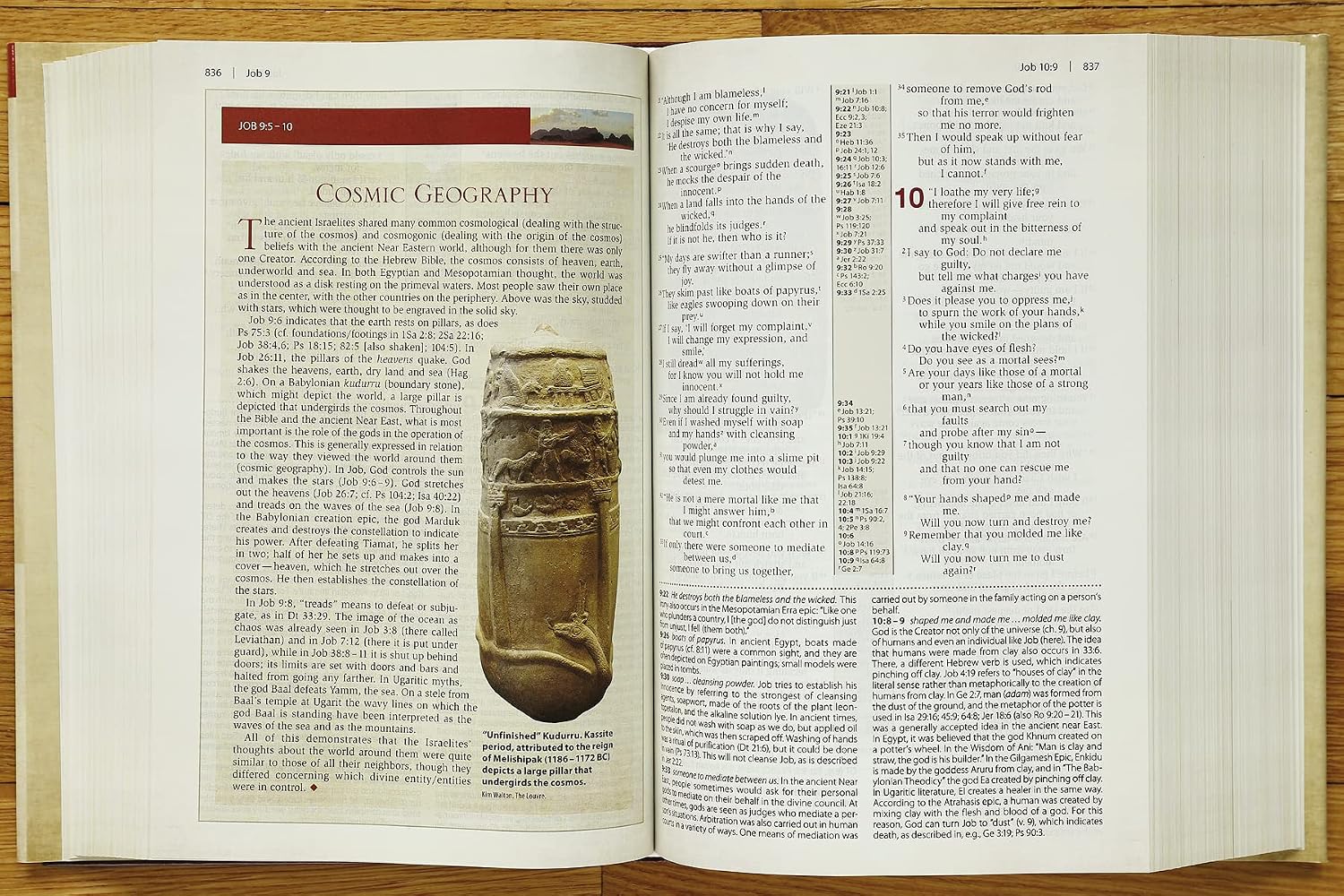
Then there are the pictures. There are 375 full-color photographs, illustrations, and images, plus charts, maps, and diagrams. These are working pictures. When Lamentations mourns that “young men ground at the millstones” (Lamentations 5:13), the page shows you an ancient Egyptian model of a servant grinding grain. You see the posture. You feel the ache in the back and the shoulders. The verse becomes a man on his knees at a stone.
The Physical Bible
This is the hardcover edition with a full-color dust jacket, and it is a desk Bible. It runs around 2,400 pages, weighs about four pounds, and measures roughly nine and a half by six and a half inches and better than two inches thick.
The text is set in two columns with the cross-references running down the center, the classic study Bible layout. The type is 8.9-point, and the notes below it are smaller still. That small type is the most common complaint about this Bible, and it is a fair one. Read it in good light.
It is a red-letter edition. The binding is sewn, so it opens and stays open on the table. The margins are narrow, so if you are a heavy note-taker, you will be writing in the white space at the top and bottom of the page. The paper is thin, as it has to be in a Bible this full. Use a dry highlighter or a soft pencil.
Where It Falls Short
The narrow focus that makes this Bible strong also sets its limits. It will tell you a great deal about the world of the text and very little about the theology of the text. That is a design choice, and a good one, but it means this should not be the only study Bible you own. Pair it with one built for theology, like the NIV Biblical Theology Study Bible, and you have the two halves of the job covered.
Some of the notes generalize. The ancient world was big and varied, and a few notes describe a custom as if everyone everywhere did it the same way. Reviewers at The Gospel Coalition pointed to a note on the destruction of enemy temples as one example, where the evidence is more mixed than the note suggests. Hold the notes loosely when they speak in sweeping terms.
The same reviewers noticed that the Old Testament notes are condensed from the Zondervan backgrounds commentary without crediting the individual scholars who wrote the original entries. That does not make the notes less useful. But if a note catches your attention, it is worth tracking down the full commentary. There is usually more there.
And there is a caution I give with any background resource, including my own posts. Background illuminates the text. It never overturns it. If a piece of history makes a passage mean the opposite of what it plainly says, the history is doing too much work. To its credit, this Bible mostly knows its place. It gives you the world of the text and then gets out of the way.
Who This Bible Is For
If you teach, put this one on your desk. Sunday school, small group, Friday night, or pulpit, the background notes will answer the questions your class is going to ask before they ask them.
If you have read the Bible for years and keep running into customs, places, and practices that make no sense to you, this Bible was built for that exact frustration.
If you are working through the Feed Yourself series, this Bible is built for part three, asking who a book was written to (This Letter Has Someone Else’s Name on It), and part four, recovering what the first readers already knew.
If you want a study Bible that tells you what to believe and how to apply it, this is the wrong tool. Pick up a theology-focused study Bible and keep this one beside it.
A Pastoral Word
Here is why all this matters, and it is bigger than trivia.
“God, who at various times and in various ways spoke in time past to the fathers by the prophets, has in these last days spoken to us by His Son.”
Hebrews 1:1-2, NKJV
The phrase “at various times and in various ways” is two Greek words, polymerōs (πολυμερῶς, G4181) and polytropōs (πολυτρόπως, G4187). The first means in many portions, piece by piece. The second means in many manners. God did not drop a finished book out of the sky in a language nobody spoke. He spoke in pieces, over centuries, through real people standing in real places, in the languages and customs of the people He was talking to.
And when He spoke His final Word, He did the same thing. “When the fullness of the time had come, God sent forth His Son, born of a woman, born under the law” (Galatians 4:4). Jesus was born at a particular time, in a particular town, under a particular empire. He held up a coin stamped with Caesar’s face and asked whose image it bore. He ate with tax collectors the whole town despised. He died on a Roman cross.
When you take the trouble to learn that world, you are honoring the way God chose to speak. He came near enough to be misunderstood. The least we can do is take the trouble to understand Him.
So read their mail. Read it slowly, with this Bible open, and let the first readers teach you what they already knew. You will find that the God who spoke to them in their world has not stopped speaking in yours.
Recommended.

Leave a Reply