
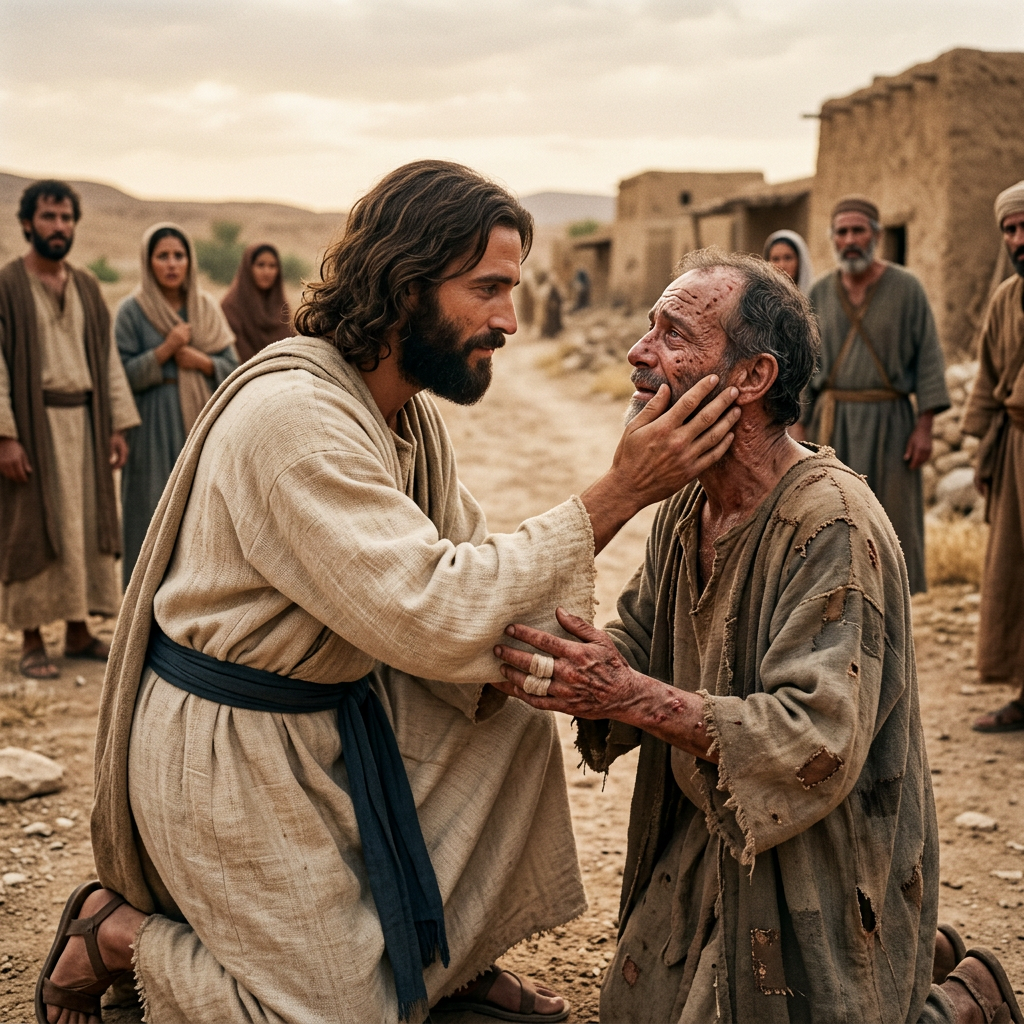
We started this series with a word. Skandalon, the stumbling block, the thing set in the road that trips a walking man. Jesus was that stone under the feet of the most devout men of his day. Not because he was careless with holiness, but because he kept holding it in a way they had never seen a holy man hold it. He handled it like fire that spreads instead of a candle that has to be guarded from the wind. And nowhere is that clearer than the day he reached out his hand and touched a leper.
Read Mark 1 slowly. A man comes to Jesus, kneeling, and says, “If You are willing, You can make me clean” (Mark 1:40). Mark tells us Jesus was moved with compassion, and then comes the line that should stop us cold. “Then Jesus, moved with compassion, stretched out His hand and touched him” (Mark 1:41).
Touched him.
Every person in that crowd knew what that meant. Under the law this man was a walking quarantine. He tore his clothes, left his hair unkempt, covered his lip, and cried “Unclean! Unclean!” wherever he went (Leviticus 13:45). He lived outside the camp, outside the town, outside the reach of anyone who wanted to stay right with God. You did not touch a leper. A leper touched you, and now you were the one carrying death home to your family.
Jesus stretched out his hand first. Before the healing, before the word, there was the hand on skin that no clean person had touched in years.
Why the devout read it as heresy
To understand the offense, you have to sit inside Leviticus 13 through 15, three chapters most of us skip. They are not cruel chapters. They are a careful map of how uncleanness moves. And the whole logic runs one direction. Uncleanness is contagious and holiness is fragile. The unclean thing defiles the clean thing on contact, never the other way around. Touch a leper and you are unclean until evening, and sometimes far longer. Touch a woman during her flow of blood and you are unclean. Touch a corpse and you are unclean. The current always ran from the defiled to the pure, and the pure could only lose.
So when Jesus laid his hand on that man, a teacher of the law watching from the edge of the crowd did not see mercy. He saw a rabbi commit a defiling act on purpose. He saw a man who claimed to speak for God treating the holiness code of Sinai as if it did not bind him. Worse than that, he saw a man who acted as though holiness were the contagious thing, spreading from Jesus into the leper, cleansing what it touched.
Look at what Mark actually says happened. “As soon as He had spoken, immediately the leprosy left him, and he was cleansed” (Mark 1:42). The current reversed. Nothing dirty flowed into Jesus. Something clean flowed out of him. That is not how the world was supposed to work. That is the scandal.
Now put Mark 5 beside it. A woman with a twelve-year flow of blood, which under Leviticus 15 made her and everything she touched unclean, pushes through the crowd and touches the hem of his garment. By the law she has just defiled the Messiah in public. And Jesus, feeling power go out from him, does not recoil. He turns and calls her Daughter and tells her that her faith has made her well (Mark 5:34). Again the current runs backward. Twelve years of uncleanness meets him, and it is the uncleanness that loses.
The word underneath it
The word that keeps surfacing in these stories is worth setting on the table.
| Greek | Transliteration | Strong’s | Meaning |
|---|---|---|---|
| καθαρίζω | katharizo | G2511 | to make clean, to cleanse, to purge, to pronounce clean |
Katharizo is the word the leper uses and the word Mark uses for what happens. “You can make me clean.” “He was cleansed.” It is the root behind our word catharsis, and behind the beatitude, “Blessed are the katharoi, the pure in heart” (Matthew 5:8). It carries both meanings at once, the ceremonial and the moral, the outward and the inward. To be katharizo-ed is to be scrubbed of the thing that kept you outside the camp and outside the presence of God.
Here is what matters. In the Septuagint, the Greek Old Testament those first readers knew, katharizo is the priest’s word. Leviticus 13 uses it over and over for the moment the priest examines the skin and declares the person clean. The priest never made anyone clean. He only inspected and announced what was already true. But in Mark, Jesus does not inspect and announce. He reaches out and makes it so. He does the thing only God was ever said to do, and he does it through the one channel the law swore could only carry defilement. Touch.
The mirror
Now turn the mirror around, and be honest about where the “we” points. It points at us.
The church has settled into a rut here, and it is a comfortable one, because it feels like reverence. We have quietly decided that some people are too messy to be touched. Not in words. We would never say it in words. But watch where the church actually puts its hands. We are glad to fund the shelter downtown and slower to sit at the table with the man who smells like the shelter. We will pray for the addict from the platform and cross the parking lot to avoid him at the door. We have built rooms so clean that the very people Jesus went looking for would not know how to walk into them, and if they did, they would feel us leaning back.
We have inherited the priest’s instinct without the Savior’s hand. We inspect. We announce who is in and who is still out. We keep our distance and we call it holiness. But we are afraid. Afraid that if we touch the unclean thing, the current will run the old direction and we will be the ones defiled. We protect our cleanness like a candle in the wind.
But that is exactly the fear Jesus walked straight into and broke. His holiness was not a candle. It was a fire.
The invitation
So here is the turn, and it is a warm one. If you belong to Jesus, the current has already reversed in you. You are not the leper anymore, kept outside the camp, and you are not the priest, guarding a purity that could shatter. You are someone the untouchable God reached out and touched, and what flowed into you was not defilement but life. “Now you are clean,” Jesus told his men, “katharoi, because of the word which I have spoken to you” (John 15:3).
A clean person does not have to keep his distance. That is the whole freedom of it. When Christ made you clean he did not make you fragile, he made you a carrier. The same holiness that flowed out of him toward a leper’s rotting skin now lives in you by his Spirit, and it does not run out when you spend it on messy people. It runs toward them.
So go touch what the church has decided is untouchable. Sit at the table. Learn the name of the man at the door. Put your hand, literally, on the shoulder of the person everyone else leans away from. You are not risking your cleanness. You are carrying it. And you carry it because a Man once stretched out his hand toward the worst of what sin does to a body, and the disease is what died.
That is the scandal this church needs. Not less holiness. Holiness that finally learned to spread.
This Church Needs a Scandal — the series
Part 2 of 8. ← Previous: This Church Needs a Scandal · Next: Who Do You Think You Are? →
Read the whole series: This Church Needs a Scandal.

Leave a Reply