


Sooner or later every serious Bible reader runs into the same surprise. The Bible is not in chronological order.
It is a library, and it is shelved by kind, not by date. The books of law sit together. Then the histories. Then the poetry. Then the prophets. So the prophets who preached during the days of the kings are stacked at the back of the Old Testament, hundreds of pages away from the kings they preached to. David’s psalms sit far from the stories of the caves and battlefields that produced them. Chronicles tells much of the story of Samuel and Kings a second time. And Paul’s letters come after the book of Acts, even though he wrote many of them during the very years Acts describes.
None of that is a mistake. The shelving has its own wisdom. But it does mean that most Christians carry the pieces of the story in their heads without ever seeing them laid end to end.
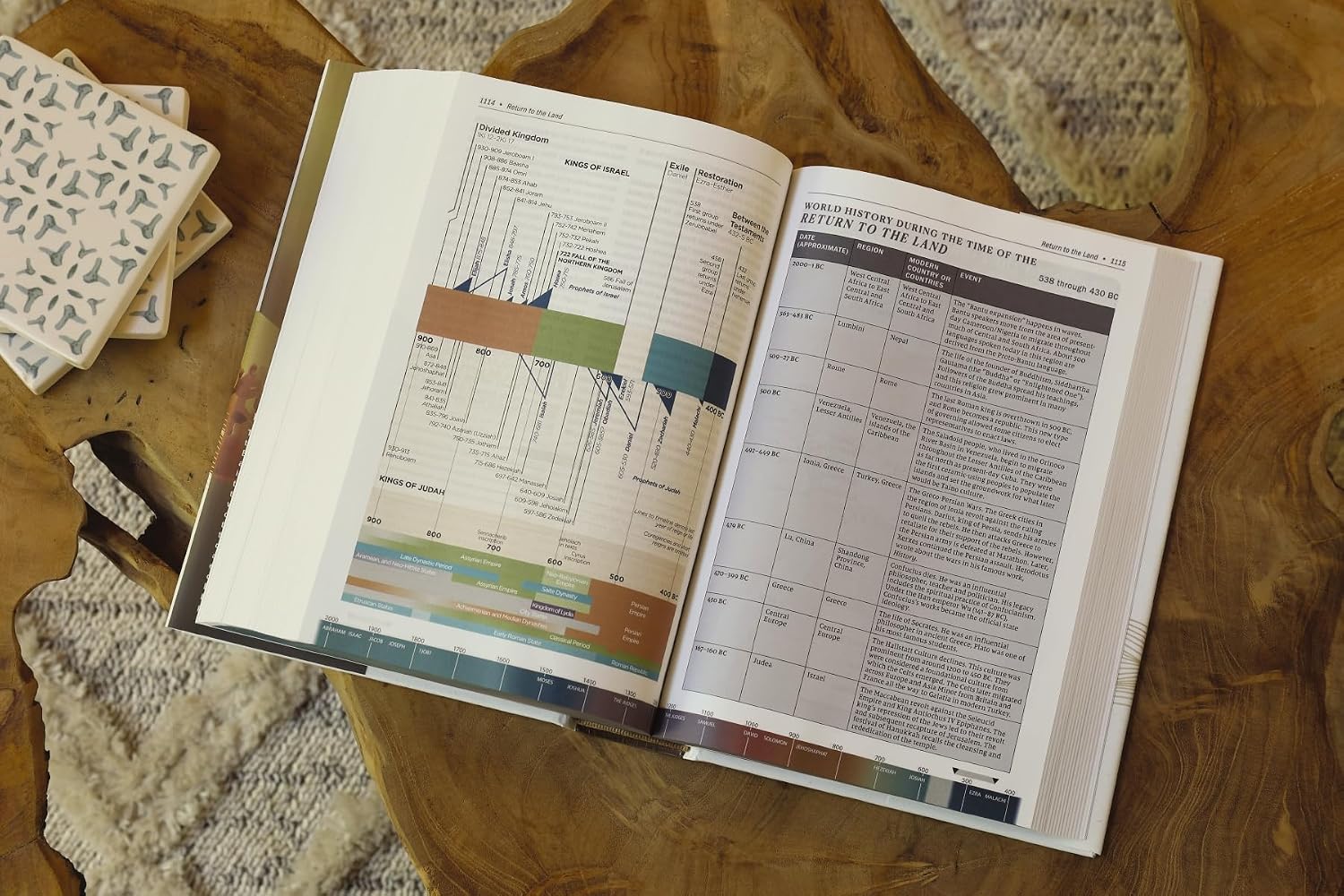
The NIV Timeline Bible takes every book off the shelf and lays it out on one long table, in the order it happened.
An Orderly Account
Luke opens his Gospel by telling Theophilus why he wrote it.
“It seemed good to me also, having had perfect understanding of all things from the very first, to write to you an orderly account, most excellent Theophilus.”
Luke 1:3, NKJV
The word behind “orderly account” is kathexēs (καθεξῆς, G2517). It means in order, one thing after another, in sequence. Luke uses it to tell Theophilus that he set the stories in order so they would make sense together.
Orderly does not always mean strictly chronological. Luke sometimes arranges by theme. But the instinct behind the word is the instinct behind this Bible. Things make more sense when you can see what came first and what came next.
Where It Came From
The name on this Bible is John R. Kohlenberger III, and if you have ever used an NIV concordance, you have used his work. He spent seven years with Edward Goodrick building the NIV Exhaustive Concordance. He produced interlinears and concordances for Hebrew and Greek readers who never went to seminary. When he died in 2015, Stan Gundry of Zondervan put it this way. What James Strong was to the KJV, John Kohlenberger was to the NIV.
Kohlenberger also built a chronological arrangement of the whole NIV years ago, the NIV Integrated Study Bible, with Scripture set in sequence and parallel accounts side by side. The Timeline Bible, released in December 2025, carries his name as editor and brings that kind of arrangement into a new full-color design with Zondervan’s Comfort Print typeface.
How It Works
The Bible is divided into six eras, from creation to the early church. Each era opens with an introduction that sets out the chronology, an outline of what was happening in the wider world at the time, maps, and timelines.
Inside each era, Scripture runs in the order the events happened. When the Bible tells the same story more than once, the accounts sit side by side in columns. Kings and Chronicles run together. The Gospels line up across the page. When Jesus feeds the five thousand, the only miracle of His ministry recorded in all four Gospels, you can read Matthew, Mark, Luke, and John at once and watch what each writer chose to tell.
A psalm can sit beside the story that produced it. Psalm 142 carries the title “A Contemplation of David. A Prayer when he was in the cave.” In Kohlenberger’s arrangement, that prayer stands right next to 1 Samuel 22, where David hides in the cave of Adullam with a band of debtors and malcontents. You read the event and then you hear what David prayed in the dark.
Two more features hold it together. The passages are color coded by genre, so you can tell at a glance what kind of writing you are reading. And a timeline runs along the bottom of every page, so you always know where you are in the long story.
There is something about seeing the columns that teaches you. In a blended harmony, someone takes four Gospels and stitches them into one story, and the seams disappear. Here the columns keep every writer’s words intact. Matthew still sounds like Matthew. John still sounds like John. You get the order without losing the voices.
A Word About the Translation
Most of you know I teach from the NKJV, and this is the NIV. The NIV sits near the middle of the translation spectrum, less literal than the NKJV and more literal than the NLT. It reads cleanly, and for a Bible meant to be read in long stretches, that is a strength. When a passage makes me stop, my NKJV is right there to check it against.
There is no NKJV edition of the Timeline Bible. But if you want a more word-for-word text, Zondervan has an NASB 1995 edition of the Timeline Bible listed for release in November 2026.
What It Is Not
This is a reading Bible, not a study Bible. There are no verse-by-verse notes at the bottom of the page. The teaching lives in the arrangement itself, the section introductions, the maps, and the timelines. If you want notes, keep a study Bible beside it. The NIV Study Bible, the NIV Biblical Theology Study Bible, or the NIV Cultural Backgrounds Study Bible would each pair well.
And every chronological Bible makes judgment calls. Scholars still debate the date of the exodus, when Job lived, where certain psalms belong, and the order of some of Paul’s letters. Kohlenberger was a careful man, and his choices are well reasoned. But they are an informed proposal, not a revelation. Where a date or a placement is disputed, hold it loosely.
One more thing. The usual order of the books is not an accident to be corrected. God’s people arranged them the way they did for reasons, and some of those reasons are theological. Reading the Bible chronologically is a second way to read it, a very good one. It does not replace the first.
The Physical Bible
The hardcover runs a little over 1,600 pages and measures about nine and a quarter by six and a quarter inches and a bit under two inches thick. It weighs about three pounds. The binding is made to lie flat when open, which matters in a Bible with this many columns. The text is 9-point Comfort Print with the words of Jesus in red, and the whole interior is in full color. There is also a brown Leathersoft edition if you want something softer in the hand.
Two practical notes. When four Gospels share a page, the columns run narrow and the lines run short, so the Gospel sections read a little more slowly than the rest. And because the books are broken up and rearranged, finding a particular verse quickly during a Sunday sermon takes some getting used to. This is a Bible for reading straight through.
Who This Bible Is For
If you have read the Bible cover to cover the usual way and want your next pass to show you something new, this is the Bible for it. You will see how the pieces fit in a way the canonical order does not show you.
If you have never been able to keep the kings and the prophets straight, or never quite understood which prophet was preaching to which king, this Bible will untangle it for you.
If you teach a Bible survey, the section introductions and the timeline across the bottom of the page give you the skeleton of the whole course.
And if you want one Bible that explains every hard verse, this is not that Bible. Pair it with a good study Bible and let each one do its job.
A Pastoral Word
Spend a few weeks with the timeline at the bottom of these pages and something sinks in. Kings rise and fall. Empires come and go. Assyria, Babylon, Persia, Greece, Rome. Each one looked permanent in its day. Each one is a few inches of timeline now.
And running through all of it is the steady hand of God.
“My times are in Your hand; Deliver me from the hand of my enemies, And from those who persecute me.”
Psalm 31:15, NKJV
The word for “times” is ‘eth (עֵת, H6256). It means a time, a season, the right moment for a thing. It is the same word Solomon uses over and over in Ecclesiastes 3. A time to be born, and a time to die. A time to weep, and a time to laugh. David prayed Psalm 31 under pressure, and he did not ask God to explain the calendar. He put the whole calendar in God’s hand.
Your life has a timeline too. Some seasons you would never have chosen. Some you would give anything to have back. The God who held Babylon and Rome in His hand holds yours, and He has not lost track of a single day of it.
So read the story the way it happened. Watch the centuries turn under God’s hand. And then put your own times in the same place David put his.
Recommended.

Leave a Reply