A quick word before we start. The Amazon links below are affiliate links. If you buy through them, I earn a small commission at no extra cost to you. As an Amazon Associate I earn from qualifying purchases.


Recently I told you that the CSB is joining the NKJV in my teaching. The NKJV stays at the center, and the CSB now stands beside it in the blog posts, the study guides, and on Friday nights.
A translation you teach from needs a study Bible behind it. When I’m preparing a lesson and a verse raises a question, I want the answer on the same page, not in a book across the room. For the CSB, the obvious place to start is the CSB Study Bible, Holman’s flagship. In my review of the CSB Ancient Faith Study Bible I told you to keep a standard study Bible close by. This is the one I’d point you to.
Where It Came From
This study Bible has a longer history than the translation it carries. It began as the HCSB Study Bible in 2010, edited by Jeremy Royal Howard and Edwin Blum, with notes from more than a hundred scholars. It won the Evangelical Christian Publishers Association’s Christian Book Award for Bibles in 2011. When Holman revised the Holman Christian Standard Bible into the CSB in 2017, the study Bible came along and was revised to match.
The original team started with focus groups and asked readers what they wanted from a study Bible. The answer they kept hearing was simple. Put the help on the same page as the text. That decision still shapes every page of this Bible.
What You Get
| Feature | Details |
|---|---|
| Translation | Christian Standard Bible (CSB) |
| Study notes | More than 16,000 |
| Word studies | 368, on key Hebrew and Greek words |
| Articles | 34 |
| Visuals | 114 photographs, 42 paintings, 24 illustrations and reconstructions |
| Reference tools | 60 timelines, 55 maps, 19 charts |
| Book introductions | With outlines and timelines for each book |
| Layout | Two columns of text, center-column cross-references, three columns of notes, words of Christ in red |
| Other helps | Topical subject headings, concordance, presentation page |
| Type | 9.5-point Bible Serif |
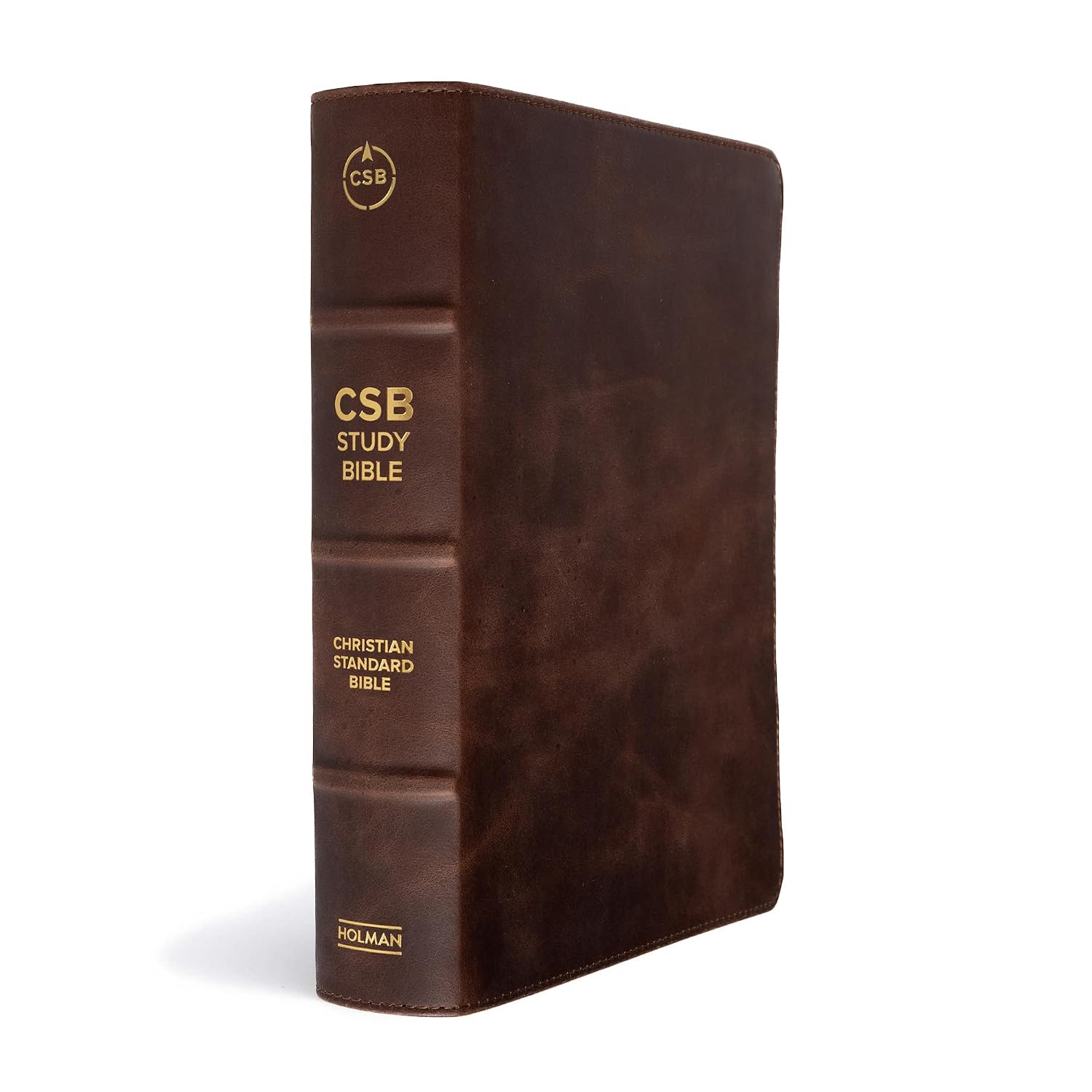
| This edition | Brown genuine leather, thumb-indexed, Smyth-sewn, 2,208 pages, list price $104.99 |
Everything on the Same Page
The Scripture runs in two columns across the top. Cross-references sit in a narrow column between them. The notes run in three columns across the bottom of the page, and the word studies, photographs, maps, and timelines sit beside the passages they explain. You almost never have to flip to the back of the book.
The notes are short and to the point. Take Mark 1:44, where Jesus heals a man with leprosy and sends him to show himself to the priest. Why the priest? The note explains that the man’s healed body would serve as the proof, standing in for any testimony he could give about what happened. That is the kind of question a careful reader asks and most of us never get answered.
Or take Philippians 4. In my last post on translations I used Philippians 4:6 to show how the CSB puts “be anxious” into plain words, “Don’t worry about anything.” The study note on that passage boils the whole teaching down to six words. “Prayer is the antidote for worry.”
The Word Studies
For anyone who loves a good word study, this is the best part of the book.
There are 368 word studies scattered through the Bible, each one set beside a passage where the word matters. Each gives you the Hebrew or Greek word, its meaning and background, how it is used across Scripture, and how many times it appears in that book and in its Testament. When you come to a word that carries the weight of a passage, the study is usually right there.
Take a word study as a starting place. It tells you where to dig. Then do what I’ve been urging all through the Feed Yourself series. Run the word through a concordance, read the other places it appears, and see how the writer uses it for yourself. The study Bible gives you a head start. It shouldn’t do all the walking for you.
A Baptist Accent
Every study Bible has a theological home, and this one lives at Lifeway. Holman is the Bible imprint of B&H Publishing, which is part of Lifeway, an entity of the Southern Baptist Convention. When the HCSB Study Bible came out, Jeremy Howard said its notes drew on scholars from a range of backgrounds and stayed within the Baptist Faith and Message.
So on questions where Christians land in different places, expect these notes to land near Baptist convictions. That is no knock on the book. The NIV Study Bible, the ESV Study Bible, and the Orthodox Study Bible all have homes of their own. You just want to know which house you’re standing in when you read the notes.
A Word About the Translation
I made my case for the CSB in that post on the change, so I won’t repeat it here. The CSB says plainly what the NKJV says closely, and the two together show you more of the text than either one alone. The CSB Study Bible is red-letter, so the words of Christ are printed in red.
The Physical Bible
This edition is bound in brown genuine leather, with thumb-index tabs cut into the page edge. The binding is Smyth-sewn, so the book lies flat from the first page to the last. The page edges are gilded, and there is a ribbon marker.
The text is set in Bible Serif, a typeface the Danish design firm 2K/DENMARK created for CSB Bibles. At 9.5 points it is comfortable for most eyes, and the notes are set smaller.
It is a big book. The page is about six and three-quarter by nine and a quarter inches, it runs 2,208 pages, and it weighs about four pounds. This is a desk Bible. Holman lists this edition at $104.99, and retailers usually sell it for less. If that is more than you want to spend, the same Bible comes in hardcover, cloth over board, and LeatherTouch, and there are large print and personal size editions too.
A Note
The size cuts both ways. All that help on the same page makes for a heavy book, and you won’t carry this one to a coffee shop. The personal size edition fixes that, at the cost of smaller type.
The type itself may be too small for some readers. If you already reach for reading glasses, look at the large print edition before you buy this one.
And a study note is a short thing. Sixteen thousand of them spread across sixty-six books means most get a sentence or two. For a hard passage you’ll want a full commentary. B&H’s own New American Commentary series is a natural next step from this Bible.
Who This Bible Is For
If you’ve taken my advice and opened a CSB beside your own Bible, this is the study Bible to go with it.
If you teach, the same-page design will save you time every week. The question you have about a verse is usually answered within a few inches of it.
If you want one study Bible that covers the basics well, with background, word studies, maps, and timelines, this one does all of it.
If you want the early church in the margins, look at the Ancient Faith Study Bible instead, and keep this one for everything else.
A Pastoral Word
On the afternoon of the resurrection, two disciples were walking home to Emmaus when a stranger fell in step with them. Luke tells what He did along the road.
“And beginning at Moses and all the Prophets, He expounded to them in all the Scriptures the things concerning Himself.”
Luke 24:27, NKJV
“Then beginning with Moses and all the Prophets, he interpreted for them the things concerning himself in all the Scriptures.”
Luke 24:27, CSB
The NKJV says Jesus “expounded.” The CSB says He “interpreted.” The Greek word is diermēneuō (διερμηνεύω, G1329), to explain fully, even to translate from one language into another. Luke uses it in Acts 9:36 when he translates the name Tabitha into Greek. Our word hermeneutics, the study of how to interpret Scripture, comes from the same family.
Then, after Jesus vanished from the table, the two men said to each other, “Did not our heart burn within us while He talked with us on the road, and while He opened the Scriptures to us?” (Luke 24:32, NKJV). The CSB says He was “explaining the Scriptures to us.”
“Opened” is dianoigō (διανοίγω, G1272), to open completely. Luke uses it three times in this one chapter. Their eyes were opened, and they knew Him (v. 31). He opened the Scriptures (v. 32). And later that night, in Jerusalem, “He opened their understanding, that they might comprehend the Scriptures” (v. 45, NKJV).
A study Bible can help with the explaining. It can tell you what a Hebrew word means, where a town stood, and why a man with leprosy had to go see a priest. Sixteen thousand notes is a great deal of help, and I’m grateful for it. But only the risen Christ opens the eyes and the understanding.
So pray before you read. Ask Him to do for you what He did on the Emmaus road. Then read the text first and the notes second. Those two men got up that same hour and walked back to Jerusalem with burning hearts, because the Lord Himself had opened the Book to them.
Recommended.

Leave a Reply