A quick word before we start. The Amazon links below are affiliate links. If you buy through them, I earn a small commission at no extra cost to you. As an Amazon Associate I earn from qualifying purchases.


Most study Bibles give you notes written by scholars who are still living. Some of them are still teaching. The CSB Ancient Faith Study Bible gives the bottom of the page to men who have been dead for more than fifteen hundred years.
Irenaeus, bishop of Lyon, wrote that as a boy he sat and listened to Polycarp, and Polycarp had been taught by the apostle John. That is how close some of these voices stand to the New Testament. Most of us have met Justin Martyr, Athanasius, John Chrysostom, and Augustine only in a church history lecture or a line in someone else’s book. This Bible lets you hear them talk about the passage in front of you.
I recently reviewed the CSB I read from every day, and before that the Orthodox Study Bible, which also puts the early church in its notes. The Ancient Faith Study Bible sits right where those two meet. It’s the translation I love to read, with the church fathers underneath it, from an evangelical publisher.
What This Bible Is
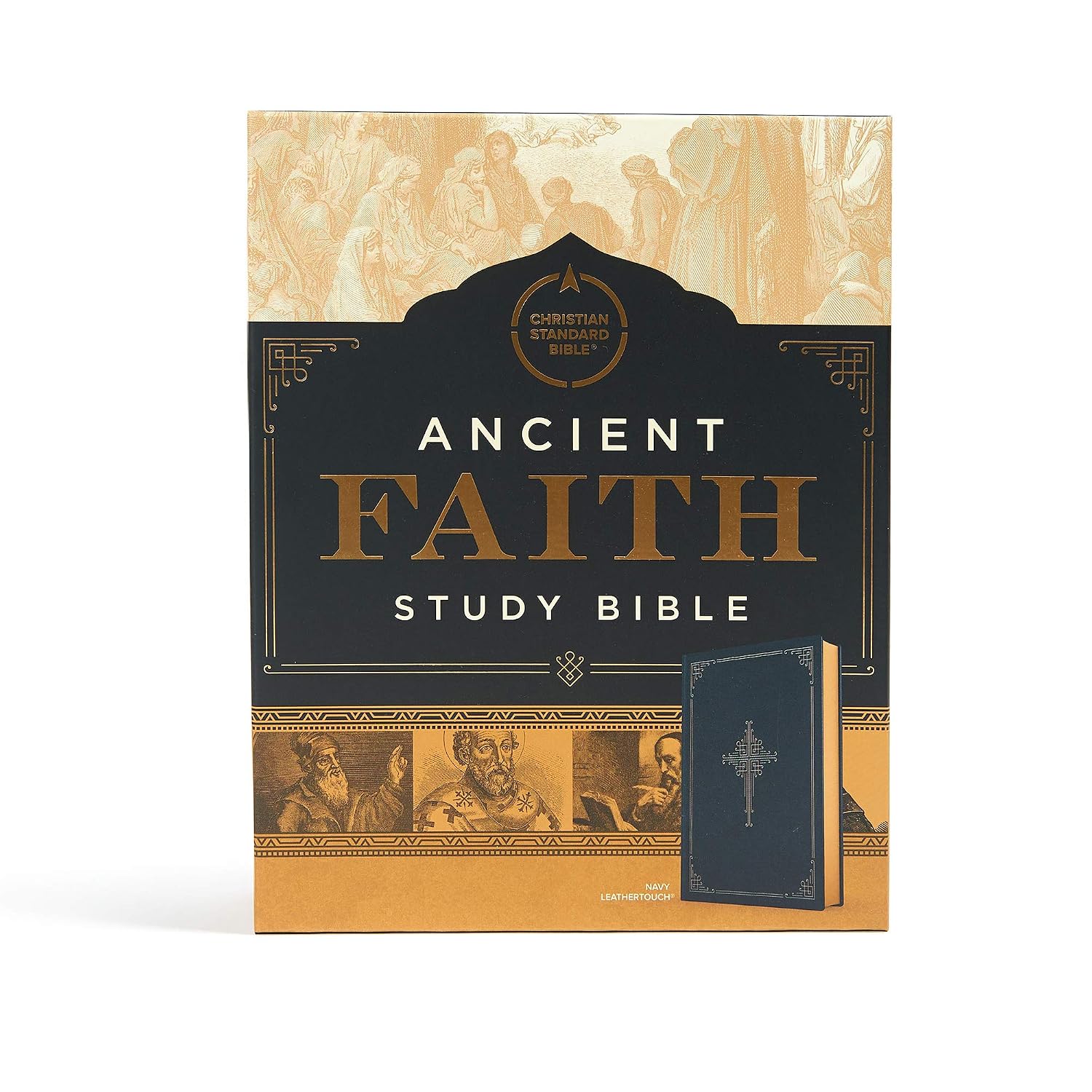
Holman first published the Ancient Faith Study Bible in 2019, and this navy LeatherTouch edition followed in 2021. Its notes draw on the writings of the church fathers from the second century into the fifth. You’ll find Irenaeus, Justin Martyr, Tertullian, Clement of Alexandria, Origen, Athanasius, the Cappadocian Fathers, Ambrose, Jerome, John Chrysostom, and Augustine, along with others.
The front of the Bible sets you up to read them well. Trevin Wax, who was overseeing Bibles and reference at Lifeway when this Bible came out, contributes an essay on how to read these men on their own terms. The introduction also lays out the two great schools of interpretation in the early church. Teachers in Alexandria leaned toward allegory and looked for spiritual meanings under the surface of the text. Teachers in Antioch leaned toward the plain historical sense. Chrysostom came out of Antioch, and you can hear it in his preaching. Origen taught in Alexandria, and you can hear that too. Knowing which school a writer came from will help you weigh what he says.
What You Get
| Feature | Details |
|---|---|
| Translation | Christian Standard Bible (CSB) |
| Study notes | Commentary drawn from the church fathers of the second through fifth centuries |
| Profiles | Biographies of 25 of the most influential church fathers |
| Feature articles | More than 25, each built around a key selection from a father on an essential Christian truth |
| Twisted Truth call-outs | Notes on where some early thinkers drifted from orthodoxy |
| Other helps | Book introductions, an index of authors, concordance, full-color maps, presentation page |
| Layout | Two columns, black-letter text, two-color design |
| Type size | 10.25-point Bible text |
| Binding | Smyth-sewn, with a ribbon marker |
| This edition | Navy LeatherTouch, 2,000 pages, list price $79.99 |
How the Notes Read
Scripture runs in two columns across the top of the page, and the notes sit below it. The notes put the fathers’ own words beside the verses they were explaining. These men wrote a great deal on Scripture. Augustine preached 124 sermons on the Gospel of John alone. Chrysostom preached his way through Matthew, John, Acts, Romans, and most of Paul’s letters. That is the well this Bible draws from.
The index of authors in the back lets you follow one father through the whole Bible. If you want to read everything Athanasius has to say, you can find it.
Some of the notes speak in a modern voice and help you apply what the fathers taught. One of them warns about the pictures we use to explain the Trinity. The egg with its shell, white, and yolk. Water as liquid, ice, and steam. A man who is a father, a husband, and a brother. Every one of them slides toward modalism, the old error that God is one person showing up in three different roles. The note suggests using those pictures to show what God is not. Those three pictures still get used in Sunday school classes every week, so that note alone would make a good lesson.
The Twisted Truth Call-Outs
This feature is the main reason I’d hand this Bible to a Protestant reader.
The church fathers were not all of one mind, and some of them went badly wrong. Origen taught that souls existed before they were born into bodies. Tertullian, who gave the Latin church the word Trinity, ended up among the Montanists, a movement built around new prophecies its followers treated as fresh revelation from the Spirit. A Bible that quotes these men has to deal honestly with that.
The Twisted Truth call-outs do that work. They mark the places where an early thinker drifted from orthodoxy and explain where he went off the road. You get the benefit of listening to the early church without being asked to swallow everything it said.
That is the right posture. The fathers are witnesses. They can show you how faithful believers read a passage when the apostles were only a few generations gone. But when one of them says something the apostles never said, the apostles win.
Next to the Orthodox Study Bible
If you read my review of the Orthodox Study Bible, you’ll want to know how these two compare. They share a love for the early church, and they are built for different readers.
The Orthodox Study Bible speaks for the Orthodox Church. Its notes draw on writers from the first ten centuries, and they read Scripture through Orthodox teaching, with liturgical notes, prayers, and icons. Its Old Testament comes from the Greek Septuagint and includes the books Protestant Bibles leave out.
The Ancient Faith Study Bible comes from Holman, the Bible imprint of B&H Publishing, which is part of Lifeway. It keeps the Protestant canon. Its Old Testament is translated from the Hebrew, and its New Testament from the Greek. Its window on church history is narrower, closing around the time of Augustine. And where the Orthodox Study Bible presents the fathers as the voice of a living tradition, this Bible lets them speak and then marks where they went wrong.
I’m glad to have both. The Orthodox Study Bible shows you how a living church reads the fathers today. The Ancient Faith Study Bible lets a Protestant reader meet them with a guide at his elbow.
A Word About the Translation
I wrote about the CSB at length in my last review, so I’ll keep this short. It’s my translation of choice for reading, and I still study from the NKJV and keep the two side by side. This Bible is black-letter, so the words of Christ are not printed in red.
The Physical Bible
This edition is bound in navy LeatherTouch, Holman’s imitation leather, with a Smyth-sewn binding that lies flat. The pages are gilded. The Bible text is set in 10.25-point type, with the notes in smaller type beneath it.
It is a big book. At 2,000 pages it weighs about four pounds, and it belongs on a desk more than in a bag. Holman lists it at $79.99, and retailers usually sell it for less. The same Bible comes in brown cloth over board, an indexed navy LeatherTouch, and a black goatskin edition in the Holman Handcrafted Collection.
Where It Falls Short
A study note can only hold a few lines, and many of these sources were long sermons. You get a taste of each father. If the notes leave you hungry, go to the fathers themselves. The Ancient Christian Commentary on Scripture from InterVarsity Press, edited by Thomas Oden, gathers far more patristic comment verse by verse. The older Ante-Nicene and Nicene and Post-Nicene Fathers series are free to read at ccel.org.
This is also a different kind of study Bible from the ones most of us own. The notes tell you how the early church read a passage. They spend far less time on Hebrew and Greek word meanings, archaeology, or the historical setting of a book. And some of these men read the Old Testament allegorically, so you’ll find notes that go well past what the author meant. Keep a standard study Bible close by.
Who This Bible Is For
If you love church history, this is one of the easiest ways I know to spend time with the early church every day.
If you teach, it will show you how the first generations of believers handled the passages you’re preparing.
If you’re a Protestant who has wondered about the church fathers but didn’t know where to start, start here. The Twisted Truth call-outs give you a guide.
If this would be your first study Bible, I’d point you to a standard one first and come back to this one later.
A Pastoral Word
The writer of Hebrews closes his letter with a charge about the men who first taught his readers.
“Remember those who rule over you, who have spoken the word of God to you, whose faith follow, considering the outcome of their conduct. Jesus Christ is the same yesterday, today, and forever.”
Hebrews 13:7–8, NKJV
The word for “considering” is anatheōreō (ἀναθεωρέω, G333). It means to look at something carefully, to look it over again and again. Luke uses the same word in Acts 17:23 for Paul walking through Athens and studying its altars. The word for “follow” is mimeomai (μιμέομαι, G3401), to imitate. Our word mimic comes from the same root.
Look at what the writer tells them to imitate. Their faith. He says nothing about copying every opinion those leaders held. And in the very next breath he warns, “Do not be carried about with various and strange doctrines” (Hebrews 13:9).
That is a fair description of how to read this Bible. Look long at these lives. Justin was beheaded in Rome for refusing to sacrifice to the gods. Athanasius was driven into exile five times for holding that Jesus is fully God. Imitate their faith. Weigh their teaching against the Word they loved.
And keep verse 8 in front of you. The leaders in verse 7 had finished their course, which is what “the outcome of their conduct” points to, and verse 17 turns to the leaders the church had now. Every man quoted in these notes is long dead too. Jesus Christ is the same yesterday, today, and forever. He is the One they wrote about, and you’ll find Him in the text above their words.
Recommended, especially for Protestants meeting the early church for the first time.

Leave a Reply