
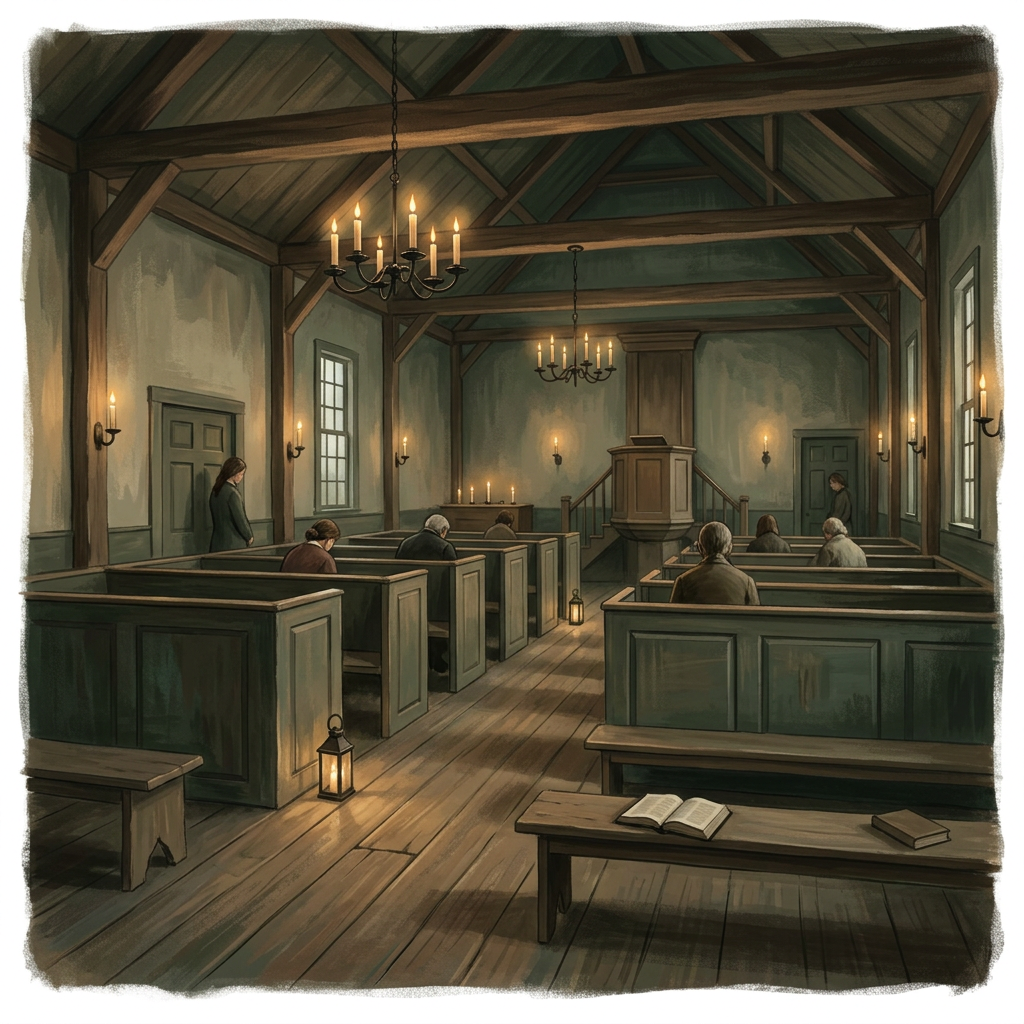
This is part six of Revive Us Again, a ten-part series on revival and renewal in Scripture and church history.
Beloved, do not believe every spirit, but test the spirits, whether they are of God; because many false prophets have gone out into the world.
1 John 4:1 NKJV
On September 10, 1741, the day after Yale’s commencement, Jonathan Edwards stood up in New Haven to speak on the most argued-over subject in New England.
The Great Awakening was two years old. George Whitefield had crossed the colonies preaching to crowds no meetinghouse could hold. Two months earlier, at Enfield, Edwards had preached “Sinners in the Hands of an Angry God,” and the moaning and crying grew so loud that he had to stop before the sermon was finished. In town after town people wept, trembled, cried out, and fell to the floor.
Everybody had an opinion about the floor. Critics pointed to the outcries and the fainting and called the whole thing delusion. Some friends of the revival pointed to the same outcries and called them proof that God was moving. Both sides argued from the same evidence, and neither could settle anything with it.
Edwards set the floor aside and opened his Bible to 1 John 4.
A Town Full of God
Edwards had seen revival before most of the colonies had.
In the winter of 1734 it came to his own church in Northampton, Massachusetts, a farm town on the Connecticut River. The young people there had been running wild on Sunday nights. Edwards preached against their frolics, and they gave them up on their own. He preached on justification by faith alone, that God declares a sinner righteous on account of Christ with nothing of the sinner’s own goodness added. Late in December a handful of people came to Christ, one after another. One of them was a young woman known around town for her wild company, and word of her change ran through Northampton.
By spring, Edwards wrote, “the town seemed to be full of the presence of God.” Parents rejoiced over their children and husbands over their wives. On Sundays the congregation sat in tears through the sermon. Edwards hoped more than three hundred people had come to Christ in half a year. He set it all down in A Faithful Narrative of the Surprising Work of God, printed in London in 1737. Surprising was his word. Nobody in Northampton had planned it.
So when all of New England caught fire a few years later, Edwards was no stranger to it. He loved it. He also knew how easily it could be counterfeited.
What Proves Nothing
Edwards began with a list most of us would never think to make. He named the things that cannot tell you either way whether a work is from God.
A work is not proved false because it is unusual. It is not proved false because people weep, tremble, groan, cry out, or lose their bodily strength. Edwards would not count it against a revival that it stirred up a great deal of talk about religion, or that people’s imaginations were moved, or that one person’s example drew in another. He granted that some caught up in it would act rashly and say foolish things. Errors would get mixed in, and Satan would sow a few delusions of his own. Some who seemed converted would later fall into gross sin. None of that, he said, proved the work as a whole was false.
He took the fainting off the scale entirely. A man on the floor might be a sinner under true conviction, or an overwrought mind, or a performance. The floor alone cannot tell you which. And if bodily effects cannot prove a work false, they cannot prove it true either.
That cut against both camps at once. The critics lost their reason to dismiss a revival for its noise, and its loudest friends lost their reason to trust it for the same.
Five Marks From One Chapter
Then Edwards gave his test. He drew every piece of it from 1 John 4, the same chapter that tells the church to test the spirits in the first place. If the apostle commanded the test, Edwards reasoned, the apostle’s own words should supply it.
The first mark is what the work does to people’s view of Jesus. John wrote that “every spirit that confesses that Jesus Christ has come in the flesh is of God” (1 John 4:2, NKJV). Edwards said a work comes from the Spirit when it raises people’s “esteem of that Jesus who was born of the Virgin, and was crucified without the gates of Jerusalem.” He meant the Jesus of the Gospels, born and crucified and risen.
The second mark is what the work does to sin. Edwards argued that the devil would never labor to tear down his own house. When a work turns people against their pet sins and their love of the world, Satan is not the one behind it (1 John 4:4–5).
The third mark is what the work does to the Bible. “He who knows God hears us” (1 John 4:6, NKJV). John meant the apostles, and Edwards applied the verse to the Scriptures they wrote. A spirit that sends people back to the Bible with a deeper regard for it is the same Spirit who gave the Bible. A spirit that teaches people to trust their impressions over the written Word is another spirit.
The fourth mark is truth. John sets “the spirit of truth and the spirit of error” side by side (1 John 4:6, NKJV). When a work convinces people of what is true, that God is holy, that they are sinners, that eternity is real, and that only Christ can save, it comes from the Spirit of truth.
The fifth mark is love. “Beloved, let us love one another, for love is of God; and everyone who loves is born of God and knows God” (1 John 4:7, NKJV). John gives the rest of the chapter to this one. A work that leaves people loving God more, and loving their neighbors with more humility, bears His mark.
A true work of the Spirit leaves people thinking more of Jesus, hating their sin, loving their Bibles, believing the truth, and loving one another.
Both Camps Needed It
New England needed the test almost at once. A young preacher named James Davenport took to the road behind Whitefield and denounced ministers by name as unconverted. In March 1743, at New London, Connecticut, he led his followers in burning a pile of religious books and then called for a bonfire of fine clothes. In Boston, Charles Chauncy gathered reports of excess into a long book arguing that the Awakening was overheated passion. Congregations split. The churches divided into Old Lights, who distrusted the revival, and New Lights, who welcomed it.
Edwards kept answering both camps. In 1746 he published Religious Affections, a much longer book with the same aim. True religion lives in the heart, he argued, and the surest sign of grace is a changed life lived out in Christian practice.
The Ash
The test held up. The town that first taught Edwards what revival looks like did not.
Edwards’s grandfather and predecessor, Solomon Stoddard, had opened the Lord’s Table to baptized adults of good character who did not claim to be converted. Edwards came to believe the Table belonged to those who could make a credible profession of faith in Christ. Northampton took that as an insult to Stoddard’s memory. On June 22, 1750, a council of churches dissolved his pastorate by a majority of one vote. Of about 230 male members in the church, roughly twenty-three wanted him to stay. Fifteen years after the town had been full of the presence of God, it put out the pastor God had used there.
The marks reached into Edwards’s own house too. In 1731 he bought an enslaved girl of about fourteen named Venus at Newport, and his household held other enslaved people over the years. The second mark says a true work sets people against sin. Edwards did not turn it on his own house. His son, Jonathan Edwards Jr., later preached against the slave trade.
Neither failure makes the Northampton revival false. Edwards himself had said that error and later scandal cannot overturn a true work of God. They do show that the test is never finished, and that a revived church and the man God used in it still need to examine themselves.
Kindling
Read 1 John 4:1–7 this week, slowly. Then think back to the last spiritual high you remember. Maybe it was a camp, a conference, a worship night, or the last night of a revival meeting. Set the goosebumps aside. Edwards would tell you they prove nothing either way. Ask his five questions instead.
- Do I think more of Jesus Christ, crucified and risen, than I did before?
- Has it turned me against a sin I had been keeping?
- Am I reading my Bible with more hunger than before?
- Am I more convinced of what is true about God and about myself?
- Is my love for God and for the people around me growing?
Then ask the same questions about the church you love. Next week we’ll put the test to work on the biggest argument in revival history, whether revival is a surprise from heaven or the product of the right methods.
Paul gave a young church the same balance Edwards was reaching for.
Do not quench the Spirit. Do not despise prophecies. Test all things; hold fast what is good.
1 Thessalonians 5:19–21 NKJV
Word Study
| Term | Original | Strong’s | Meaning | Key text |
|---|---|---|---|---|
| dokimazō | δοκιμάζω | G1381 | to test, examine, prove by trial, as metal is assayed | 1 John 4:1; 1 Thess 5:21 |
| pseudoprophētēs | ψευδοπροφήτης | G5578 | false prophet, one who claims to speak for God and does not | 1 John 4:1 |
| homologeō | ὁμολογέω | G3670 | to confess, to say the same thing, to acknowledge openly | 1 John 4:2–3 |
| agapē | ἀγάπη | G26 | self-giving love | 1 John 4:7–8 |
Discussion Questions
- Critics and friends of the Awakening both argued from tears and outcries. Where do Christians still judge a spiritual moment by how it felt?
- Edwards said bodily effects prove nothing either way. Does that make you more comfortable with emotional worship or less? Why?
- Which of Edwards’s five marks would be hardest to fake? Which would be easiest?
- Northampton saw revival and later voted out its pastor by a single vote. What does that tell us about the difference between a revived church and a mature one?
- Edwards never turned the second mark on his own household. What might a revived church today fail to examine in itself?
Going Deeper
- Jonathan Edwards, The Distinguishing Marks of a Work of the Spirit of God (Boston, 1741). The New Haven discourse itself. Short, and free online at ccel.org.
- Jonathan Edwards, A Treatise Concerning Religious Affections (Boston, 1746). Edwards’s fuller answer to both the critics and the wildfire. Demanding, and worth the effort.
- George M. Marsden, Jonathan Edwards: A Life (Yale University Press, 2003). The standard modern biography, fair to Edwards and honest about Northampton and slavery.
- Thomas S. Kidd, The Great Awakening (Yale University Press, 2007). A clear history of the whole Awakening, Davenport and the Old Light and New Light split included.
This post is drawn from The Fire Shall Never Go Out, my book in progress on two thousand years of revival and renewal.

Leave a Reply