A quick word before we start. Holman sent me a copy of this Bible, and the opinions here are my own. The Amazon links below are affiliate links. If you buy through them, I earn a small commission at no extra cost to you. As an Amazon Associate I earn from qualifying purchases.


Every Bible teacher has one book he opens first when it’s time to prepare. For me, that book has changed.
I still teach from the New King James Version, and the CSB now stands beside it. But when I sit down to get ready for a Friday night study, the study Bible lying open on the table is the CSB Baker Illustrated Study Bible. It has become my main study Bible, and it is now one of the most important tools I have for study and preparation.
The richness of the notes is what drew me in first. Then, somewhere along the way, I realized this one Bible was answering most of my questions on its own. I had stopped pulling several different study Bibles off the shelf to piece an answer together. I opened this one, and the answer was usually already there.
A few days ago I reviewed the CSB Study Bible and called it the obvious place to start. I still think so. It is a fine study Bible, and most readers would be well served by it. But I owe you a straight answer about which one I reach for first, and this is it. This review runs longer than most of mine, because this Bible has earned it.
Back in Print
This Bible has a story of its own.
Baker Books first published the CSB Baker Illustrated Study Bible in November 2018. Baker is the Michigan publisher behind a whole shelf of illustrated reference works, including the Baker Illustrated Bible Commentary, the Baker Illustrated Bible Handbook, and the Baker Illustrated Bible Background Commentary. This study Bible carried that same approach into a single volume, pairing the CSB text with study notes, articles, and full-color pictures of the ancient world.
Then it went out of print. Readers who knew about it went hunting for used copies on eBay and in secondhand shops, and Bible reviewers kept talking about it for years after it disappeared. A Kindle edition stayed available, but if you wanted the book in your hands, you had to get lucky.
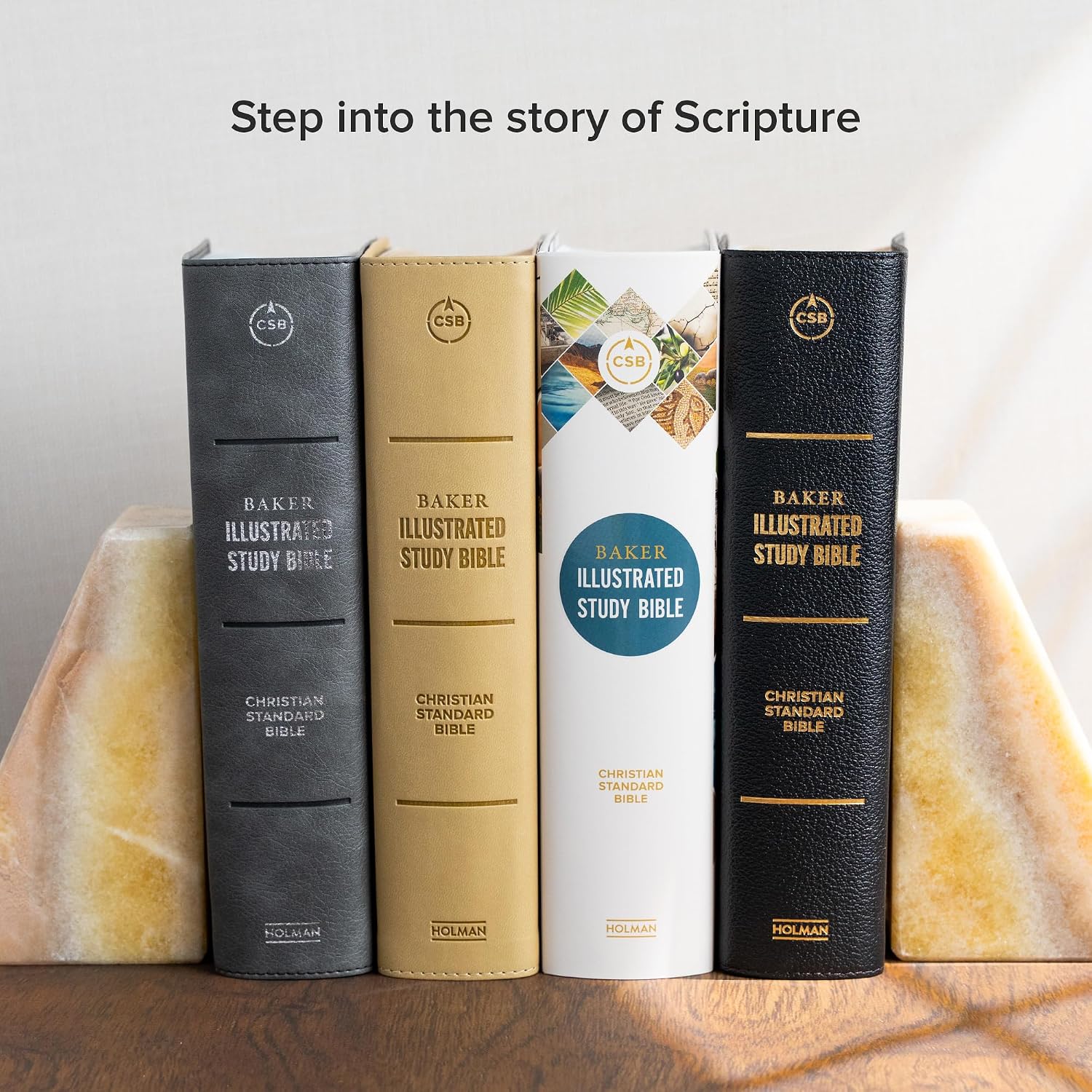
On June 15, 2026, Holman Bible Publishers brought it back. The new edition carries the same study features Baker listed in 2018, on the same 2,640 pages, now set in Holman’s Optimal Type and offered in new bindings, from hardcover to genuine leather.
What You Get
| Feature | Details |
|---|---|
| Translation | Christian Standard Bible (CSB) |
| Contributors | More than 200 evangelical scholars |
| Study notes | Section-by-section commentary, more than a million words in all |
| Introductions | The Grand Story of the Bible, a guide to reading, interpreting, and applying Scripture, Old and New Testament introductions, six section introductions, and an introduction to every book |
| Articles | More than 150 on key biblical concepts and topics |
| Definitions | More than 450, covering key words, people, places, and ideas |
| Maps | More than 100, full color |
| Visuals | Hundreds of full-color images, plus artists’ reconstructions of historical and archaeological sites and objects |
| Reference tools | Timelines, family trees, charts, and outlines |
| Layout | Single-column text, cross-references, topical subject headings, translators’ footnotes, words of Christ in red |
| Back matter | Concordance, table of weights and measures, indexes of articles, definitions, maps, and reconstructions |
| Type | 9-point Optimal Type |
| Binding | Smyth-sewn, lays flat, with a ribbon marker and presentation page |
| Pages | 2,640 |
| Editions | Hardcover ($54.99), charcoal or khaki LeatherTouch ($74.99), indexed LeatherTouch ($84.99), black genuine leather ($94.99), indexed genuine leather ($104.99) |
Section by Section
Most study Bibles hang their notes on single verses. You read verse 4, look down, and find a note on verse 4. That is useful. But it can leave you with a pile of small facts and no sense of how the passage moves.
The Baker Illustrated Study Bible works by sections. The notes take a passage as a unit, the way a good commentary does, and walk you through its flow of thought before they stop on the details. Baker put the total at more than a million words, about what you’d find in a one-volume commentary, and here it sits right under the text.
For a teacher, this is the whole game. When I prepare a lesson, the first thing I need is the shape of the passage. Where does it start? Where does it turn? What is the writer driving at? Section notes answer those questions first, and then the details have somewhere to hang.
Take Psalm 19. The note there traces the psalm’s movement. David starts with what God has shown everyone in the sky, moves to what God has shown His people in His Word, and ends with the prayer of a man who knows he needs forgiving. General revelation, then special revelation, then repentance. Once you see that path, you can teach the psalm. I’ll come back to Psalm 19 before we’re done.
The Pictures Earn Their Place
The word “illustrated” can mean a lot of things. Plenty of Bibles add pictures to look nice. The pictures in this one teach.
The Bible happened on real ground. Abraham dug wells and pitched tents. David hid in the wilderness of Judah. Paul sailed from harbor to harbor and walked into cities crowded with temples. When you can see the ground, the text gets traction.
That is what the visuals do here. More than a hundred full-color maps sit near the passages they explain. Hundreds of photographs show the land and the objects archaeologists have pulled out of it. Artists’ reconstructions, drawn from historical and archaeological study, show you what a building or a place looked like when it was standing. When a passage turns on a place or a structure, a reconstruction will often show you in one look what three paragraphs would struggle to describe.
When you can see the ground, the text gets traction.
Then there are the timelines and family trees. If you’ve ever lost track of which Herod is which, or tried to keep the kings of Israel and Judah straight, you know what those are worth. The timelines tie the people and events of the Bible to each other and to the wider ancient world, so you can see, for instance, how Isaiah’s ministry lines up with the rise of Assyria.
Articles and Definitions
Beyond the notes, there are two more layers of help.
The first is more than 150 articles on key biblical concepts and topics. These are short and substantial. The entry on the virgin birth is a good example. It argues that the virgin conception is about who Jesus is. Without it, there would have to be some moment in history when Jesus became the Son of God, and an adopted Son is a man and nothing more. The article ties the doctrine to John 1, where the Word was with God before Bethlehem ever happened, and to Paul’s picture of Jesus as the second Adam who obeyed where the first one failed. That is the kind of writing that takes a position and shows its work.
The second layer is more than 450 definitions of key words, people, places, and ideas. When you hit a term like “covenant” or “revelation” or a name you half remember, a short definition is usually close by. The entry on the revelation of God, for instance, starts where it should, with who God is, all-powerful, all-knowing, morally perfect, the Creator, before it explains how He makes Himself known.
And before you ever reach Genesis, the front of the Bible gives you a short tour of the grand story of Scripture and a guide to reading, interpreting, and applying the Bible. That guide covers much of the same ground I’ve been walking through in the Feed Yourself series. Read it first. It will make you a better reader of everything that follows.
The Single-Column Page
Here is something you notice the minute you open it. The Bible text runs in a single column, the way a regular book does, instead of two narrow columns side by side.
It makes a bigger difference than you’d think. Poetry keeps its lines. Paul’s long sentences don’t get chopped into three-word scraps at the edge of a column. You read Scripture the way it was written, as connected thought. For a study Bible, where the text has to share the page with notes, maps, and pictures, keeping it in one clean column is a deliberate choice, and I think it is the right one.
The cross-references and translators’ footnotes are there too, along with topical headings that help you find your place.
How to Work Through a Passage
Here is how I’d suggest working through a passage with this Bible.
- Read the passage itself first, with no notes. If you have an NKJV handy, read it there too.
- Read the book introduction and the section introduction, so you know where you are in the story.
- Read the section note to get the flow of the passage.
- Look at the maps, pictures, and timelines on the page. Ask what they tell you that the words alone didn’t.
- Follow up on any article or definition the passage points you toward.
- Then go to the original words yourself. Pick the key word, find it in a concordance, and read the other places it appears.
The study Bible gets you to the edge of the field. You still have to plow it.
Next to the CSB Study Bible
Since I reviewed the CSB Study Bible just days ago, you’ll want to know how these two compare. Both carry the CSB. Both are serious study Bibles. They are built differently.
| CSB Study Bible | CSB Baker Illustrated Study Bible | |
|---|---|---|
| Publisher | Holman, 2017 | Baker Books, 2018, reissued by Holman in 2026 |
| Text layout | Two columns | Single column |
| Notes | More than 16,000, keyed to verses | Section by section, more than a million words |
| Word helps | 368 word studies | More than 450 definitions |
| Articles | 34 | More than 150 |
| Maps | 55 | More than 100 |
| Contributors | More than 100 scholars, with a Baptist home | More than 200 evangelical scholars |
| Type | 9.5-point Bible Serif | 9-point Optimal Type |
| Pages | 2,208 | 2,640 |
| Hardcover list price | $54.99 | $54.99 |
The CSB Study Bible gives you quick answers on the verse in front of you, and its word studies are excellent. It is a great everyday study Bible, and it’s lighter on the arm.
The Baker Illustrated Study Bible gives you more of everything else. The notes read the passage as a whole. The articles go deeper. The maps and pictures put you in the land. And with more than two hundred contributors from across the evangelical world, you’ll hear a wide range of voices.
If you want one study Bible for daily reading and quick reference, the CSB Study Bible will serve you well. If you teach, or you want to understand a passage the way a commentary would help you understand it, this is the one I’d hand you.
A Word About the Translation
I made my case for the CSB in my post on the change. The CSB says plainly what the NKJV says closely, and the two together show you more of the text than either one alone. A study Bible built on the CSB gives me notes keyed to the translation I’m reading beside my NKJV.
The Physical Bible
This is a big book. My copy is the hardcover. At 2,640 pages, it runs about two and a half inches thick and weighs more than four pounds. It belongs on a desk or a table.
The binding is Smyth-sewn, so the pages are sewn in sections and the book lies flat. A Bible this thick needs that. You can leave it open to Leviticus and walk away without coming back to find it has flipped itself to Lamentations.
The text is set in 9-point Optimal Type, Holman’s own typeface, designed to cut down on eye strain at small sizes. The page is full color throughout. There is a ribbon marker and a presentation page.
You can get it in seven editions. The hardcover lists at $54.99, which is a lot of Bible for the money. The LeatherTouch comes in charcoal or khaki at $74.99, or $84.99 indexed. Black genuine leather lists at $94.99, or $104.99 indexed. Retailers usually sell all of them for less.
A Pause
No study Bible does everything, and this one has its trade-offs.
The size is the first. You won’t carry this to church on Sunday morning, and you won’t read it in bed. It is a working Bible for a working table.
The type is the second. Nine points is small. Optimal Type helps, and the page is clean, but if you already reach for reading glasses, take a look at it in a store before you order.
The third is the number of voices. With more than two hundred contributors, the notes don’t all sound alike. Some books read like a seminary lecture and some like a Sunday school lesson. And on questions where Christians land in different places, one contributor may lean one way while another leans the other. I count that more strength than weakness. You hear the range of evangelical scholarship, and you learn to weigh it. But you should know it going in.
And section notes have a cost. Because they treat a passage as a whole, a single verse you’re curious about may not get its own comment. When that happens, keep a verse-by-verse study Bible or a good commentary within reach.
Who This Bible Is For
If you teach, in a pulpit, a classroom, or a living room, this is the study Bible I’d put in your hands. The section notes give you the shape of the passage, and the visuals give you something to show the people you’re teaching.
If you learn by seeing, the maps, reconstructions, and timelines will open up parts of the Bible that have always felt flat on the page.
If you want something close to a one-volume commentary without buying a separate set of books, this gets you most of the way there.
If you missed it the first time and have been watching the used market, you can stop watching.
If you need a Bible to carry, look elsewhere and keep this one at home.
A Pastoral Word
I promised I’d come back to Psalm 19. Here is how it begins.
“The heavens declare the glory of God; And the firmament shows His handiwork. Day unto day utters speech, And night unto night reveals knowledge.”
Psalm 19:1–2, NKJV
“The heavens declare the glory of God, and the expanse proclaims the work of his hands. Day after day they pour out speech; night after night they communicate knowledge.”
Psalm 19:1–2, CSB
The NKJV says “firmament.” The CSB says “expanse.” The Hebrew word is raqia (רָקִיעַ, H7549), from a verb that means to beat out or spread out, the way a smith hammers metal thin. David looks up at that great hammered dome of sky and hears it talking. The NKJV says it “utters” speech. The CSB says it “pours out” speech. The verb is naba (נָבַע, H5042), to bubble up and gush, like water from a spring. The sky can’t keep quiet about its Maker.
But the sky can only say so much. It tells you God is mighty. It can’t tell you His name. In the first six verses David names God only once, in verse 1, as El (אֵל, H410), God, the Mighty One. Then in verse 7 everything changes.
“The law of the LORD is perfect, converting the soul; The testimony of the LORD is sure, making wise the simple.”
Psalm 19:7, NKJV
From here to the end of the psalm, David uses the covenant name, Jehovah, seven times. The sky shows you God’s power. His Word shows you His name and His heart. The law of Jehovah is tamim (תָּמִים, H8549), perfect, whole, the same word used for a sacrifice without blemish. And it does what no sunset can do. The NKJV says it is “converting the soul.” The CSB says it is “renewing one’s life.” The verb is shuv (שׁוּב, H7725), to turn back, to bring home.
Then David turns from the Word to himself, and the psalm ends in prayer.
“Let the words of my mouth and the meditation of my heart Be acceptable in Your sight, O LORD, my strength and my Redeemer.”
Psalm 19:14, NKJV
The CSB calls the LORD “my rock.” The Hebrew is tsur (צוּר, H6697), rock, the solid stone you build on. And “Redeemer” is goel (גֹּאֵל, from H1350), the kinsman-redeemer, the family member who pays to buy back what was lost. That is Boaz standing up for Ruth. It is Christ standing up for us.
Psalm 19 also shows the right way to use an illustrated study Bible. The pictures of the land and the reconstructions of ancient cities are a little like the sky in Psalm 19. They tell you true things about a real world, and they draw your eye upward. But they are meant to carry you to the Word, and the Word is meant to carry you to the Redeemer. Look at the pictures. Read the notes. Then close the book and pray verse 14.
Going Deeper
If this Bible whets your appetite for the world behind the text, Baker’s other illustrated works make good companions. J. Scott Duvall and J. Daniel Hays edited The Baker Illustrated Bible Background Commentary (Baker Books), which goes deep on the history, culture, and archaeology behind each book. Gary Burge and Andrew Hill edited The Baker Illustrated Bible Commentary (Baker Books), a full one-volume commentary with the same visual approach. And if you want to sharpen how you read the Bible for yourself, Duvall and Hays’s Grasping God’s Word (Zondervan) is a standard textbook on interpretation that a serious lay reader can work through.
If you want to see inside before you buy, three video walkthroughs will show you the pages. Tim Wildsmith takes a full look at the new Holman edition in The Baker Illustrated Study Bible Is Back (And I Finally Understand the Hype). DiscipleDojo reviewed the original Baker edition in How Did I Not Know About This Bible?!, and the follow-up, How to Use Your New Baker Illustrated Study Bible, walks through putting it to work at any level.
The Verdict
Highly recommended. This is the study Bible on my table, and I expect it to stay there.
Scripture quotations marked NKJV are taken from the New King James Version®. Copyright © 1982 by Thomas Nelson. Used by permission. All rights reserved. Scripture quotations marked CSB have been taken from the Christian Standard Bible®, Copyright © 2017 by Holman Bible Publishers. Used by permission. Christian Standard Bible® and CSB® are federally registered trademarks of Holman Bible Publishers.

Leave a Reply