
This is the final post of The Strange Parts, a series on the passages of Scripture that only make sense with a supernatural worldview. Every thread we have pulled comes together here.
There is a temptation, after seven posts of divine councils and rebel princes, to breathe a sigh of relief when we reach the New Testament. Back to solid ground, we think. Parables, epistles, church potlucks. But the New Testament is not a tidier, more modern book than the Old. It is the same supernatural story reaching its turn, and its authors assume every strange thing we have studied. You can see it in where Jesus chose to stand when He said certain things.
A Declaration of War, On Location
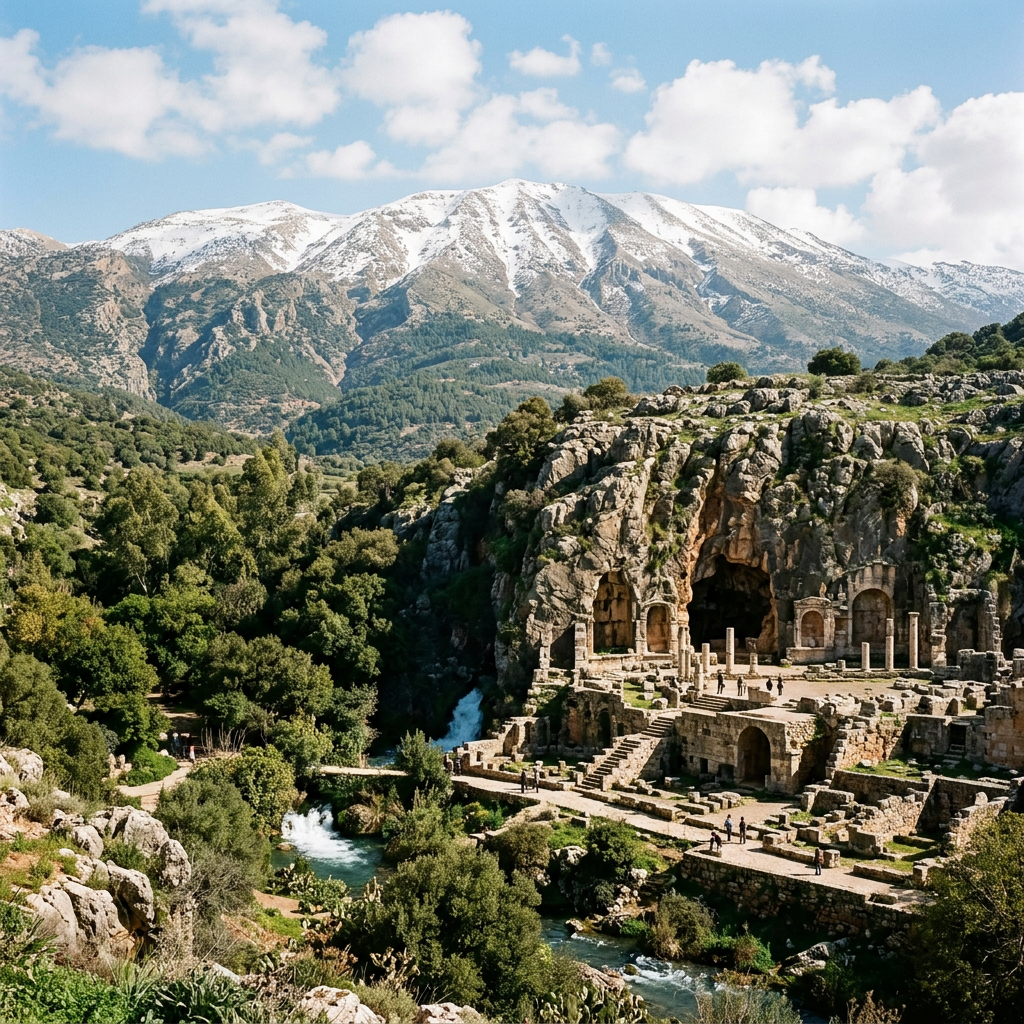
Matthew 16 happens at Caesarea Philippi, and geography is the sermon. This is the far north of Israel, at the foot of Mount Hermon, the mountain Jewish tradition named as the place where the sons of God of Genesis 6 came down. The region was a center of pagan worship for centuries, and at the base of the cliff was a cave men called the gates of Hades, a mouth into the underworld, with shrines built around it. Of all the ground in Israel, this is where Jesus takes His disciples to ask who men say He is. And when Peter confesses Him as the Christ, the Son of the living God, Jesus answers on location.
“And I also say to you that you are Peter, and on this rock I will build My church, and the gates of Hades shall not prevail against it.”
Matthew 16:18 NKJV
We read that verse as if it promises the church will survive the devil’s attacks. Look again. Gates do not attack anybody. Gates defend. Jesus stands in front of the most haunted ground in the country and announces that His church is the army on offense, and the enemy’s gates will not hold. The old rebellion gets its eviction notice at its own front door.
Seventy Sent, and Babel Runs Backwards
Remember the seventy nations of Genesis 10, the ones portioned out under lesser powers at Babel. In Luke 10 Jesus appoints seventy and sends them out ahead of Him, and when they return with joy He tells them what He was watching while they preached. I saw Satan fall like lightning from heaven. The number is a claim. The mission to the disinherited world has begun, and the powers are already losing altitude.
Then comes Pentecost, and Luke slows down to give you a list he could have skipped. Parthians and Medes and Elamites, dwellers in Mesopotamia, Egypt, Libya, Rome, Cretans and Arabs, devout men from every nation under heaven, each hearing the wonderful works of God in his own language. At Babel, languages were confused to divide the nations under judgment. At Pentecost, languages are multiplied to gather them back. Luke’s list is the Table of Nations run in reverse. The disinheritance is being undone, family by family, exactly as Jehovah promised Abram it would be.
At Babel the languages divided the nations under judgment. At Pentecost the languages gathered them home.
The Public Spectacle
And the cross, which looked like the powers’ finest hour, turns out to be the ambush that ended them. Paul writes it like a war correspondent.
“Having disarmed principalities and powers, He made a public spectacle of them, triumphing over them in it.”
Colossians 2:15 NKJV
The word behind triumphing pictures a Roman victory parade, the defeated generals marched through the streets behind the conqueror’s chariot. Paul says that is what happened at the cross, in the unseen realm, to the very powers we have traced since Babel. First Corinthians 2:8 adds the bitter irony. Had the rulers of this age known, they would not have crucified the Lord of glory. The powers pushed for the crucifixion and sprang the trap on themselves.
The Leftover Strangeness
A series like this should sweep out its corners, so let me touch two oddities we have not placed. Paul tells the Corinthians he knew a man caught up to the third heaven, into Paradise. That numbering sounds strange to us, but inside the worldview we have been building it is simply the geography of the unseen, the sky above, the heavens beyond, and the place of the throne, and Paul talks about it the way a man talks about rooms in a house he has visited. And a few chapters earlier sits the genuinely hard one, baptism for the dead in 1 Corinthians 15:29. I will be honest with you. Nobody knows exactly what practice Paul is referencing, and he neither commands nor commends it. He points at something the Corinthians were doing and asks why they would do it if the dead are not raised. It is an acknowledged puzzle, and that is fine. A worldview big enough to hold the council and the princes is big enough to hold a verse we cannot fully place. We do not need to hide it. We need to keep reading.
| Word | Original | Strong’s | Meaning |
|---|---|---|---|
| pylai hadou | πύλαι ᾕδου | G4439, G86 | Gates of Hades. Defensive works, not an attacking army |
| apekdyomai | ἀπεκδύομαι | G554 | To strip off, to disarm. What the cross did to the powers |
| archai | ἀρχαί | G746 | Principalities, the ruling powers |
| exousiai | ἐξουσίαι | G1849 | Authorities, powers |
Where You Are Seated
So here is the whole series in one paragraph. The world was made good, and the unseen world with it. Rebellion came from both realms, the council corrupted, the nations disinherited at Babel, the boundary crossed in Genesis 6. Jehovah kept one family for Himself and promised through it to bless every family He had given up. The prophets stood in His council and watched the war. And then the Son came, walked to the enemy’s gate, died the death the powers engineered, and turned their victory into their parade of defeat. Pentecost began the harvest of the nations, and the book of Revelation ends with the kings of the earth bringing their glory into the city of God. The strange parts were never a detour. They were the plot.
And Paul will not let you read any of it as a spectator. He says God raised Christ far above all principality and power and might and dominion, and every name that is named, and then he says the thing that should take your breath. He raised us up together and made us sit together in the heavenly places in Christ Jesus. Seated. Above the princes of Persia and Greece and every power that ever frightened you. That is your address, believer. Not because you are strong, but because He is, and He has never been anything else.
The unseen world is real. It is contested. And its outcome is already decided. The strange parts of your Bible were never meant to embarrass you, and they were never meant to frighten you. They were meant to show you the size of the victory.
Discussion Questions
- Why does it matter that Jesus spoke Matthew 16:18 at Caesarea Philippi rather than in Galilee or Jerusalem?
- Gates defend rather than attack. How does that reverse the way you have heard Matthew 16:18 preached?
- Trace the seventy from Genesis 10 to Luke 10 to Acts 2. What is Jehovah doing across those three texts?
- Read Colossians 2:13-15. What exactly was disarmed at the cross, and what does that mean for the powers that remain?
- Ephesians 2:6 says you are seated with Christ in the heavenly places. What fear would lose its grip on you if you believed your address?
Going Deeper
Heiser’s Reversing Hermon traces the Genesis 6 rebellion through the Gospels and epistles, and the closing chapters of The Unseen Realm cover Pentecost as the reversal of Babel. Read Ephesians 1:15-2:7 in one sitting and count how many times Paul locates the believer above the powers. Then go back and read Psalm 82:8 one more time. Arise, O God, judge the earth, for You shall inherit all nations. That prayer has been answered, is being answered, and will be answered. Thanks for walking the strange parts with me. Now go read your whole Bible.

Leave a Reply