
This is part seven of Read It Again, a series on verses we get wrong and the reading habits that would have caught the mistake. Today, a verse about a thief, and a chapter number that fell in the middle of a conversation.
The transmission goes out on the truck. The water heater floods the laundry room the same week. Somebody at church shakes his head and says the thief comes to steal, kill, and destroy. Everybody nods. The thief is the devil, and the devil has been busy.
Then the second half of the verse gets used the opposite way. Jesus came to give abundant life, so the truck and the water heater are not supposed to happen to people with enough faith.
Both readings come from the same mistake, and it was made by a man with good intentions about eleven centuries after John put down his pen.
The Verse and the Flat Tire
“The thief does not come except to steal, and to kill, and to destroy. I have come that they may have life, and that they may have it more abundantly.”
John 10:10 NKJV
Scripture does call the devil a destroyer. Peter says he walks about like a roaring lion (1 Peter 5:8). Satan is no harmless figure. My question is who Jesus was talking about on the day He said this. To answer that, we have to know who was standing in front of Him, and the chapter number hides it.
The Conversation the Chapter Break Hides
John 10 opens with Jesus already speaking. “Most assuredly, I say to you.” So back up and find where He started.
In John 9 Jesus heals a man who was born blind. The Pharisees question the man, then his parents, then the man again, and when he will not denounce Jesus they throw him out of the synagogue. For a Jew in that city it meant losing his whole community in an afternoon. Jesus goes and finds him. Then some Pharisees who are standing nearby ask whether He is calling them blind, and Jesus tells them, “your sin remains” (John 9:41 NKJV).
That is the last verse of chapter 9. The next words out of His mouth are the first verse of chapter 10. Same day, same place, same Pharisees.
“Most assuredly, I say to you, he who does not enter the sheepfold by the door, but climbs up some other way, the same is a thief and a robber.”
John 10:1 NKJV
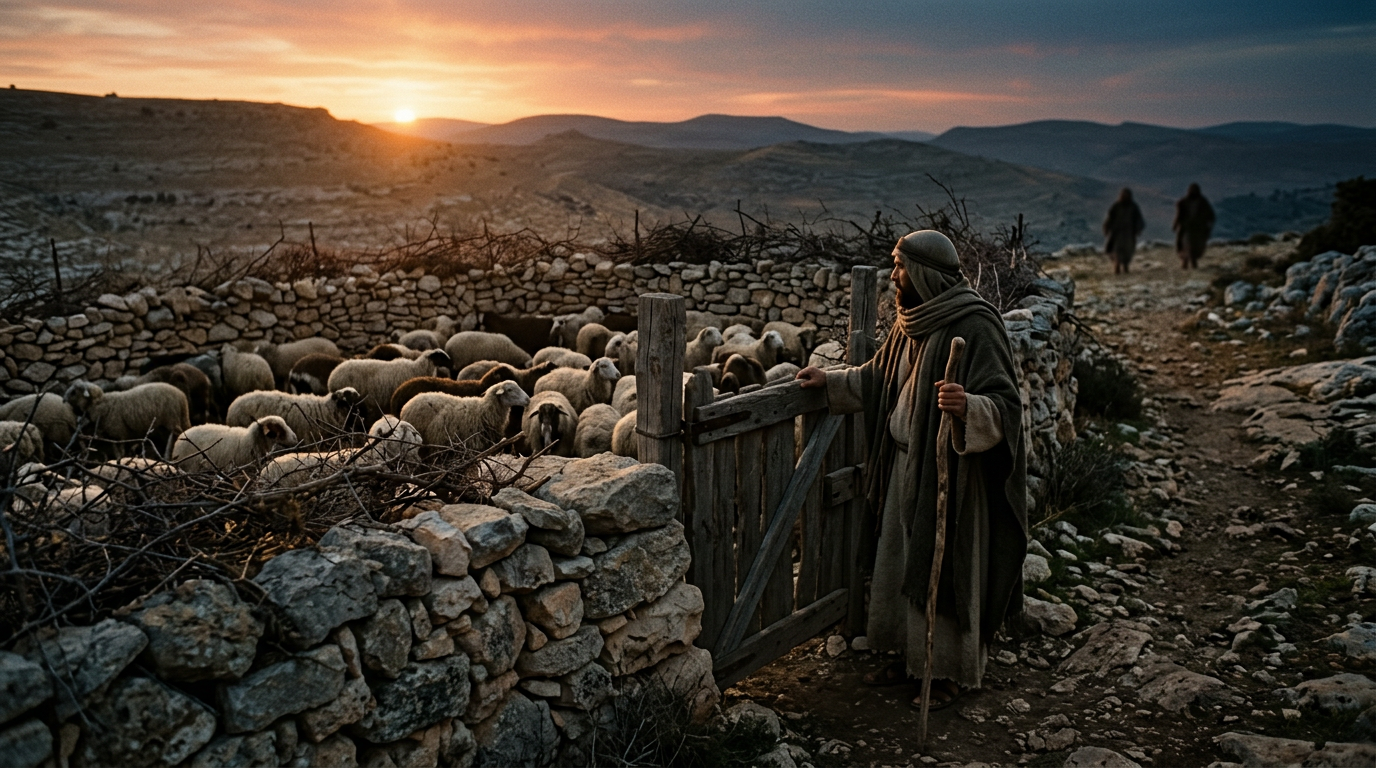
Now the picture is plain. The sheep is the man who was just thrown out. The thieves and robbers are the leaders who threw him out, men who held authority over the flock and used it to protect themselves. In verse 8 Jesus says, “All who ever came before Me are thieves and robbers.” And the good shepherd is the One who went looking for the sheep they discarded.
John even tells us the scene never changed. When the speech ends, the crowd argues about it, and some of them say, “Can a demon open the eyes of the blind?” (John 10:21 NKJV). They are still talking about the healing.
Behind all of it stands Ezekiel 34. There Jehovah condemns the shepherds of Israel who feed themselves and not the flock, and He promises, “I Myself will search for My sheep and seek them out” (Ezekiel 34:11 NKJV). When Jesus stood in front of those Pharisees and said “I am the good shepherd,” every one of them knew what chapter He was claiming.
The thieves of John 10 are the religious leaders who had just thrown a healed man out of the synagogue. The good shepherd is the One who went and found him.
The Habit
Read across the chapter break.
The chapter numbers in your Bible were added in the early 1200s. They are handy for finding a place. But they were laid over a text that already had its own shape, and sometimes they fall in the middle of a scene, a speech, or a sentence.
The great Servant song of Isaiah starts at Isaiah 52:13, three verses before the chapter number that most of us think begins it. The love chapter, 1 Corinthians 13, sits in the middle of Paul’s teaching on spiritual gifts in chapters 12 and 14, and it was written to correct a church that was fighting over them. It was not written for weddings, though it does a wedding no harm.
So whenever a chapter opens with someone already talking, or with a word like “then” or “therefore,” turn back a page. Find where the scene started. Read from there.
The Words Under the Verse
| Word | Original | Strong’s | Meaning |
|---|---|---|---|
| kleptes | κλέπτης | G2812 | Thief, one who steals by stealth. John 10:1, 8, 10 |
| lestes | λῃστής | G3027 | Robber, bandit, one who takes by force. John 10:1, 8 |
| poimen | ποιμήν | G4166 | Shepherd. The title Jesus takes in John 10:11, with Ezekiel 34 behind it |
| perissos | περισσός | G4053 | Abundant, beyond measure. The life the shepherd gives His sheep |
For the Sheep Somebody Threw Out
Read in its setting, this verse is harder on church leaders than on the devil. A thief, in Jesus’ words, is anyone who climbs into authority over God’s people and uses them. He fleeces the sheep to build his own name. He drives out the ones who ask honest questions. That should make every pastor and teacher search himself, and I include myself.
It also has something for the person on the other side of that door. Some of you were put out of a church for telling the truth. Maybe nobody voted. The room just went cold until you left. The blind man knew that feeling. He could finally see, and the first thing he saw was his own leaders turning their backs.
Read John 9:35 slowly. “Jesus heard that they had cast him out; and when He had found him.” He heard, He went looking, and He found him. The abundant life of John 10:10 is the life of a sheep who has been found by that Shepherd and knows His voice. They could not take it from the blind man, and nobody can take it from you.
Discussion Questions
- Read John 9:1 through 10:21 as one scene. Who are the sheep, the thieves, and the shepherd in the story you just read?
- How does John 10:21 show that the healing of the blind man is still the subject?
- Read Ezekiel 34:1-16. What were the shepherds of Israel doing wrong, and what does Jehovah promise to do Himself?
- What does “abundant life” mean for the man born blind, who gained his sight and lost his synagogue on the same day?
- Find another place in your Bible where a chapter break interrupts a scene or an argument.
Going Deeper
Read Ezekiel 34 in full, then John 10:1-30, and mark every phrase Jesus borrows. Read 1 Peter 5:1-4 and Acts 20:28-30 for what the apostles expected of shepherds. If you can get a reader’s Bible, one printed without chapter and verse numbers, try this passage in it. The Feed Yourself post The Margins Are a Map shows how cross references lead from a text like John 10 back to its Old Testament source.

Leave a Reply