
This is part five of Revive Us Again, a ten-part series on revival and renewal in Scripture and church history.
I have set watchmen on your walls, O Jerusalem; They shall never hold their peace day or night.
Isaiah 62:6 NKJV
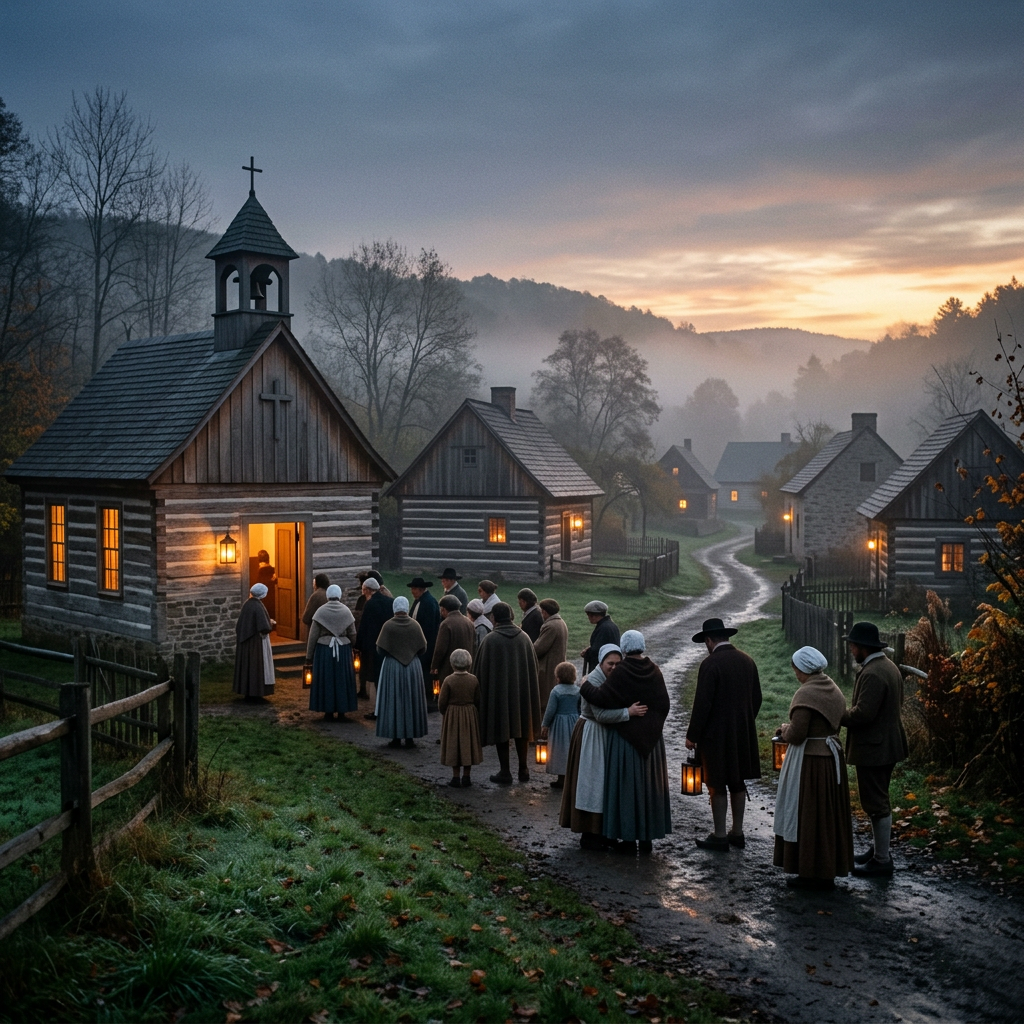
By the spring of 1727, a little village on a hillside in eastern Germany was tearing itself apart.
Nobody would have predicted it. Many of its people had suffered for the same faith. They came from the Unity of the Brethren, Czech believers who carried on the teaching of Jan Hus after the Council of Constance burned him in 1415. The Unity was crushed after the Protestant defeat at White Mountain in 1620, and for a hundred years a remnant in Moravia kept the old faith in secret. In 1722 a carpenter named Christian David led a few of those families over the mountains to the Saxon estate of a young nobleman, Count Nicolaus Ludwig von Zinzendorf. Christian David swung his axe into the first tree on a swampy patch of ground under a hill called the Hutberg. The settlement took the name Herrnhut, the Lord’s Watch.
Others came. Lutherans came, and Reformed believers, and followers of the mystic Caspar Schwenkfeld. Within five years more than two hundred people lived on the hill, and they could not get along. They fought over doctrine and over whether they belonged to the Lutheran parish down the road at Berthelsdorf. One agitator named Krüger called the parish pastor the False Prophet and the Count the Beast. The Moravian historian J. E. Hutton summed up those years in one line. “As poverty crept in at the door love flew out of the window.”
That is where one of the great revivals in church history began. In a church fight.
Peace Before the Altar
Zinzendorf could have washed his hands of them. He moved in instead.
On May 12, 1727, he gathered the settlers and spoke for more than three hours on the sin of division. They shook hands and promised to keep the rules he read them. That summer he drew up a covenant for everyone who wanted to live together as brothers in Christ, the Brotherly Agreement, and he put his own name to it. He held meetings every day and is said to have visited every adult in the village.
Jesus told us to do it in that order.
Therefore if you bring your gift to the altar, and there remember that your brother has something against you, leave your gift there before the altar, and go your way. First be reconciled to your brother, and then come and offer your gift.
Matthew 5:23–24 NKJV
Herrnhut spent the summer of 1727 leaving its gifts at the altar, one house at a time. Nobody would have called it revival. It looked like a long run of hard conversations.
The Day They Learned to Love
On Wednesday, August 13, 1727, the people of Herrnhut walked down to the church at Berthelsdorf to take the Lord’s Supper together.
We don’t know what was preached that day. The village diary doesn’t say. It does tell us what happened to the people. “We were quite beside ourselves when we all went home.” They spent the days that followed in a hushed and joyful frame of mind, and then comes the line Moravians have repeated ever since. They “learned to love.”
The verb has no object, and it doesn’t need one. At the Table they saw Christ crucified for them, and they took the bread and the cup beside people they had been fighting for five years. Love for God and love for each other came back on the same morning. Moravians still keep August 13 as their Pentecost.
About two weeks later, twenty-four men and twenty-four women agreed to divide the day and the night among themselves, one hour each, so that someone in Herrnhut would be praying at every hour. More joined them. The watch is said to have run without a break for more than a hundred years.
A village that could not stand itself came to the Lord’s Table together, and two weeks later it started praying around the clock.
Watchmen on the Wall
Isaiah 62 opens with God Himself speaking. “For Zion’s sake I will not hold My peace” (Isaiah 62:1, NKJV). The verb is chashah, to be silent, to sit still. God refuses to be quiet about His people. Then in verse 6 He posts watchmen on the walls who share that refusal. “They shall never hold their peace day or night.” Same verb.
Most watchmen in the Old Testament face outward, scanning the road for runners or raiders. Isaiah’s watchmen, the shomrim, face God. Isaiah calls them “you who make mention of Jehovah,” and in Hebrew that is a single word, mazkirim, from zakar, to remember. It describes people who cause someone else to remember. The same word was the title of an officer at David’s court. “Jehoshaphat the son of Ahilud was recorder” (2 Samuel 8:16, NKJV). The recorder kept the king’s business in front of the king. Isaiah hands that job to praying people. They stand before Jehovah holding His own promises and put Him in mind of what He said. God does not forget. He has chosen to work through the prayers of His people.
Then Isaiah goes further. “Do not keep silent, And give Him no rest till He establishes And till He makes Jerusalem a praise in the earth” (Isaiah 62:6–7, NKJV). Both phrases use domi, a rare word for stillness. The watchmen allow themselves no silence, and they allow God none either. Jesus taught the same thing, “that men always ought to pray and not lose heart” (Luke 18:1, NKJV).
One more word hides inside the NKJV’s “never” in verse 6. It is tamid, the word Leviticus uses for the altar fire that must always burn (Leviticus 6:13). We met it in the first post of this series. Isaiah’s watchmen tend a fire of prayer the way the priests tended the altar, every hour, with nobody skipping a shift. Herrnhut built a schedule out of that word.
A Potter and a Carpenter
The love learned at Berthelsdorf did not stay on the hill.
In 1731 Zinzendorf met Anthony Ulrich in Copenhagen, a baptized slave from the Danish island of St. Thomas in the Caribbean. Ulrich told him about the Africans on the island’s plantations who had never heard the gospel. A young potter at Herrnhut named Leonard Dober could not put the story down. The Brethren cast lots, as they often did, and Dober’s slip read, “Let the lad go, for the Lord is with him.” A carpenter named David Nitschmann would go with him.
They left Herrnhut before dawn on August 21, 1732, almost exactly five years after the communion at Berthelsdorf. In Copenhagen a court official asked how two German tradesmen expected to live among slaves. “We shall work as slaves among the slaves,” Nitschmann told him. The official said no white man would be allowed to. So they planned to earn their bread at their trades, and before the year was out they were ashore on St. Thomas. Within a decade Moravian workers had gone to Greenland, Suriname, South Africa, the Gold Coast, and Georgia.
The Ash
The Moravians’ own historians have not skipped the ash, and neither will we.
Within twenty years the community that kept the watch had drifted into what Moravians call the Sifting Time. Devotion to the wounds of Christ turned sentimental and strange, full of baby talk about the Lamb and lavish festivals the church could not afford. Zinzendorf finally rebuked it and afterward took the blame on himself. On St. Thomas the missionaries bought a plantation, and with the land, as Hutton admits plainly, the church became owner of the enslaved people who worked it. The field was deadly besides. By Hutton’s count, 160 missionaries died on St. Thomas alone in the first fifty years. Herrnhut grieved them and sent more.
A Storm on the Atlantic
On January 25, 1736, a small ship called the Simmonds was pitching across the Atlantic toward Georgia. On board was a young Anglican clergyman named John Wesley, along with a company of Moravians and their new bishop. The bishop was David Nitschmann, the same carpenter who had gone with Dober to St. Thomas. That evening, in the middle of a storm, Wesley went to the Germans’ service.
“In the midst of the psalm wherewith their service began, the sea broke over,” Wesley wrote. The English passengers screamed. “The Germans calmly sung on.” Afterward Wesley asked one of them whether he had been afraid. “I thank God, no.” And the women and children? “No; our women and children are not afraid to die.”
Wesley was afraid to die, and he knew it. Two years later, back in London with his Georgia mission in ruins, he turned to another young Moravian, Peter Böhler, for counsel. Then on May 24, 1738, he went very unwillingly to a society meeting on Aldersgate Street, where someone was reading Luther’s preface to Romans.
About a quarter before nine, while he was describing the change which God works in the heart through faith in Christ, I felt my heart strangely warmed. I felt I did trust in Christ, Christ alone, for salvation; and an assurance was given me that He had taken away my sins, even mine, and saved me from the law of sin and death.
John Wesley, Journal, May 24, 1738
Within a year Wesley was preaching in the open air outside Bristol, and the Methodist awakening was under way. Some of the wood for that fire was cut on a hillside in Saxony.
Kindling
Look at the order at Herrnhut. Peace came first, then the Table, then the watch, then the ships. Jesus said all people would know His disciples by their love for one another (John 13:35). Herrnhut learned that love at home before it carried it to St. Thomas.
Plenty of churches want the prayer meeting without the reconciliation. They keep a prayer list and a feud at the same time.
So before you ask God for anything else this week, think of one believer you have been at odds with. Go to that person. Call, write a letter, or knock on the door. Leave your gift at the altar and be reconciled first.
Then pick an hour. Herrnhut’s watch started with forty-eight ordinary people and a schedule. Whoever takes an hour stands that watch beside a greater Watchman.
Behold, He who keeps Israel Shall neither slumber nor sleep.
Psalm 121:4 NKJV
The word for keeps is shomer, the same word Isaiah used for his watchmen on the wall.
Word Study
| Term | Original | Strong’s | Meaning | Key text |
|---|---|---|---|---|
| shomrim (shamar) | שֹׁמְרִים | H8104 | watchmen, keepers, from the verb to keep, guard, watch over | Isa 62:6; Ps 121:4 |
| chashah | חָשָׁה | H2814 | to be silent, still, to hold one’s peace | Isa 62:1, 6 |
| mazkirim (zakar) | מַזְכִּרִים | H2142 | from the verb to remember. In this form, those who cause someone to remember, who make mention | Isa 62:6; 2 Sam 8:16 |
| domi | דֳּמִי | H1824 | stillness, silence, rest | Isa 62:6, 7 |
Discussion Questions
- Herrnhut’s settlers had suffered for the same faith and still nearly split apart. Why do believers who agree on so much fight so hard?
- Read Matthew 5:23–24. What would it look like for your church to come to the Lord’s Table the way Herrnhut did in August 1727?
- Read Isaiah 62:6–7 beside Luke 18:1–8. How does the picture of watchmen who give God no rest change the way you think about persistent prayer?
- The first missionaries Herrnhut sent were a potter and a carpenter. Who in your church might God be getting ready to send?
- The Moravians’ calm in the storm exposed John Wesley’s fear of death. When has someone else’s faith under pressure shown you your own?
Going Deeper
- J. E. Hutton, A History of the Moravian Church (Moravian Publication Office, 1909). Written by a Moravian minister who loved Zinzendorf and still told the truth about him. It is in the public domain and free online.
- A. J. Lewis, Zinzendorf, the Ecumenical Pioneer (SCM Press, 1962). A readable study of the Count’s vision for mission and for unity among believers.
- Paul Peucker, A Time of Sifting (Pennsylvania State University Press, 2015). The Moravian archivist’s careful and fair account of what went wrong in the 1740s.
- Jon F. Sensbach, Rebecca’s Revival (Harvard University Press, 2005). The St. Thomas mission told from the side of the African believers who carried it on.
This post is drawn from The Fire Shall Never Go Out, my book in progress on two thousand years of revival and renewal.

Leave a Reply