
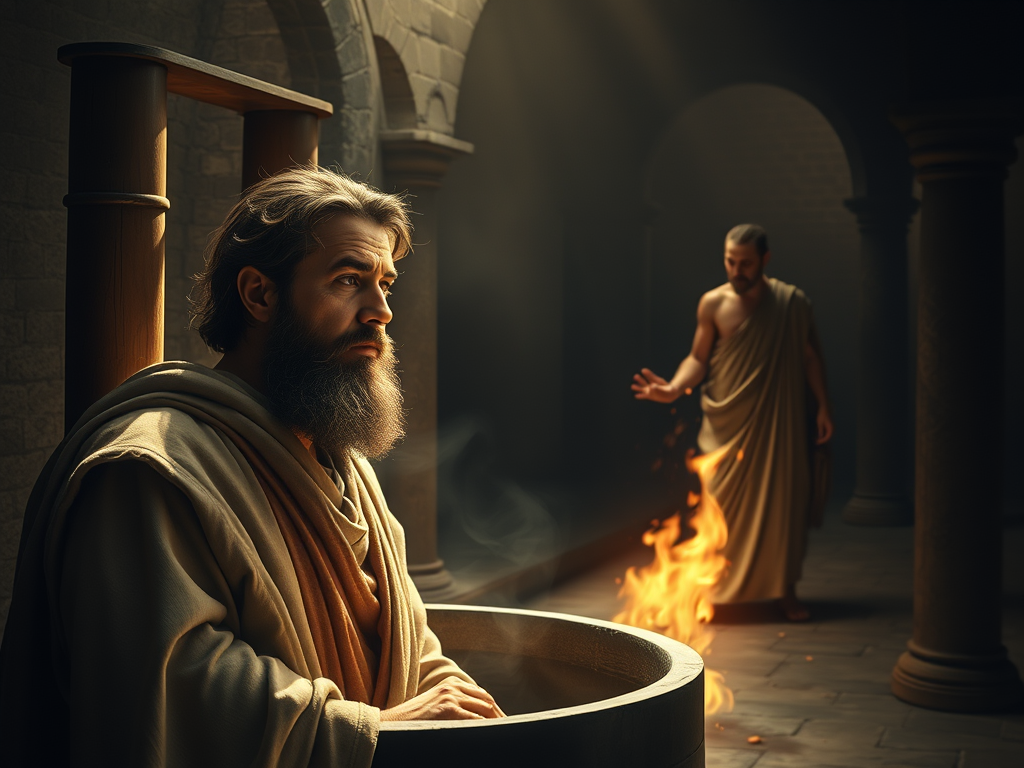
Gideon and Peter stand in different Testaments, but their stories run on the same track: fearful, ordinary men transformed into courageous leaders when God clothes them with His Spirit.
Gideon: fear in the winepress
When the angel of the LORD first finds Gideon, he is hiding in a winepress to thresh wheat, trying not to be noticed by the Midianite oppressors. Gideon’s own assessment is bleak: his clan is the weakest in Manasseh, and he is the least in his father’s house, stacking up reasons why he cannot possibly be God’s answer to Israel’s crisis.
Gideon then asks for signs, hesitates, and even obeys God at night because he is afraid of his family and townspeople, proving that his default setting is anxiety, not heroism. Yet when the Spirit of the LORD “clothes” him, he blows the trumpet and the Abiezrites rally behind him, marking a clear turning point from hiding to heralding that cannot be explained by personality alone.
Peter: fear in the courtyard
Peter’s story of fear plays out in a different setting: a courtyard on the night of Jesus’ trial. After promising unwavering loyalty, he denies even knowing Jesus three times to servants and bystanders, undone by the pressure of association with a condemned man.
The Gospels portray Peter as outspoken yet unstable, quick to speak and quick to fall, a disciple whose courage collapses when following Jesus suddenly looks costly. By the time we reach Acts, this same Peter stands before crowds and councils, but something fundamental has shifted in his inner life.
Clothed and filled by the Spirit
Gideon’s turning point comes in Judges 6:34, where the Spirit of the LORD comes upon him—literally “puts him on” like a garment—enabling him to act as God’s visible instrument of deliverance. His circumstances have not changed, his pedigree is the same, and the Midianites are still formidable, but the presence of the Spirit turns excuses into action and fear into obedience.
Peter’s turning point comes at Pentecost, when he and the other disciples are filled with the Holy Spirit and begin to speak in other tongues as the Spirit enables them. The one who once crumbled under the questions of a servant girl now preaches to thousands, explaining Jesus’ death and resurrection with clarity and confronting his listeners with the claim that God has made Jesus both Lord and Christ.
Boldness in the face of pressure
Gideon still wrestles with fear even after the Spirit comes upon him; he asks for more signs and moves cautiously, but he moves. Commentators observe that Gideon’s story is not about a naturally brave man but about a fearful man who keeps choosing obedience one step at a time because God has promised to be with him.
In Acts 4, Peter and John face the same council that condemned Jesus, yet Peter, “filled with the Holy Spirit,” addresses them directly, proclaiming that salvation is found in no other name. Observers are astonished at their boldness, recognizing they are ordinary, uneducated men, and later the gathered believers pray for even more courage until the place is shaken and they are all filled with the Holy Spirit and speak the word of God with boldness.
From their story to ours
Gideon and Peter together show that Spirit-empowered boldness is not the absence of fear but the presence of a greater reality: God with and in His people. One man blows a trumpet and leads a small army; the other lifts his voice and leads thousands into the kingdom, yet both are living out the same miracle—a God who “puts on” weak people so His strength can be seen.
For readers today, their journeys invite a simple, searching question: where does life feel like the winepress or the courtyard, and what might it look like to ask for—and act in—the same Spirit-given courage? The God who met Gideon in hiding and Peter in failure still delights to clothe and fill fearful hearts, turning small, trembling steps into part of His larger story.

Leave a Reply