
Most of us have read Matthew 16:18 a hundred times. The gates of Hades will not prevail against the church. We hear it as a vague promise of victory. We picture Jesus saying it somewhere in Galilee, in a synagogue maybe, on a hillside maybe, on a road definitely.
He said it in front of a cliff the locals called the gate of hell.
The location matters. The location was the sermon.
Where Jesus took them
Mark and Matthew both mark the location precisely. Caesarea Philippi. The far northern edge of the land Israel had ever called its own. Twenty-five miles north of the Sea of Galilee, at the foot of Mount Hermon, in territory that had been pagan for centuries.
The Jews around Jesus did not go there. There was nothing for them there. The place was almost entirely Gentile, mostly Greek-speaking, dominated by foreign cults and a recent Roman temple. It was the last place in the region a Jewish rabbi would take his students for a teaching field trip.
Jesus took them there on purpose.
The cliff of the dead gods
The place had a long religious history before he arrived. In the time of the Old Testament it had been called Baal-Hermon and Baal-Gad, names that tell you what was being worshiped on the slopes. By the time of Jesus it was named for the Greek god Pan, and the locals called it Paneas, which is preserved in the modern Arabic name Banias.
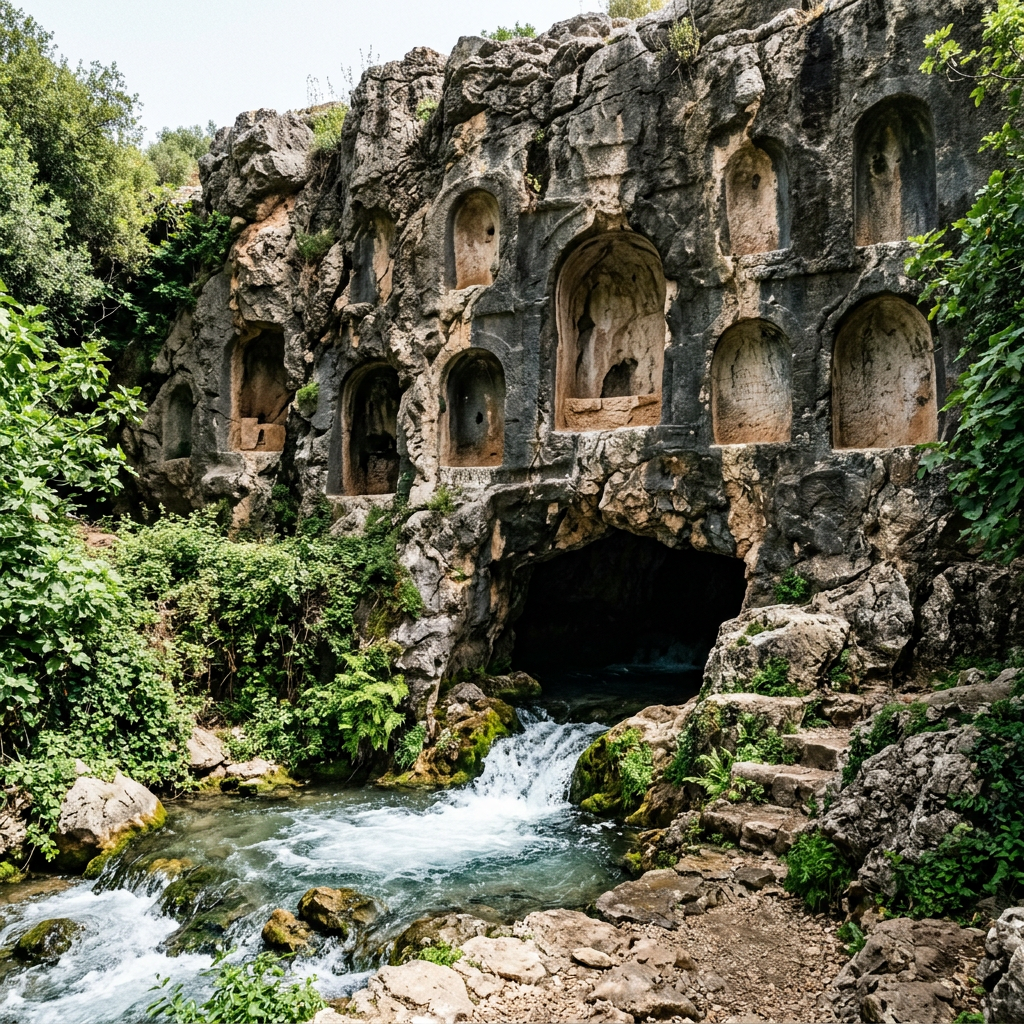
A massive cliff face rose at the back of the city. Carved into that cliff was a row of niches that had once held statues of Pan and other Greek gods. You can still see those niches today. The cliff was called the Rock of the Gods.
At the base of the cliff was a cave. The locals believed the cave was a literal gate to the underworld. Spring water poured out of the cave, which they believed came up from the realm of the dead. The Greeks and Romans performed rituals there meant to summon and to please the gods of the depths. The ancient writer Eusebius records that goats were thrown into the cave as offerings and never reappeared, which the locals took as evidence that the cave reached all the way down. The whole place dripped with what was called underworld access.
And on top of all that, Herod the Great’s son Philip had recently built a gleaming white marble temple to Caesar Augustus on the platform above the cliff. The imperial cult planted in the very rock the locals called the mouth of hell. Pagan idolatry and Roman imperialism stacked on top of one another at the worst religious address in the region.
The question and the confession
Jesus started with the easy question. Who do men say that I am. The disciples gave him the polite answers. John the Baptist. Elijah. Jeremiah. One of the prophets. Then he sharpened the question. But who do you say that I am.
Peter answered. “You are the Christ, the Son of the living God” (Matthew 16:16, NKJV). Notice the phrasing. The Son of the living God. Spoken in front of a row of dead gods carved into a cliff. Peter is not just confessing the deity of Jesus. He is contrasting Jesus with everything that cliff face stood for. The God in front of us is alive. The gods in the niches behind you are not.
The rock and the gates
Then Jesus answered. “On this rock I will build My church, and the gates of Hades shall not prevail against it” (Matthew 16:18, NKJV).
The Greek for rock is petra (G4073), a feminine noun meaning a massive ledge of stone, a cliff, bedrock. Not a stepping stone. Not a pebble. The kind of rock you build a wall on top of. He may well have gestured at the cliff while he said it. On this rock. He was claiming the rock everyone thought belonged to death and to Caesar for his church.
The Greek for church is ekklēsia (G1577), the called-out assembly, used in the Greek Old Testament for the congregation of Israel gathered before the Lord. This is the first time the word appears in the Gospels. The church gets its name in a sermon delivered at the gate of hell.
And the famous line is doing something we miss in the English. Gates do not advance. Gates do not attack. Gates hold a position. They defend. To say that the gates of Hades will not prevail is to say that the gates will fail. The church will be the one advancing, and the gates of hell will be the ones falling. He is not promising the church will survive the onslaught. He is promising the church will lead the onslaught and the gates will not hold.
The Greek word for prevail is katischuō (G2729), to overpower, to be strong enough to hold off. Hell does not have the strength to hold off the church his Father is going to build. The picture is hell on its heels.
Why he picked the worst spot
He did not announce the church in the Court of the Gentiles at the temple. He did not announce it in a quiet field outside Jerusalem. He announced it in front of the cliff of the dead gods, with the marble temple of Caesar above it, the cave of the underworld behind it, and a row of empty idol niches as the backdrop. The location was the sermon.
There is something deeply pastoral about that choice. Look at where you have lived your worst spiritual experience and assume Jesus would never set foot there. The place of your secret shame. The room where you betrayed somebody. The car where you signed the lie. The bar where the addiction had its grip on you. We expect Jesus to call us back to the safe places. He calls us out to the cliff faces. He builds on the ground the enemy thought belonged to him.
If he is willing to plant his church at the gate of hell, he is willing to plant his work in the address you would never bring him to. He picks the worst spot on purpose. That is not bad news for the worst spot on your map. That is the gospel.
The rock will not hold. The gates will fall. And he will build what he said he would build, on the ground you thought was already lost.
This is the second post in the Hidden in Plain Sight series, on the sayings of Jesus that open up when you know the world they were spoken into.

Leave a Reply