
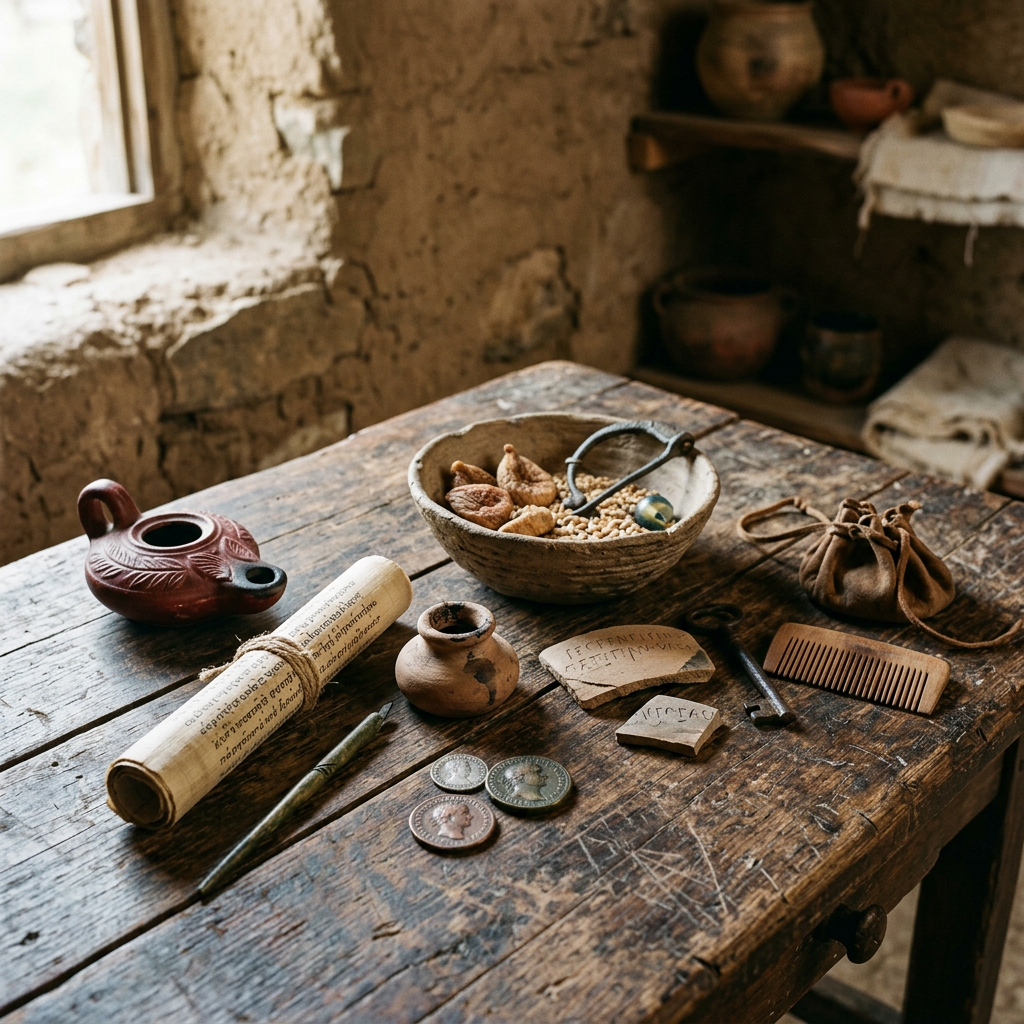
Jesus did not preach from a podium with notes. He preached on a hillside, on a boat, in a vineyard, at a well, in a borrowed dining room. He preached to fishermen and farmers and housewives and tax collectors and Pharisees and beggars. He used what they had in their hands.
A coin. A seed. A wineskin. A needle. A jar. A net. A lamp. A handful of bread. He reached for ordinary objects because his hearers handled them every day. The object did half the teaching.
You can hear his teaching without knowing any of this. You can read the words and walk away nodding. But when you know the object, the same teaching opens out. The denarius gets heavier. The seed gets smaller. The needle gets impossibly small. The cloak gets warmer. The two mites land with a different sound.
The eye of the needle
A camel through the eye of a needle. The picture is famous, and the explanation that has gone around for centuries is wrong. You have probably heard about a small gate in the wall of Jerusalem called the Needle’s Eye, supposedly low enough that a camel had to kneel and have its baggage removed to get through. There is no first-century evidence for that gate. It is a medieval invention that softened a saying everyone in the church was uncomfortable with.
Jesus meant the plain absurdity. A camel was the largest animal in the region. The eye of a sewing needle was the smallest opening anyone handled in daily life. He paired the biggest thing he could name with the smallest gap.
The disciples reacted exactly as you would expect. “Who then can be saved?” (Matthew 19:25, NKJV). They heard the impossibility on purpose, because the impossibility was the point. His answer is the line we should be repeating. “With men this is impossible, but with God all things are possible” (Matthew 19:26).
The widow’s two mites
The temple treasury was a long room with thirteen receptacles, shaped like trumpets, narrow at the top and flaring out below to receive coins dropped through the opening. The rich brought heavy bags, and pouring out a large gift made a loud clatter as the coins rattled down the metal flange. The whole crowd could hear who was giving big.
Jesus sat opposite the treasury and watched.
A widow came up and dropped in two lepta. The lepton was the smallest copper coin in circulation, worth about one one-hundred-twenty-eighth of a denarius. The two together were practically silent in the trumpet. The faintest possible sound in the loudest possible room.
Jesus called the disciples over and told them that her two coins were more than all the rest combined. “She out of her poverty put in all that she had, her whole livelihood” (Mark 12:44, NKJV). She had heard the clatter of the rich and gave anyway. He heard the quietest gift in the loudest room and called it the greatest.
Heaven listens for the faintest coins.
The grain of wheat
The setting matters. Some Greeks have just come up to the feast asking to see Jesus (John 12:20-22). It is the signal he has been waiting for. The hour has come when the message will reach beyond Israel. The gospel is about to go to the nations.
And it is at that moment, with the Greeks waiting and the door to the world opening, that he says, “Unless a grain of wheat falls into the ground and dies, it remains alone, but if it dies, it produces much grain” (John 12:24, NKJV).
Every farmer in the crowd knew the picture by heart. The seed has to be buried and broken to multiply. Jesus turns the plainest fact of the field into the logic of his own death and the harvest it would bring. The Greeks at the gate are the first heads of grain. The harvest he is talking about is us.
What was in his hand is in yours
Read your Gospel with the objects in mind and the parables stop being abstract. They become the actual stuff of actual lives. Jesus did this on purpose. He did not bring a sermon down out of the air. He picked up what was on the table.
There are two takeaways here for our reading and our walking.
For the reading. When you find an object in a saying, stop and ask what it cost, who used it, what it was made of, how big it was, how loud when it hit the bottom of the trumpet. The object is doing work. Look it up. A study Bible with cultural notes will pay for itself in the first week.
For the walking. The Lord is still doing this. He is still teaching with what is in your hand right now. The pen, the steering wheel, the spatula, the laptop, the diaper, the credit card, the hammer, the spoon. None of these is too ordinary to carry his lesson, and most of his lessons in your life are not going to come from a pulpit. They are going to come from what is in your hand.
The mustard seed got his attention. The throwaway sparrow got his attention. So does the very small thing in front of you right now.
He has not changed the way he teaches. We have just gotten used to expecting him to do it some other way.
This is part of the Hidden in Plain Sight series. The full study is available as a book and as a six-week small group resource at hanksbiblestudy.com.

Leave a Reply