
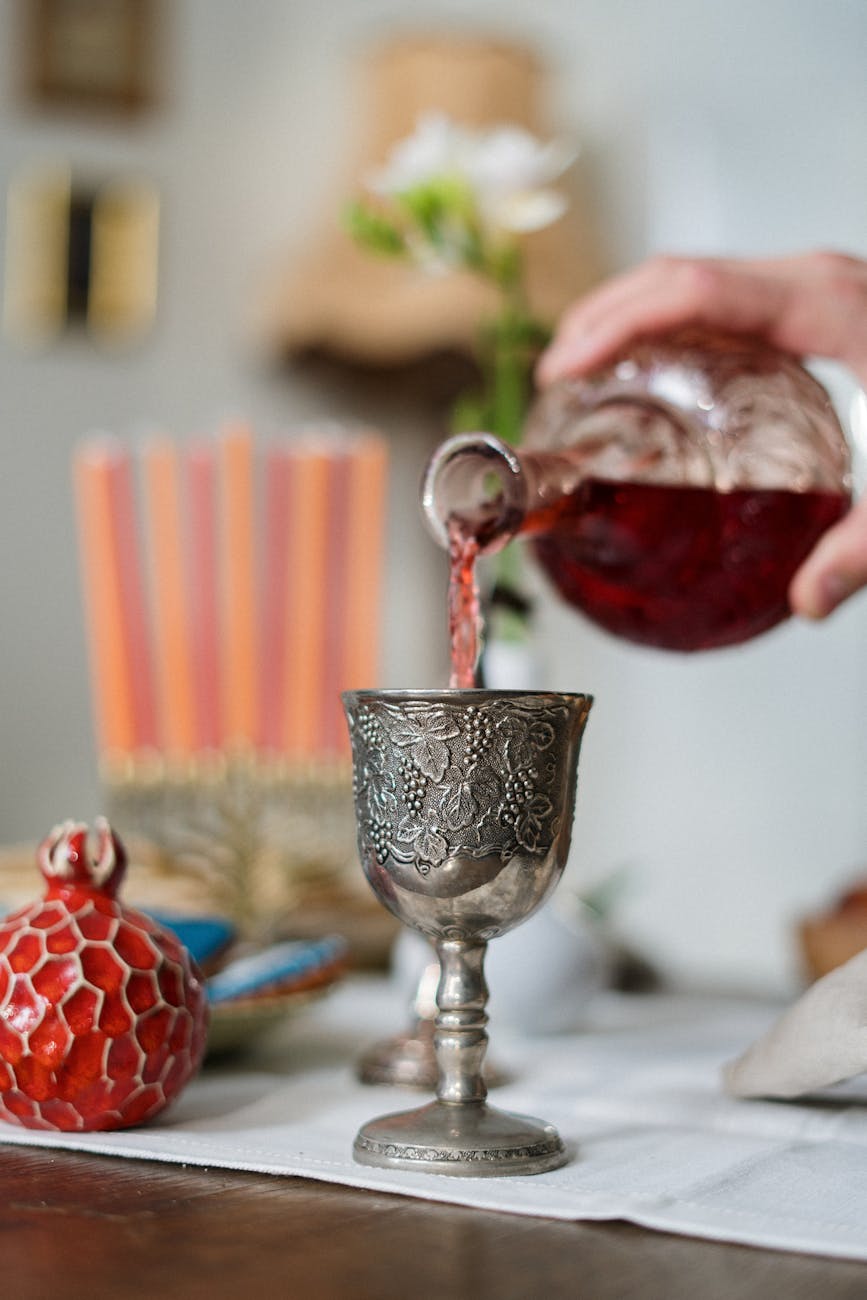
From Egypt’s Broken Gods to the Table of the Risen Christ
Exodus 2; 12 · 1 Corinthians 5:7; 10:16 · John 6:53–56 · Romans 8:11 · Ephesians 1:19–20
There is a verse tucked into the middle of the Exodus narrative that reframes everything. God is about to strike Egypt with the final, climactic plague, and He states His purpose with unmistakable clarity:
| Exodus 12:12“Against all the gods of Egypt I will execute judgment — I am the LORD.” |
That single sentence changes how we read the entire sequence of plagues. What follows is not a random catalogue of natural disasters escalating toward a grand finale. What follows is a systematic, point-by-point demolition of the Egyptian pantheon — a declaration by the God of Abraham, Isaac, and Jacob that He, and He alone, is sovereign over every domain the gods of Egypt claimed to rule.
But the story doesn’t begin at Exodus 12. It begins with a basket on the Nile. And it doesn’t end when Israel walks out of Egypt. It ends at a table — the night before the cross — where Jesus picks up the Passover cup and says, “This is the new covenant in My blood.”
Follow the thread from the first deliverer to the last, from the blood on the doorposts to the blood of the eternal covenant, and you will find one of the most carefully constructed theological arguments in all of Scripture. God doesn’t improvise. He prepares.
Before the Passover: The Deliverer Who Was Delivered
God could have sent Moses into Egypt without a backstory. He didn’t. The opening chapters of Exodus are themselves a theological overture — a miniature gospel announcement hidden in a story about a Hebrew mother and a basket coated in pitch.
Pharaoh’s Death Decree
Exodus 1 closes with Pharaoh issuing an order that chills the blood of every Hebrew family: every newborn son is to be cast into the Nile. It is a genocide decree designed to eliminate the future of an entire people.
Matthew 2 records another Pharaoh issuing another death decree over another generation of Hebrew boys. The parallel is not accidental. Matthew wants his Jewish readers to feel it the moment they encounter the infant Jesus: a new Moses has arrived. The tyrant can feel it too. And this deliverer, like the first one, will be preserved through the shadow of a ruler’s murderous hand.
The Basket and the Ark
Exodus 2:3 records what Moses’ mother does when she can no longer hide her son:
| Exodus 2:3“But when she could no longer hide him, she took an ark of bulrushes for him, daubed it with asphalt and pitch, put the child in it, and laid it in the reeds by the river’s bank.” |
That word translated “ark” deserves a second look.
| תֵּבָה (TEVAH) H8392 |
| Meaning: Ark, chest, vessel of preservationThis word appears in exactly two places in all of Scripture: Genesis 6:14 (Noah’s ark — the vessel that carried humanity through the waters of judgment) and Exodus 2:3 (Moses’ basket — the vessel that carried the deliverer through the waters of death). God is not being subtle. Both are vessels of salvation drawn through death-waters by the hand of God. |
The same word links Noah’s rescue from the flood to Moses’ rescue from Pharaoh’s edict. God is signaling, through the vocabulary of the text itself, that He works in consistent patterns — that history is not a series of unrelated episodes but a single unfolding story with a single Author.
Pharaoh’s daughter draws the infant from the water and gives him his name:
| מֹשֶׁה (MOSHEH) H4872 |
| Meaning: “Drawn out” — “I drew him out of the water” (Exodus 2:10)The name is a declaration of identity rooted in prior deliverance. The man who would one day lead Israel through the Red Sea was himself first drawn out of death-waters. The deliverer was first delivered. |
This pattern becomes one of the load-bearing structures of redemptive history. God consistently chooses deliverers who have themselves passed through the experience of rescue. Moses was drawn out before he could lead Israel out. Christ entered death — and conquered it — before He could lead us through it. The One who says “I am the resurrection and the life” is not speaking theoretically. He is speaking from the far side of an empty tomb.
A War Against Gods: The Ten Plagues and the Egyptian Pantheon
With that context in place, we can now read the plagues the way the original audience would have read them — not as a sequence of natural disasters, but as a systematic theological assault on the entire religious system of Egypt’s civilization.
Egypt was not a nation that happened to have a few gods on the side. Egyptian religion was the organizing principle of Egyptian society, economy, agriculture, medicine, and kingship. The gods were credited for the Nile, the crops, the sun, the fertility of women, the health of livestock, and the immortality of kings. Pharaoh himself was not merely a human monarch — he was the divine son of Ra, the embodiment of Horus, the living god of Egypt.
When God declared “Against all the gods of Egypt I will execute judgment,” He meant it comprehensively. What follows is plague by plague, domain by domain, the methodical humiliation of every deity in the Egyptian hierarchy:
1. Water to Blood (Exodus 7:14–25) — Hapi, Khnum
Hapi was the god of the Nile’s annual flood, credited with Egypt’s agricultural prosperity. Khnum was the ram-headed guardian of the Nile’s source. The Nile was not merely a river to Egypt — it was sacred, essentially divine, the source of all life in an otherwise desert land. Turning it to blood was not merely an inconvenience. It was a declaration: the god you have credited for your civilization’s survival is under the authority of Yahweh, and Yahweh alone decides what flows in its banks.
2. Frogs (Exodus 8:1–15) — Heqet
Heqet was the frog-headed goddess of fertility and childbirth, associated with the miraculous gift of new life. Frogs were sacred to her — a symbol of blessing and abundance. The plague weaponized Israel’s own object of worship, turning a sign of divine favor into an overwhelming, rotting curse. Significantly, Pharaoh had to beg Moses to remove the frogs. Heqet could not remove her own sacred animals. The goddess of new life could not manage the infestation that bore her face.
3. Lice / Gnats (Exodus 8:16–19) — Geb, and the Egyptian priestly system
Geb was the god of the earth — the very ground beneath Egyptian feet. When Moses struck the dust of the ground and it became gnats, God was declaring Geb’s domain forfeit. More tellingly, the Egyptian magicians who had matched Moses in the first two plagues could not replicate this one. They admitted to Pharaoh: “This is the finger of God.” Egyptian priests maintained elaborate ritual purity — shaved bodies, multiple daily baths — to remain worthy of approach to their deities. The infestation rendered them ritually impure, unable to serve at the altars. The priestly system itself was disabled.
4. Flies / Swarms (Exodus 8:20–32) — Khepri
Khepri was the scarab-beetle god of the rising sun and new creation, one of the most recognizable deities in the Egyptian pantheon. The sacred beetles that Egyptians wore as amulets and worshiped as symbols of divine power became the instrument of judgment. This plague also marks a theological boundary: for the first time, Goshen is separated from Egypt. A geographical line is drawn in judgment. Yahweh controls the boundaries the Egyptian gods cannot. The protection is not general — it is specific, covenantal, and sovereign.
5. Livestock Disease (Exodus 9:1–7) — Hathor, Apis, Mnevis
Hathor was the cow-headed goddess of love, sky, and motherhood — one of Egypt’s most beloved deities. The Apis bull was kept in a temple at Memphis and worshiped as a living manifestation of the god Ptah. The Mnevis bull was the sacred bull of the sun god at Heliopolis. These animals were not merely symbols; they were treated as living gods. The death of the livestock was an assault on the most visible, tangible, irreplaceable expressions of Egyptian religious devotion. The living gods were dying in the fields.
6. Boils (Exodus 9:8–12) — Sekhmet, Isis, Imhotep
Sekhmet was the lion-headed goddess of both disease and healing — the deity Egyptians called upon for protection from sickness. Isis was the great goddess of magic and healing. Imhotep, the ancient physician, had been deified and was invoked for medical intercession. In this plague, the gods of healing could not protect even their own priests. The text notes that the magicians — Egypt’s professional religious intercessors — were themselves covered with boils and could not even stand before Moses. The healers needed healing. The gods of medicine had no medicine for what God had sent.
7. Hail (Exodus 9:13–35) — Nut, Seth, Osiris
Nut was the sky goddess who arched her body over the earth as the visible dome of heaven. Seth was the god of storms and chaos. Fire and hail falling together — a phenomenon described as unprecedented in Egyptian history — overturned the sky gods on their own turf. The crops destroyed were not randomly chosen: flax and barley, crops associated with specific agricultural deities, were stripped bare. Wheat and spelt were spared — not because the storm was indiscriminate, but because God was exercising precise sovereignty over what lived and what died.
8. Locusts (Exodus 10:1–20) — Nepri, Osiris, Seth
Nepri was the god of grain; Osiris ruled vegetation and the fertility of the land. Whatever the hail had left standing, the locusts consumed. Egypt’s entire agricultural religion — the system that credited the gods with the fertility of the land — was stripped bare. The nation that had been the breadbasket of the ancient world was being systematically unmade, field by field, crop by crop. Pharaoh’s own officials had already begun to plead with him to let Israel go, calculating the economic catastrophe. The gods could not protect their domain.
9. Darkness (Exodus 10:21–29) — Ra, Amun-Ra, Horus, Aten
This may be the single most theologically pointed plague in the sequence. Ra was the supreme deity of Egypt — the sun god, the source of all light and life, the deity most closely identified with Pharaoh’s divine lineage. Amun-Ra, Horus, and Aten all represented aspects of solar divinity. Three days of absolute, palpable darkness — “darkness which may be felt” (v. 21) — was not merely a meteorological anomaly. It was a direct, three-day declaration of Yahweh’s supremacy over the greatest deity in Egypt’s pantheon. Pharaoh himself was considered the living son of Ra, Horus incarnate. The darkness that fell over Egypt was darkness over the throne. The divine king sat in the dark while Israel had light in their dwellings.
10. Death of the Firstborn (Exodus 11–12) — Pharaoh as son of Ra, Osiris
The tenth plague is the capstone and the convergence of everything that has come before. The firstborn son of Pharaoh dies — the heir to divinity, the next vessel of Ra’s presence, the future “son of god” of Egypt. The entire Egyptian theology of the afterlife, which was Osiris’s domain, is exposed as hollow. Osiris cannot protect the dead. Ra cannot protect his son. The gods of Egypt had no answer for the angel of death that moved through the land that night. And Yahweh — who passes over every blood-marked household — demonstrated with finality that He, and He alone, holds authority over life and death.
| KEY TRUTH The plagues were not random punishment. They were a comprehensive, systematic theological argument — delivered in ten acts — proving that every claim every Egyptian deity had ever made was false. By the night of the Passover, the entire Egyptian religious system lay in ruins. The only thing that could protect any household was something the Egyptian gods could not provide: the blood of a substitute. |
The Night That Changed Everything: The Passover Instructions
Into this landscape of shattered gods, God gives Israel precise, detailed instructions for the one thing that will protect them when death moves through Egypt. The instructions in Exodus 12 are not improvised. Every element is deliberate, every detail carries weight, and — as the New Testament will make explicit — every detail was designed to point forward.
The Spotless Lamb
The lamb had to be tamim — without blemish. This was not a suggestion or a preference. It was the standard for every sacrifice in Israel’s entire covenant system.
| תָמִים (TAMIM) H8549 |
| Meaning: Complete, whole, without blemish, sound, perfectUsed 91 times in the Old Testament: of sacrificial animals (Ex. 12:5), of Noah — “blameless” (Gen. 6:9), and of God’s own character — “His work is perfect” (Deut. 32:4). The New Testament echo is unmistakable: Peter describes Christ as “a lamb without blemish and without spot” (1 Pet. 1:19), using this exact concept as his interpretive frame. |
Only a perfect substitute can stand in for another. A defective offering insults both the one it is offered to and the one it is offered for. The spotlessness of the Passover lamb is not a sanitary standard — it is a Christological requirement written into the very first sacrifice.
The Blood on the Door
The blood was applied to the doorposts and lintel of every household — not as information God needed to locate His people, but as a covenantal sign. A death had occurred in that household. A substitute had borne what the firstborn of that house would otherwise have faced. Protection was not granted based on the merit of the people inside. It was granted entirely on the basis of the substitute that died.
| Exodus 12:13“And when I see the blood, I will pass over you.” |
God was not looking for good Israelites. He was looking for the blood. This is the architecture of grace — not moral achievement, but substitutionary covering. The household under the blood was not partially protected. They were completely protected. The angel of death had nothing to say to a door marked with the blood of a spotless lamb.
No Bone Broken
Exodus 12:46 records an instruction that seems, on first reading, like a logistical detail: “You shall not break one of its bones.” File this. It will come back in a way that should stop you cold.
A Memorial Kept Open
God immediately commanded Israel to repeat this meal every year — the same lamb, the same blood, the same questions, the same story. He was not closing the narrative. He was keeping it open, sustaining a question in the life of every generation of Israelites: “What does this lamb mean? What is this blood for? Why does God pass over us and not our enemies?” He was giving Israel 1,400 years of asking before He gave them the full answer.
The Pattern Points Forward: Three Connections Across Fifteen Centuries
The New Testament does not treat the Passover as a fond historical memory. It treats it as a prophetic blueprint — a precise advance sketch of what God was always planning to do in Christ. Three connections in particular demand attention.
The Spotless Lamb → The Sinless Son
| 1 Peter 1:18–19“…knowing that you were not redeemed with corruptible things, like silver or gold… but with the precious blood of Christ, as of a lamb without blemish and without spot.” |
Peter’s language is Exodus 12 language. The tamim requirement laid down for the Passover lamb is the very qualification Peter invokes for Christ. A defective substitute cannot stand in for another. Only a sinless one can absorb what a sinful one deserves. The Passover lamb’s spotlessness was a shadow cast fifteen centuries before the substance arrived.
No Bone Broken → The Cross
Now retrieve the detail we filed away. John 19:33 records the moment when the soldiers came to break Jesus’ legs to hasten His death — standard Roman crucifixion practice. When they reached Him, they found He was already dead. They did not break His legs.
| John 19:36“For these things were done that the Scripture should be fulfilled, “Not one of His bones shall be broken.”” |
John is explicit: a Roman soldier’s decision not to break a condemned man’s legs fulfilled a ritual instruction given in Exodus 12. A single detail, preserved through 1,400 years of annual Passover observance, became physical evidence at Golgotha. The type had arrived at its fulfillment, and even the soldiers of the empire were unknowing participants in the script God had been writing since Egypt.
The Blood on the Door → Justification
| ἹΛΑΣΤΉΡΙΟΝ (HILASTĒRION) G2435 |
| Meaning: Propitiation — the turning away of divine wrath through a satisfactory sacrificeAlso the word for the mercy seat on the Ark of the Covenant (Heb. 9:5; LXX Ex. 25:17). Christ is the true mercy seat: the place where God’s wrath is fully satisfied and His mercy is freely dispensed. The blood on Egypt’s doorposts was a shadow of this. The cross is the reality. |
Paul’s declaration in Romans 3:24–25 is built on this imagery: God set forth Christ as a hilastērion — a propitiation. Divine wrath is not avoided at the cross; it is absorbed. It falls entirely on the substitute. The household under the blood in Egypt was not partially safe. They were safe — completely. And so is every soul that has stepped inside the covering of Christ’s blood. Paul’s summary statement in 1 Corinthians 5:7 is not a comparison or a spiritual metaphor. It is a fulfillment announcement: “Christ, our Passover, was sacrificed for us.”
The Last Passover Becomes the First Communion
Fourteen hundred years of Passover observance came to their appointed destination in an upper room in Jerusalem. Jesus and His disciples gathered to eat the same meal Israel had eaten since the night in Egypt. Jesus knew the ritual. His disciples knew the ritual. But on this night, He reinterprets the entire meal around Himself.
| Luke 22:19–20“He took bread, gave thanks and broke it, and gave it to them, saying, “This is My body which is given for you; do this in remembrance of Me.” Likewise He also took the cup after supper, saying, “This cup is the new covenant in My blood, which is shed for you.”” |
The Passover bread had always pointed to the Exodus departure — the haste of that night, the bread baked without time to rise. Jesus says: “This is My body.” The Passover cup had always pointed to God’s redemption from Egypt. Jesus says: “This cup is the new covenant in My blood.”
He is not adding a new layer of meaning to the Passover. He is revealing the meaning the Passover always had. Every lamb slaughtered on every Passover for fourteen centuries was pointing here, to this table, to this cup, to this Man.
The Timing Was Not Coincidental
Jesus was crucified on the fourteenth of Nisan — the same day tens of thousands of Passover lambs were being slaughtered in the Jerusalem temple courts. The calendar convergence was not a coincidence. It was divine choreography. God set the date 1,400 years in advance, synchronized the clock of redemptive history with the Passover calendar, and delivered the Lamb of God on the precise day the whole system had been pointing toward.
An Unfinished Feast
Luke 22:18 records something Jesus said that the disciples may not have fully understood in the moment: “I will not drink of the fruit of the vine until the kingdom of God comes.” He withheld the final cup. Every Communion we take is an eschatological meal — we eat between the cross and the coming kingdom. As Paul writes in 1 Corinthians 11:26: “For as often as you eat this bread and drink this cup, you proclaim the Lord’s death till He comes.” The feast is not finished. There is a cup still to come.
More Than Memory: Communion as Present-Tense Participation
When most Christians think about Communion, they think about remembrance — looking back to the cross. And that is real. The Greek word for remembrance is anamnēsis, and Jesus uses it: “Do this in remembrance of Me.” But there is a second word in the New Testament’s teaching on Communion that changes everything about what we understand it to be.
| 1 Corinthians 10:16“The cup of blessing which we bless, is it not the communion of the blood of Christ? The bread which we break, is it not the communion of the body of Christ?” |
| ΚΟΙΝΩΝΊΑ (KOINŌNIA) G2842 |
| Meaning: Participation, fellowship, active sharing-in, partnership — present-tense unionThis is not the word for remembering something from a distance. It is the word for actively sharing in, being a participant in, having union with. Paul uses the same word in Philippians 3:10 (“the fellowship of His sufferings”) and 2 Corinthians 13:14 (“the communion of the Holy Spirit”). Koinōnia is always about present, active participation — not past-tense recollection. |
Paul is not saying: “We remember Christ’s blood.” He is saying: “We participate in it. We have union with it. We share in the life it carries.” When you take Communion, you are not visiting a museum exhibit about a past event. You are declaring present-tense union with a living Person.
Abiding: The Word Beneath the Words
John 6:53–56 pushes even deeper:
| John 6:56“Whoever eats My flesh and drinks My blood abides in Me, and I in him.” |
| ΜΈΝΩ (MENŌ) G3306 |
| Meaning: To remain, abide, dwell, continue — ongoing present-tense realityThis is the same word Jesus uses throughout John 15: “Abide in Me, and I in you.” It describes a continuous, present-tense dwelling — not a single past event. Jesus is saying: the eating and drinking of Communion points to and participates in an ongoing union with Him. You are not consuming a memory. You are declaring: I am abiding in the risen Christ. He is abiding in me. |
The Power That Raised Christ Lives in You
The Passover gave Israel the power to walk out of Egypt. What Communion declares is something incomparably greater than the power of a single night’s deliverance. It declares the power that is now resident in every believer through the indwelling Spirit.
| Romans 8:11“But if the Spirit of Him who raised Jesus from the dead dwells in you, He who raised Christ from the dead will also give life to your mortal bodies through His Spirit who dwells in you.” |
| Ephesians 1:19–20“…and what is the exceeding greatness of His power toward us who believe, according to the working of His mighty power which He worked in Christ when He raised Him from the dead…” |
| ἘΝΈΡΓΕΙΑ (ENERGEIA) G1753 |
| Meaning: Working, operative energy, active power — root of our word ‘energy’Paul says the energeia that raised Christ from the dead is the same power directed ‘toward us who believe.’ This is resurrection power — not past tense. Present tense. The power that split the grave on the third morning is not a historical curiosity. It is the operative energy of the indwelling Spirit of God. |
From Doorpost to Dwelling
There is one final contrast that captures the entire movement from Exodus to Pentecost. Under the old covenant, the blood was applied to the doorframe of an external structure — protection placed on the outside of a building. Under the new covenant, something incomparably greater has taken place.
| ΝΑΌΣ (NAOS) G3485 |
| Meaning: The inner sanctuary — the Most Holy PlaceNot hieron (the outer temple courts) but naos — the innermost chamber where the Shekinah glory dwelt, where only the High Priest could enter, once a year. Paul uses this word in 1 Corinthians 6:19: “Do you not know that your body is the temple (naos) of the Holy Spirit?” |
Under the old covenant: the blood covered the doorposts of a house. Under the new covenant: the Spirit of the living God dwells inside the believer. You are not a building with blood on the door. You are the inner sanctuary of God.
The direction of God’s movement throughout redemptive history is always inward — closer, more intimate, more pervasive. The Passover blood was outside. The Holy Spirit is inside. The Passover protected a household for one night. The indwelling Spirit transforms a person for eternity.
| KEY TRUTH Communion is not a museum visit to a past event. It is a present-tense declaration: the risen Christ is in me. His resurrection power is in me. The same Spirit that raised Him from the dead is the Spirit who lives in me and animates my life today. |
The Arc of the Whole Story
Stand back and see what God has constructed across these pages.
A mother coats a basket with pitch and sets it among the reeds, and God uses the same word for that basket that He used for the ark that carried humanity through the flood — because He is signaling that He works in consistent patterns of salvation drawn through death-waters.
A deliverer is pulled from the Nile and given a name that means “drawn out” — because the deliverer himself was first delivered, and the One who would fulfill Moses’ type would one day descend into death and be drawn out of it on the third day.
Ten plagues systematically demolish the religious system of the most powerful empire on earth, demonstrating that every claim every Egyptian god ever made was false — because Yahweh will not share His glory with the works of human hands, and because Israel needed to see that their God was sovereign over every domain and every power that claimed authority over their lives.
A lamb without blemish is slaughtered, its blood applied to a door, its bones left unbroken — because God is encoding the precise specifications of the cross into the genetic material of Israel’s annual worship, so that when the fulfillment arrives, there will be no mistaking it.
Jesus picks up the Passover cup in an upper room and says “This is the new covenant in My blood” — because He is the reality the shadow was always pointing toward, the Lamb whose death ends the need for any other.
And the risen Christ sends His Spirit to dwell not on the doorposts of houses but inside the bodies of believers — because the direction God always moves is inward, closer, more pervasive — until the day He says “I will wipe away every tear from their eyes” at a table far greater than any upper room in Jerusalem.
Every time you take Communion, you are standing at the intersection of all of this. You are not doing a ritual. You are declaring the whole story — that you were once under the sentence of death with no covering, that the Lamb died in your place, that His blood marks the door of your life, that you are not merely protected but indwelt, and that you are eating the appetizer of a feast that has not yet been finished.
The blood still speaks. And what it says is: it is finished, it is present, and the best is yet to come.

Leave a Reply