
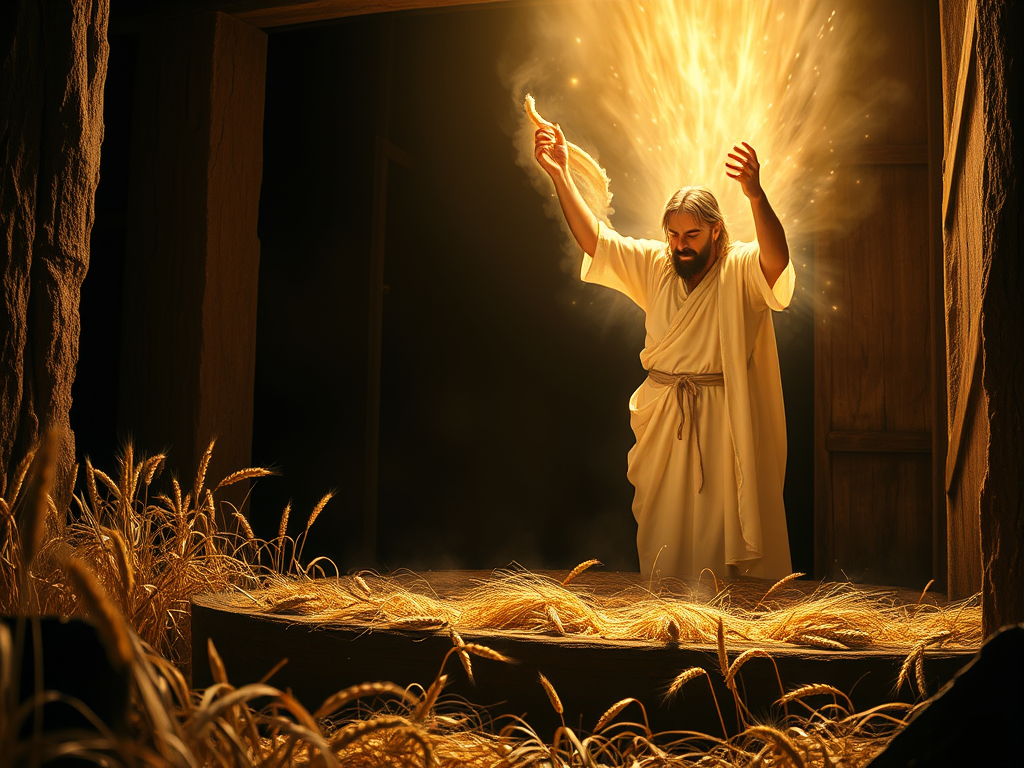
The book of Judges presents us with an unusual hero. Gideon wasn’t seeking glory—he was hiding in a winepress, threshing wheat in fear of the Midianites. Yet in this moment of weakness, Scripture records something extraordinary: “But the Spirit of the LORD came upon Gideon” (Judges 6:34).
The Hebrew word lāḇaš translated as “came upon” literally means “to put on” or “to clothe.” Most English translations obscure this vivid imagery, but a more literal rendering would be: “The Spirit of the LORD clothed Himself with Gideon” or “The Spirit of the LORD put on Gideon like a garment.”
God Wears Us Like a Garment
This reversal is stunning. We don’t simply receive the Spirit as an internal force—the Spirit envelops us, wears us, operates through us. Gideon became the visible expression of God’s invisible power. His hands became God’s hands. His voice became God’s voice. His leadership became the channel through which divine purposes flowed into history.
Think about what clothing does. It’s the part of you that the world sees first. It represents you in public spaces. It protects and equips you for specific tasks. When the Spirit clothes Himself with us, we become His visible presence in the world—His hands extended, His voice speaking, His love made tangible.
This brings a whole new dimension to “We are His hands and feet.” QUITE LITERALLY.
This isn’t about our adequacy. Gideon was the least in his father’s house, from the weakest clan in Manasseh. He had every reason to disqualify himself. But God’s power doesn’t depend on our strength. When the Spirit puts us on, our weakness becomes the perfect backdrop for displaying His might.
Fullness for Purpose
Notice what happened immediately after the Spirit clothed Himself with Gideon: “then he blew the trumpet, and the Abiezrites gathered behind him.” The Spirit’s clothing wasn’t for Gideon’s personal blessing alone—it was for mobilizing God’s people toward His purposes. Being full of the Holy Spirit always connects to divine assignment.
The same pattern appears throughout Scripture. When the Spirit came upon the seventy elders, they prophesied. When the Spirit filled Bezalel, he created the tabernacle. When the Spirit descended on Jesus, He immediately went into the wilderness and then into ministry. Fullness leads to fruitfulness.
We might prefer a Spirit-filling that feels comfortable, like a warm blanket on a cold night. But the Spirit clothes us for action. He equips us for specific tasks that advance God’s kingdom. The question isn’t whether we feel qualified—it’s whether we’re willing to be worn by God for His purposes.
Surrendering to Be Worn
Being clothed with the Spirit requires surrender. A garment doesn’t direct the person wearing it; the person directs the garment. When God puts us on, we yield our will to His, our plans to His purposes, our strength to His power. We become the instrument, not the conductor.
This surrender isn’t passive resignation. Gideon still had to blow the trumpet. He still had to lead. But his actions flowed from God’s initiative, not his own. There’s a beautiful tension here—we’re fully engaged yet fully dependent, actively obedient yet completely reliant on His power.
Many believers struggle because they try to manufacture what only God can initiate. We cannot clothe ourselves with the Spirit through discipline alone, though spiritual practices create space for His work. We cannot conjure His power through correct theology, though understanding matters. The Spirit moves when we position ourselves in humble availability, acknowledging our need and His sufficiency. Remember the Ephesian church in Revelation. Correct in theology, cold in the leading and loving of God.
Living Clothed in the Spirit
For contemporary believers, being clothed with the Spirit looks like daily surrender. It means starting each morning acknowledging that without Him, we can do nothing of eternal value. It means facing our assignments—whether leading nations or changing diapers—recognizing that His power makes the difference.
It also means expecting the Spirit to move. Gideon didn’t blow the trumpet hesitantly, wondering if anyone would respond. When the Spirit clothes us, we can act with confidence—not in ourselves, but in the One wearing us. We speak truth boldly. We love sacrificially. We serve faithfully. Not because we’ve mustered great willpower, but because we’ve been enveloped by divine power.
The Spirit who clothed Himself with Gideon is the same Spirit offered to every believer. Jesus promised that when He ascended, the Spirit would come with power. That promise hasn’t expired. The God who put on a fearful thresher to defeat armies still puts on ordinary people to accomplish extraordinary purposes.
The question is whether we’ll make ourselves available—whether we’ll stand ready to be worn by God, to become the visible expression of His invisible presence, to let our lives become the garment through which He moves in the world.
When we do, something remarkable happens. The weak become mighty. The fearful become bold. The inadequate become sufficient. Not through self-improvement, but through divine habitation. The trumpet sounds, and people gather—not to us, but to the One who clothes Himself with willing vessels.
God “putting on” Gideon opens a window into a consistent biblical pattern: the Spirit of God clothing, filling, or coming upon ordinary people so they can walk in His will with supernatural power.
The meaning of “God putting us on”
Judges 6:34 uses the Hebrew verb lāḇaš, meaning “to put on a garment” or “to clothe,” to describe how the Spirit of the LORD came upon Gideon. Commentators note that the idea is not merely inner encouragement but the Spirit wrapping around Gideon like armor or a mantle, making him “invulnerable and invincible” in God’s strength for his calling.
This imagery suggests several things: God takes the initiative, God takes ownership, and God makes Himself visible through a human vessel. As a garment expresses the shape and movement of the person wearing it, so a Spirit-clothed believer becomes the expression of God’s leadership, wisdom, and courage in a particular moment of history.
Gideon: From hiding to herald
Before the Spirit clothed him, Gideon hid in a winepress, defined by fear, family weakness, and a sense of insignificance. When the Spirit “put him on,” he blew the trumpet and the Abiezrites rallied behind him, a visible sign that God’s power—not Gideon’s charisma—had suddenly taken center stage.
This clothing did not erase Gideon’s personality but transformed his role: timid farmer became Spirit-chosen deliverer. Gideon’s story illustrates that God does not search for the naturally impressive; He looks for those willing to be worn, to let their lives become the fabric through which His courage and strategy are woven into a fearful generation.
Samson: Raw power and a warning
Samson repeatedly experiences the Spirit of the LORD “rushing upon” him, enabling feats far beyond human strength—tearing a lion, striking down enemies, and carrying city gates. This same Spirit-empowerment language appears across Judges, highlighting that victory over Israel’s enemies is consistently attributed to God’s Spirit, not human might.
Yet Samson’s moral compromises show that supernatural gifting does not guarantee spiritual maturity. God can “put on” a deeply flawed person for a moment of deliverance, while still holding that person accountable for character and obedience, reminding readers that the highest work of the Spirit is not power displays but forming a people who walk with God.
Saul and David: Leadership under the Spirit
King Saul is transformed when the Spirit of God comes upon him; he prophesies and is enabled to lead Israel in battle, becoming “another man” for a time. However, Saul’s later disobedience and the Spirit’s departure from him reveal the tragedy of resisting the One who has clothed and lifted you into your calling.
In contrast, David is anointed and the Spirit of the LORD “rushes upon” him from that day forward, marking a more enduring relationship between king and Spirit. David’s psalms show deep dependence on God’s presence, including the plea not to be stripped of the Holy Spirit, underscoring that true leadership is sustained not by talent but by ongoing yieldedness to the One who empowers it.
Prophets and spokesmen: God’s voice in human mouths
The Old Testament records the Spirit of God coming upon prophets and leaders so that God’s word can be spoken with clarity and courage. For example, the Spirit “clothes” Zechariah in Chronicles, and comes upon others like Amasai and Jahaziel, enabling them to speak timely, authoritative messages to God’s people.
These scenes echo the Gideon pattern: when God puts someone on, that person’s voice becomes a vehicle for God’s own voice in a specific context. The prophet’s authority is not rooted in personality but in having been gripped, filled, and clothed by the Spirit for that moment.
Bezalel, Moses, and the seventy: Empowered for “ordinary” work
The Spirit’s empowering is not limited to pulpits and battlefields; it also touches craftsmanship, administration, and shared leadership. Bezalel is “filled with the Spirit of God” for artistic design and construction of the tabernacle, showing that creativity and technical excellence can be a direct overflow of the Spirit’s presence.
In Numbers 11, God takes some of the Spirit that is on Moses and places it on seventy elders, and when the Spirit rests on them they prophesy, signifying divine empowerment for shared leadership. This distribution of the Spirit anticipates a future in which God’s empowering presence is not restricted to a single hero but shared among many servants.
From partial to universal: Jesus and Pentecost
All these Old Testament moments—Gideon, Samson, Saul, David, the prophets, Bezalel, Moses, and the elders—portray the Spirit coming upon particular individuals for specific tasks, often temporarily. The New Testament reveals the fulfillment of this pattern in Jesus, upon whom the Spirit rests in fullness as He preaches, heals, and liberates, embodying perfect cooperation between God and a human life.
At Pentecost, this empowering presence is poured out on all believers, not just a select few, fulfilling the promise that God’s people would be “clothed with power from on high.” The fearful disciples become bold witnesses as the place shakes, they are filled with the Holy Spirit, and they speak the word of God with courage, mirroring the transformation seen in Gideon and others but now extended to the entire Church.
Living today as God’s “garments”
The biblical pattern suggests at least three implications for believers today. First, availability matters more than natural adequacy; God consistently chooses those who feel weak and small, then clothes them with His Spirit for His purposes. Second, empowerment is tied to assignment—whether speaking, creating, leading, or serving, the Spirit’s clothing is given so that God’s will can be done through surrendered human lives.
Third, this empowering is meant to be ongoing, not merely a one-time event; early Christians are repeatedly filled with the Spirit for fresh boldness and obedience as new challenges arise. To live as God’s “garments” is to daily offer minds, mouths, hands, and calendars to Him, expecting that the same Spirit who put on Gideon, David, and the early disciples delights to clothe ordinary people today for the glory of Jesus and the good of the world.
Jesus’ Baptism and the Spirit
[Mat 3:16-17 NKJV] 16 When He had been baptized, Jesus came up immediately from the water; and behold, the heavens were opened to Him, and He saw the Spirit of God descending like a dove and alighting upon Him. 17 And suddenly a voice [came] from heaven, saying, “This is My beloved Son, in whom I am well pleased.” At His baptism, Jesus is publicly affirmed by the Father (“This is My beloved Son…” – Matthew 3:17) and anointed by the Spirit descending like a dove (Matthew 3:16).
This marks the formal beginning of His public ministry. Up until then, Jesus lived in relative obscurity in Nazareth.
The Immediate Conflict with Satan
Right after His baptism, the Spirit leads Jesus into the wilderness to be tempted by Satan ([Mat 4:1 NKJV] 1 Then Jesus was led up by the Spirit into the wilderness to be tempted by the devil.). This shows that His Spirit-filled ministry immediately provokes confrontation with the enemy.
The temptations target His identity (“If You are the Son of God…”) and mission, suggesting Satan is now directly opposing the revealed plan of God.
Was Satan Unaware Before?
Scripture doesn’t explicitly say whether Satan knew Jesus’ identity or mission before the baptism. But several clues help:
Genesis 3:15 already promised a coming “seed” who would crush the serpent’s head. Satan knew someone was coming.
Prophecies throughout the Old Testament pointed to a Messiah, so Satan likely anticipated Him but may not have recognized Jesus until His baptism revealed Him.
The baptism was a public unveiling: the Spirit’s descent and the Father’s voice made clear that Jesus was the chosen One. This may have been the moment Satan realized the battle had begun in earnest.
The baptism is both empowerment (Jesus filled with the Spirit for ministry) and identification (declared Son of God).
Satan’s opposition intensifies once Jesus steps into His Spirit-empowered mission. Before this, Jesus’ life was hidden; after this, His ministry is revealed.
In a sense, the baptism is the “launch signal” — both to the world and to the powers of darkness — that the Messiah has arrived.
Hidden Messiah → Revealed Son of God
Preparation → Confrontation
Obscurity → Spiritual warfare
It’s not that Satan was completely ignorant of God’s plan, but the baptism marks the moment when Jesus’ mission becomes visible, Spirit-empowered, and unstoppable — and Satan responds immediately.
WHAT HAPPENED TO THE MODERN CHURCH?
[2Ch 7:14 NKJV] 14 “if My people who are called by My name will humble themselves, and pray and seek My face, and turn from their wicked ways, then I will hear from heaven, and will forgive their sin and heal their land.
This verse is God’s response to Solomon after the dedication of the Temple in Jerusalem. God is making a covenantal promise to Israel: if they stray and experience drought, pestilence, or judgment, there is a pathway back to Him through repentance.
The phrase “My people who are called by My name” refers specifically to Israel, but through Jesus, New Testament believers are now grafted into that covenant (Romans 11:17-22) and also bear the Name of Christ (Christian – “little Christ”).
[Rom 11:17-22 NKJV] 17 And if some of the branches were broken off, and you, being a wild olive tree, were grafted in among them, and with them became a partaker of the root and fatness of the olive tree, 18 do not boast against the branches. But if you do boast, [remember that] you do not support the root, but the root [supports] you. 19 You will say then, “Branches were broken off that I might be grafted in.” 20 Well [said]. Because of unbelief they were broken off, and you stand by faith. Do not be haughty, but fear. 21 For if God did not spare the natural branches, He may not spare you either. 22 Therefore consider the goodness and severity of God: on those who fell, severity; but toward you, goodness, if you continue in [His] goodness. Otherwise you also will be cut off.
“Humble themselves” (Heb: kanaʿ – כָּנַע):
→ To bend the knee, to submit oneself fully, implying surrender and brokenness before God.
“Pray” (Heb: palal – פָּלַל):
→ To intercede, to plead, to stand in the gap spiritually.
“Seek My face” (Heb: baqash panim – בָּקַשׁ פָּנִים):
→ Not just seeking God’s hand (blessing), but His face—His presence, His heart, His intimacy.
“Turn from their wicked ways” (Heb: shub – שׁוּב):
→ To repent, to return, to change direction, restoring covenant relationship.
THESE ARE BELIEVERS. HUMBLE-PRAY-SEEK-REPENT
[1Pe 2:9 NKJV] 9 But you [are] a chosen generation, a royal priesthood, a holy nation, His own special people, that you may proclaim the praises of Him who called you out of darkness into His marvelous light;
For Spirit-Filled Believers Today:
- “Humble themselves”
→ We must walk in spiritual humility, recognizing our dependence on grace ([Jas 4:6 NKJV] 6 But He gives more grace. Therefore He says: “God resists the proud, But gives grace to the humble.”). Humility precedes revival and spiritual awakening. - “Pray”
→ Not just surface prayers, but Spirit-led intercession ([Rom 8:26 NKJV] 26 Likewise the Spirit also helps in our weaknesses. For we do not know what we should pray for as we ought, but the Spirit Himself makes intercession for us with groanings which cannot be uttered.). Prayer builds intimacy with Abba and shifts the atmosphere. - “Seek My face”
→ A deep hunger for His presence, not performance. This is where transformation happens—where identity is revealed, and direction is given ([Psa 27:8 NKJV] 8 [When You said], “Seek My face,” My heart said to You, “Your face, LORD, I will seek.”). - “Turn from wicked ways”
→ Continual repentance and a lifestyle of holiness, empowered by the Spirit of holiness ([Rom 12:1-2 NKJV] 1 I beseech you therefore, brethren, by the mercies of God, that you present your bodies a living sacrifice, holy, acceptable to God, [which is] your reasonable service. 2 And do not be conformed to this world, but be transformed by the renewing of your mind, that you may prove what [is] that good and acceptable and perfect will of God., [Gal 5:16 NKJV] 16 I say then: Walk in the Spirit, and you shall not fulfill the lust of the flesh.). - “Then I will hear from heaven…”
→ This is not a distant God, but our Father in heaven responding to His children. Through Jesus, the veil is torn, and we have bold access ([Heb 4:16 NKJV] 16 Let us therefore come boldly to the throne of grace, that we may obtain mercy and find grace to help in time of need.). - “Will forgive their sin and heal their land”
→ Forgiveness flows through the cross, and healing (spiritual, emotional, national) follows repentance and return. Land here isn’t just physical—it represents families, communities, churches, nations.
[2Co 5:18-20 NKJV] 18 Now all things [are] of God, who has reconciled us to Himself through Jesus Christ, and has given us the ministry of reconciliation, 19 that is, that God was in Christ reconciling the world to Himself, not imputing their trespasses to them, and has committed to us the word of reconciliation. 20 Now then, we are ambassadors for Christ, as though God were pleading through us: we implore [you] on Christ’s behalf, be reconciled to God.

Leave a Reply